

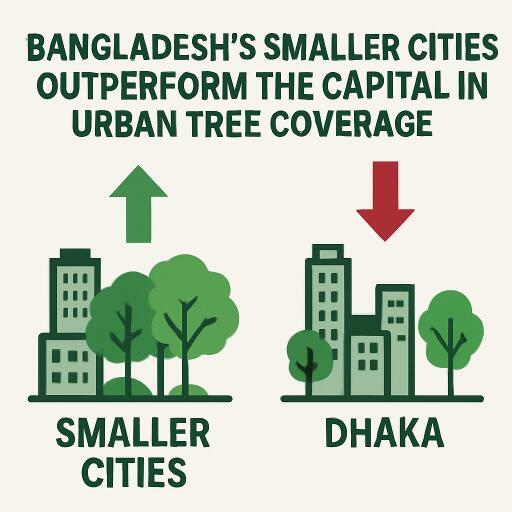
Bangladesh’s Smaller Cities Outperform the Capital in Urban Tree
Bangladesh’s urban tree cover is delivering an unexpected lesson in environmental performance: several smaller cities are generating stronger green benefits for residents than the capital and its industrial neighbors. A recent nationwide assessment of city corporations found that greener, less congested urban centers are doing a better job of cleaning the air, storing carbon, and easing pressure on drainage systems than the country’s most crowded metropolitan zones.
The contrast is especially striking because the cities with the weakest tree-related benefits are also the ones facing the heaviest burdens from heat, traffic emissions, and hard, flood-prone surfaces. In practical terms, many residents of the capital region live where shade is scarce, stormwater runs off quickly, and vegetation is least able to offset pollution.
The study examined land cover across Bangladesh’s major city corporations using a standardized digital canopy assessment system. Instead of counting each tree one by one, researchers analyzed sampled points on aerial imagery and grouped land into categories such as tree and shrub cover, grassy areas, bare ground, roads, buildings, and other paved surfaces. From those patterns, they estimated how much urban vegetation contributes to pollution removal, carbon capture, and rainfall interception.
While the method produces modeled estimates rather than direct field measurements, it offers a useful way to compare cities under the same framework. That comparison revealed a highly uneven map of urban nature.
Green space varied sharply from one city to another. In some locations, herbaceous and grassy cover occupied a substantial share of the urban landscape, while in others it had been squeezed out by dense construction and transport infrastructure. Tree and shrub cover remained the main source of urban greenery overall, but its distribution was far from balanced. The most intensely developed cities showed the clearest deficits, with built surfaces replacing vegetation that would otherwise cool neighborhoods and support public health.
Among the strongest performers was Barishal, which emerged as a leader in several categories of ecosystem service. Its urban canopy was estimated to remove more air pollutants per unit area than any other city corporation in the analysis. It also ranked at the top for carbon sequestration and showed strong performance in reducing stormwater runoff. In contrast, Dhaka South, along with nearby industrial centers such as Gazipur and Narayanganj, fell behind.
That pattern points to a deeper problem in how environmental benefits are distributed. The places with the greatest need for urban trees are often the places with the least access to them. In the capital region, high population density means far more people must share a much smaller base of ecological resources. As a result, green infrastructure benefits available to each resident drop sharply.
The study also translated those benefits into monetary terms on a per-person basis, highlighting the issue of urban inequality. Smaller cities with stronger canopy cover delivered far greater value per resident than the capital’s core districts. This does not simply reflect aesthetics or park access; it reflects measurable services like cleaner air, reduced runoff, and climate regulation.
The findings arrive at a crucial moment for Bangladesh, where rapid urban expansion has transformed land at remarkable speed. Wetlands, open ground, and vegetated areas have increasingly been replaced by housing, roads, factories, and commercial development. In and around the capital, this trend has intensified flood risk, worsened heat stress, and left fewer natural buffers against air pollution.
Urban trees matter because they perform multiple jobs at once. Their leaves can trap pollutants from traffic and industry. Their roots and surrounding soils help absorb rainfall before drainage systems overflow. Their shade cools streets and buildings, reducing exposure to extreme heat. And by storing carbon, they contribute, however modestly, to climate mitigation. When those functions are missing in dense urban districts, city residents lose a layer of protection that is increasingly vital.
Beyond mapping tree cover, the assessment raised concerns about governance. The problem is not only whether environmental rules exist on paper, but whether planning systems and enforcement mechanisms are strong enough to preserve and expand urban canopy in practice. The research suggests that implementation remains weak, allowing unequal access to green benefits to persist across regions.
This has consequences for climate resilience and environmental justice. If some cities consistently enjoy cleaner air, cooler neighborhoods, and stronger stormwater protection while others remain trapped in concrete-heavy landscapes, urban development is not just uneven; it is unfair. The gap becomes most visible when comparing well-performing secondary cities with the overstressed capital region.
The results also indicate that technology could play a larger role in city planning. Remote sensing, canopy modeling, and geospatial monitoring can help authorities track losses in urban vegetation, identify neighborhoods with the poorest coverage, and prioritize planting or protection efforts. These tools could support more transparent planning, especially in fast-growing areas where green spaces tend to disappear quietly under development pressure.
For policymakers, the message is clear: Bangladesh does not need to guess where intervention is most urgent. The capital and its industrial satellites stand out as places where tree cover is least able to meet environmental demand. Protecting existing trees, restoring degraded urban land, and integrating canopy targets into development approvals would be practical starting points.
The broader lesson is that urban greening is not merely decorative. In Bangladesh’s cities, it is tied directly to flood control, public health, thermal comfort, and resilience under climate stress. Smaller cities have shown that better outcomes are possible. The challenge now is whether larger and more crowded urban centers can close the gap before ecological deficits become even harder to reverse.



Leave a Reply