

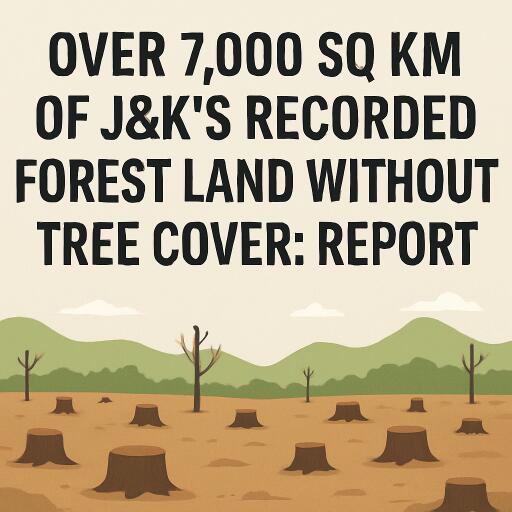
Over 7,000 sq km of J&K’s recorded forest land without tree cover: Report
A new policy study has found that more than 7,000 square kilometres of land officially classified as forest in Jammu and Kashmir currently lacks tree cover, underlining a sharp mismatch between what is listed in government records and what exists on the ground.
The assessment estimates that around 7,087 sq km of recorded forest land is without trees. The finding has drawn attention to the fragile state of the region’s natural ecosystems, especially in a Himalayan landscape where forests are closely tied to water security, slope stability, biodiversity and rural livelihoods.
Researchers say the distinction is important: land entered as forest in official records is not always the same as land that is actually forested. In practical terms, that means the total recorded forest area cannot automatically be treated as evidence of healthy vegetation cover.
The study presents this gap as a major ecological challenge for Jammu and Kashmir. Forests in the region support watersheds, help regulate stream and river flows, reduce soil erosion and provide habitat for wildlife, while also sustaining communities that depend on fuelwood, grazing resources and other forest-linked income.
Beyond tree loss, the report paints a broader picture of environmental stress. It points to growing pressure on forests, glaciers, lakes, springs and other natural systems that are vital to the region’s economy and daily life. Any continued decline in these resources could affect farming, horticulture and water availability across both urban and rural areas.
The document frames ecological degradation as one of several structural challenges facing Jammu and Kashmir. It argues that environmental decline is unfolding alongside gaps in social development and limited livelihood opportunities, making restoration not just a conservation issue but also an economic and social priority.
To address this, the study proposes a five-year investment of Rs 19,131 crore for ecological regeneration and improved natural resource management. The suggested outlay is presented as part of a broader development vision, rather than as an approved or allocated government budget.
A central recommendation is to restore degraded forest landscapes through community participation and the planting of diverse native species. The report cautions against overreliance on monoculture plantations, which may increase green cover on paper but often fail to recreate the ecological functions of natural forests.
It also stresses the need to protect water catchments and revive damaged ecosystems in ways that strengthen long-term hydrological resilience. In a mountain region increasingly vulnerable to climate stress, forest restoration is linked not only to biodiversity recovery but also to future water supply and disaster risk reduction.
At the same time, the report does not claim that the entire 7,087 sq km was recently stripped of trees. Instead, the figure reflects the present difference between legally recorded forest land and actual tree cover. It does not by itself establish when tree loss happened, what caused it, or whether some areas were historically sparsely wooded for natural or land-use reasons.
Even so, the findings raise important questions about forest governance, monitoring and restoration strategy in Jammu and Kashmir. They suggest the need for more detailed field assessment of recorded forest land, particularly in ecologically sensitive zones where degraded landscapes can intensify flooding, erosion, habitat fragmentation and water scarcity.
For policymakers, the message is clear: conservation must move beyond land classification and focus more closely on ecological condition. In a region where mountain ecosystems underpin both environmental stability and local economies, restoring tree cover and natural habitats may be essential to long-term resilience.



Leave a Reply