

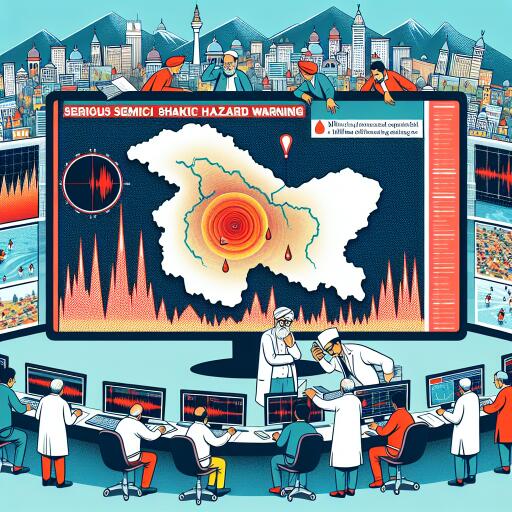
Millions at risk: Experts call for urgent seismic preparedness across Jammu and Kashmir
A growing chorus of geoscientists is warning that Jammu and Kashmir faces a severe and underappreciated earthquake threat. Beneath a surface sense of calm, the region’s fragile geology, rapid urbanization, and weak enforcement of building standards have combined to create a perilous situation for densely populated districts—especially the capital, Srinagar.
A major hazard hiding in plain sight
Specialists emphasize that the Himalayan arc is one of the world’s most seismically active mountain chains. Stress continues to build along major faults, making powerful earthquakes not a remote possibility but an eventuality. One senior earth scientist, Shakil Ahmad Romshoo, cautions that Srinagar’s housing stock is overwhelmingly ill-prepared for strong shaking. He estimates that nearly all residential buildings in the city lack adequate seismic resilience—an alarming gap in a place with roughly a quarter-million homes.
Romshoo notes that modern, code-compliant construction would add only a modest premium—about 10 percent—to typical building costs. Yet, he says, these life-saving design features are too often ignored or value-engineered out, even as urban expansion accelerates on soft sediments and floodplains that can amplify shaking.
Why Srinagar is uniquely exposed
Situated in a sediment-filled basin crisscrossed by the Jhelum River, Srinagar is vulnerable to “site effects” that can intensify ground motion. Unreinforced masonry, irregular floor plans, and heavy rooftop loads compound the danger. Informal growth on unstable slopes increases the chances of landslides during or after a quake, while weak soils heighten liquefaction risks—where ground temporarily behaves like a liquid, undermining foundations and lifelines.
Beyond homes, critical infrastructure—hospitals, schools, bridges, and water networks—must remain operational after a major shock. Experts warn that without targeted retrofits and contingency planning, cascading failures could magnify casualties and prolong recovery, especially during harsh weather or concurrent hazards.
History’s reminders—and a warning for the future
The Kashmir region bears a long record of destructive earthquakes. Historical accounts describe a devastating event in the mid-16th century, and more recent memory holds the 2005 Muzaffarabad earthquake, which killed tens of thousands and reshaped entire communities. Scientists caution that segments of the Himalayan front are capable of producing earthquakes of magnitude 8 or higher. Even a magnitude 7 event, striking near population centers, could cause catastrophic damage if structures are not engineered to modern standards.
Preparedness gap: urgent actions that save lives
While the hazard cannot be eliminated, vulnerability can. Specialists outline a clear set of priorities that could rapidly reduce risk and improve survival odds:
- Enforce and update seismic building codes, with special oversight for high-occupancy and essential facilities.
- Launch a large-scale retrofit program for schools, hospitals, and bridges, focusing first on unreinforced masonry and soft-story buildings.
- Develop and publish detailed seismic microzonation maps to guide safe siting and design across neighborhoods.
- Restrict new construction on liquefaction-prone soils, floodplains, and unstable slopes; pair land-use planning with slope stabilization where needed.
- Train builders and masons in practical, low-cost earthquake-resistant techniques; require on-site compliance checks.
- Run regular community drills on drop–cover–hold, evacuation routes, and family reunification plans; tailor outreach for older adults, children, and people with disabilities.
- Equip emergency services, hospitals, and utilities with backup power, spare parts, and interoperable communications.
- Expand seismic monitoring and public alerting tools to speed post-quake damage assessment and response.
Counting the true costs
The perceived expense of safer construction often deters action, yet the economics favor preparedness. A modest increase in upfront costs can prevent catastrophic losses in housing, livelihoods, and public services. Experience from other quake-prone regions shows that every unit invested in risk reduction can save many times more in avoided disaster costs—while preserving priceless lives and cultural heritage.
Intersecting risks in a changing environment
Earthquakes themselves are not driven by climate change, but disasters unfold at their intersections. Shaking can trigger landslides that dam rivers and raise the risk of sudden flooding. If a major quake hit during periods of heavy rain or snowmelt, unstable slopes and saturated soils could fail more readily, complicating rescue and relief. Planning must therefore bridge geology, hydrology, and urban design, ensuring that contingency plans account for multi-hazard scenarios.
The window for prevention is now
Experts stress that the question is not if a powerful earthquake will strike, but whether policies, buildings, and communities will be ready when it does. The path forward is clear: enforce the rules that already exist, retrofit what is most at risk, and train people to act swiftly and safely. With disciplined implementation and public buy-in, Jammu and Kashmir can turn a looming catastrophe into a manageable emergency—and save countless lives in the process.



Leave a Reply