

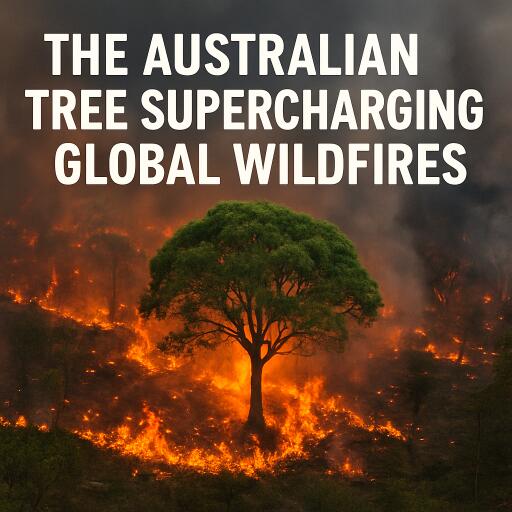
The Australian Tree Reshaping Fire Risk Around the World
As another season of extreme heat grips parts of Europe, attention is once again turning to a fast-growing Australian tree that has spread far beyond its native range: eucalyptus. Valued for paper production, timber and quick financial returns, it has been planted across multiple continents. But scientists and local communities increasingly warn that these plantations can make wildfires more intense and harder to control.
In northwestern Spain, the change is especially visible. Landscapes once dominated by native oak and chestnut are now crowded with eucalyptus stands. Similar shifts have taken place in Brazil, Chile, India, South Africa and parts of the United States, where the species has been promoted for its rapid growth and commercial value.
Globally, eucalyptus plantations cover millions of hectares and support major rural industries. Yet their success has come with environmental trade-offs. Researchers say the tree is not usually the cause of ignition, but once a fire begins, eucalyptus can dramatically worsen conditions.
The reason lies in the tree’s biology. Its leaves contain volatile oils that burn easily, while loose bark can peel away and become airborne embers. Under hot, dry and windy conditions, these embers may travel far ahead of the main fire, sparking new blazes and making suppression far more difficult. In fire-prone regions, this ability to spread flames over distance is a serious concern.
Scientists who study fire ecology note that introducing eucalyptus into new environments can alter local fire behavior. Fires may burn hotter, move faster and return more frequently. These changes can transform entire ecosystems, especially where plantations replace more diverse native forests.
In Galicia, eucalyptus has expanded quickly because it matures far faster than many local species. While native broadleaf trees may take decades to fully develop, eucalyptus can be harvested in a fraction of that time. After a fire, it also rebounds rapidly, often outcompeting slower-growing native vegetation. This creates a cycle in which fire helps reinforce the spread of the very species that can intensify future fires.
The growth of plantations in the region accelerated over recent decades, encouraged by demand from the pulp and timber sectors. Today, eucalyptus occupies a vast area and plays an important role in the local economy. But critics argue that economic gains have not been matched by adequate land management.
One major challenge is rural abandonment. As populations move from the countryside to cities, more forest land is left unmanaged. In such areas, eucalyptus can spread beyond planted plots, while dense vegetation and fallen debris accumulate. This combination creates ideal conditions for severe wildfires.
Regional restrictions on new plantations have been introduced in some places, but campaigners argue that enforcement is inconsistent and that unauthorized planting still occurs. They also say the issue is not only about legal plantations, but about what happens after land is neglected, burned or left open to aggressive regrowth.
Officials have acknowledged that past oversight was often too weak. Still, many policymakers resist outright bans, preferring stricter planning rules, better monitoring and more diverse forests instead. Their argument is that the problem can be reduced through proper management rather than the elimination of eucalyptus altogether.
On the ground, some communities are no longer waiting for broader policy shifts. In parts of rural Galicia, residents have organized volunteer efforts to remove eucalyptus from communal land and encourage the return of native species. Their goal is not just ecological restoration, but also the creation of landscapes that are less likely to carry destructive fire.
These local initiatives often focus on building “green firebreaks” using native trees that hold more moisture and are typically less combustible than dense eucalyptus stands. Over time, supporters hope these restored woodlands will become more resilient to drought, rising temperatures and repeated fire events.
The concern is not theoretical. Southern Europe has already experienced deadly wildfire disasters in recent years, with entire communities exposed to fast-moving flames. Such events have fueled growing debate about plantation design, species choice and the dangers of allowing highly flammable monocultures to dominate large areas.
Experts say eucalyptus still has a place in modern forestry, but only under tightly controlled conditions. That means limiting where it is planted, avoiding replacement of ecologically valuable native habitats, maintaining buffer zones and reducing fuel build-up through active management. Without those safeguards, the commercial benefits may come at an increasingly high cost.
As climate change lengthens fire seasons and intensifies heat waves, the question is becoming more urgent. Forests planted for profit decades ago are now being reassessed through the lens of public safety, biodiversity and landscape resilience. For many scientists and residents living on the front lines of wildfire, the lesson is clear: the composition of a forest can determine how fiercely it burns.



Leave a Reply