

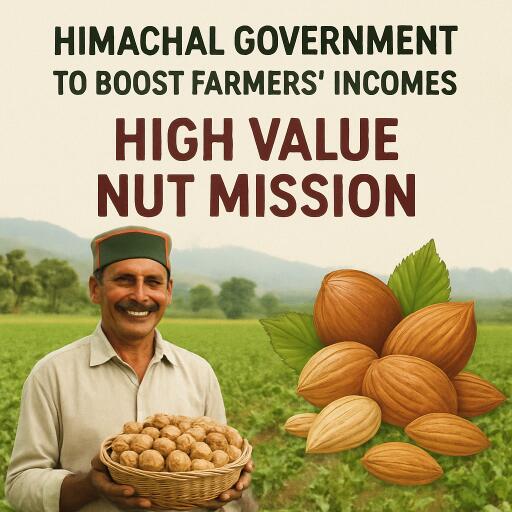
Himachal government to boost farmers’ incomes through High Value Nut Mission
The Himachal Pradesh government is preparing a major push for nut-based horticulture with a new High Value Nut Mission scheduled to run from 2026 to 2031. The programme is designed to raise farm incomes by modernising orchards, introducing improved planting systems and building better support infrastructure for growers across the state.
The plan focuses on temperate nut crops that are well suited to Himalayan conditions, including walnut, almond, apricot and chilgoza pine nut. Officials see these crops as a promising route to diversify rural livelihoods, especially in hill regions where climate, terrain and landholding patterns often limit conventional agricultural expansion.
The mission targets several long-standing bottlenecks in the sector. Many orchards are ageing and produce below their potential, while weak post-harvest handling and limited processing capacity reduce the value farmers can earn from their harvests. By combining scientific farm practices with market-oriented investments, the government aims to create a more productive and resilient horticulture economy.
Reviving old orchards and promoting intensive plantations
A central feature of the mission is the planned coverage of around 1,000 hectares through orchard renewal and new plantation models. Most of this area—about 900 hectares—will involve the rehabilitation of old, low-performing orchards. The approach includes canopy correction, replacement of unproductive trees, top-working techniques, better soil nutrition and improved water-use systems.
The remaining 100 hectares are expected to be developed as model high-density plantations. These demonstration plots will rely on quality saplings, micro-irrigation and climate-responsive cultivation methods. High-density planting can improve per-hectare output when managed properly, and the state hopes such examples will encourage wider adoption of modern orchard design.
Technology and planting material at the core
To support this transition, the government plans to establish four hi-tech nurseries and two Centres of Excellence in key nut-growing belts. These facilities are expected to supply certified, disease-free planting material—an essential requirement for improving orchard productivity and reducing long-term risk.
Beyond plant production, the centres are also intended to function as hubs for training, field demonstrations, research and farmer outreach. In practical terms, that means growers will be able to access updated advice on pruning, pest control, irrigation, nutrient management and other orchard practices that increasingly depend on science and precision management rather than traditional routines alone.
Reducing losses after harvest
One of the biggest weaknesses in mountain horticulture is what happens after the crop leaves the farm. In response, the mission includes plans for 10 modern units dedicated to collection, grading, sorting, packaging, processing and value addition. Such infrastructure can help reduce spoilage, improve consistency in quality and make products more attractive to buyers in larger markets.
For growers, this matters because the difference between raw produce and properly graded, packaged and processed nuts can be substantial. Better handling also opens possibilities for branding and premium marketing, allowing farmers to capture more value rather than losing margins within fragmented supply chains.
Building stronger market institutions
The government also intends to encourage the formation and strengthening of Farmer Producer Organisations, which can help small growers pool produce, negotiate better prices and access inputs or services at lower cost. Alongside this, officials want to attract private participation through partnership models and improve access to institutional funding for horticulture-linked infrastructure.
This combination of public support and private investment reflects a broader shift in agricultural policy: moving beyond crop production alone and building entire value chains around storage, processing, logistics and market access.
Special attention on chilgoza and fragile mountain ecosystems
The mission gives particular importance to chilgoza, a high-value pine nut with strong ecological and economic significance in Himachal Pradesh’s tribal regions. Unlike orchard crops grown in managed fields, chilgoza is linked closely to forest ecosystems, making conservation and livelihood planning inseparable.
To address this, the programme proposes measures such as assisted natural regeneration, community-led forest management and specialised propagation support to improve seed germination. These efforts are expected not only to protect biodiversity but also to create more durable income opportunities for communities that depend on this resource.
From an ecological standpoint, this element of the mission may prove especially important. Nut-based landscapes, when managed well, can support soil stability, long-term carbon storage and diversified habitat value. In a mountain state facing climate pressures, crop strategy is increasingly tied to environmental resilience.
A rural development strategy, not just a crop scheme
State leaders have presented the mission as more than an agricultural intervention. It is being framed as a broader rural development strategy aimed at boosting productivity, raising profitability and creating employment for young people in horticulture-linked activities.
By focusing on orchard renewal, value addition, branding and stronger market access, the government expects the initiative to deliver higher returns to farm households. The programme is also expected to include targeted support for women, tribal communities and collective farmer institutions, with the goal of making growth more inclusive.
If implemented effectively, the High Value Nut Mission could reshape parts of Himachal Pradesh’s horticulture economy over the next five years. Its success, however, will depend on execution in the field: quality nursery systems, steady extension support, functioning infrastructure and reliable market integration. For farmers in the hill state, the promise is clear—higher-value crops, better technology and a stronger path to income growth.



Leave a Reply