

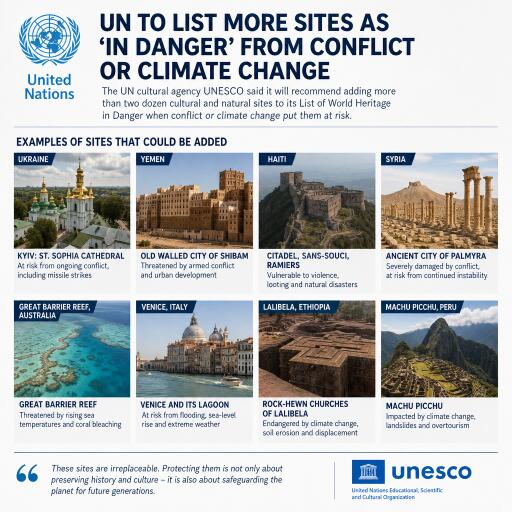
UN To List More Sites As ‘In Danger’ From Conflict Or Climate Change
The United Nations is poised to expand its roster of world treasures formally recognized as being at risk, citing the twin pressures of armed conflict and the accelerating impacts of climate change. Member states of UNESCO will gather in Busan, South Korea, next week to vote on new entries to the World Heritage list and to the more urgent World Heritage in Danger list.
From the Amazon to the Mediterranean, and from the West Bank to Siberia, the anticipated decisions reflect a rapidly shifting risk landscape. With around 1,200 sites already inscribed as World Heritage, the label often ushers in protective funding and responsible tourism. By contrast, an “in danger” designation is designed to unlock emergency attention and support—not to punish states, but to rally partners, resources, and expertise to safeguard sites before losses become irreversible.
Urgent candidates for the “in danger” list
Several places are expected to bypass the usual two-step process and be moved directly onto the danger list:
- Sebastia (Biblical Samaria), West Bank: This archaeological site sits in an Israeli-controlled area of the West Bank, with a neighboring Palestinian community historically reliant on tourism linked to the ruins. Ongoing access concerns and political volatility have raised alarms over both preservation and livelihoods.
- Fortified castles of southern Lebanon: Five castles, including the Crusader-era Qalaat al-Chakif (Beaufort Castle), lie in a region under intermittent fire. Built to withstand medieval sieges, they are ill-equipped for modern bombardment and the cumulative stress of conflict.
- Boma–Badingilo ecosystem, South Sudan: A vast grassland and woodland savannah supports one of the planet’s great overland wildlife movements, with roughly a million antelopes and gazelles coursing between the White Nile and the Ethiopian border. War, poaching pressures, and climate extremes are eroding this migration corridor, leaving visible scars on the landscape.
Although Israel withdrew from UNESCO in 2017, it remains a member of the World Heritage Committee that casts final votes on inscriptions—an illustration of how geopolitics and conservation are increasingly entwined.
Existing heritage sites facing new peril
Several places already on the World Heritage list may receive the added “in danger” status due to escalating threats:
- Tyre, Lebanon: Roman baths, a triumphal arch, and a second-century hippodrome have weathered centuries—but recent airstrikes and the chronic instability surrounding them raise serious questions about structural integrity and long-term conservation.
- Tauric Chersonese, Crimea: The ancient Greek settlement faces risks from unauthorized excavations, large-scale construction, and the movement of artifacts. Heritage guardians warn that contested governance can compound the damage by complicating oversight and accountability.
- Lake Baikal, Russia: The world’s deepest lake, holding about a fifth of Earth’s unfrozen freshwater, is under mounting stress from pollution, mass tourism, logging, and lowering water levels influenced by upstream hydropower operations. A 2023 assessment by the agency cautioned that unless “unfolding ecological degradation” is urgently reversed, reclassification as “in danger” would be unavoidable. The lake’s extraordinary biodiversity—earning it the nickname “the Galapagos of Russia”—hangs in the balance.
New nominations for the World Heritage list
Alongside the emergency docket, several culturally significant sites are vying for standard inscription:
- Normandy landing beaches, France: The shorelines where Allied forces began the liberation of Western Europe on June 6, 1944, are contenders for recognition as a global symbol of resistance to tyranny and a living classroom in the cost of war.
- Amazonian theaters, Brazil: Two historic performance venues built deep within the rainforest—testaments to the rubber boom’s cultural imprint—offer a striking blend of architecture, music heritage, and the environmental history of the world’s largest tropical forest.
- Sidi Bou Said, Tunisia: A hillside village famed for its blue-and-white palette and Mediterranean light, long celebrated by artists and writers, seeks protection that can channel tourism into preservation rather than unchecked development.
Climate, conflict, and a changing mandate
For UNESCO’s heritage stewards, the agenda is expanding. Traditional conservation threats—neglect, looting, and piecemeal development—now interact with intensifying climate hazards: heatwaves fueling wildfires, invasive species thriving in warmer waters, coastal erosion accelerating under rising seas, and droughts stressing ancient waterworks. When conflict overlaps with climate shocks, the damage multiplies, both to the stones themselves and to the communities whose identities and economies are intertwined with them.
Protecting these places requires more than plaques and pledges. It means climate-proofing conservation plans, deploying early-warning systems and ecological monitoring, training local teams, directing tourism revenue into maintenance, and ensuring emergency funds can move quickly when crises hit. It also means recognizing that safeguarding heritage can help societies heal—anchoring memory, livelihoods, and a sense of continuity amid upheaval.
Delegates in Busan are unlikely to resolve the wars, political disputes, or warming trends that put so many places at risk. But their votes will carry weight. Each new inscription or danger listing signals to governments, donors, and the public that the world is watching—and that there is still time, in many cases, to act before the losses become permanent.



Leave a Reply