

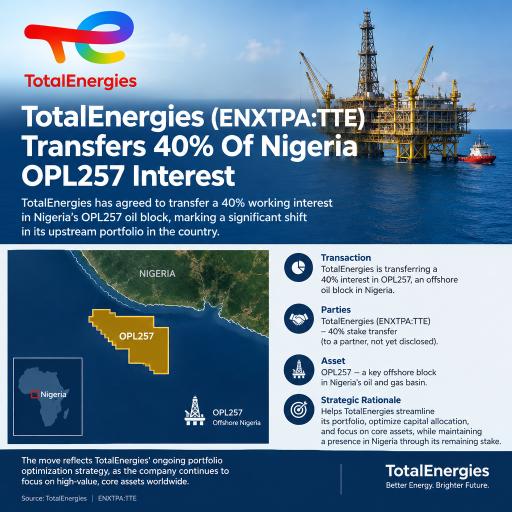
TotalEnergies (ENXTPA:TTE) Transfers 40% Of Nigeria OPL257 Interest
TotalEnergies has agreed to transfer a 40% stake in Nigeria’s offshore OPL257 licence to South Atlantic Petroleum, commonly known as SAPETRO. The transaction is intended to advance the appraisal of the Egina South discovery and assess its development through existing offshore infrastructure.
A shared approach to Egina South
Following completion of the deal, TotalEnergies will retain a 50% interest and remain operator of OPL257. SAPETRO will hold 40%, while Conoil will continue to own the remaining 10%.
This ownership structure distributes the financial and technical risks associated with further exploration and development. It also gives the partners an opportunity to evaluate a lower-cost route for bringing Egina South into production.
Rather than constructing an entirely new production hub, the companies are considering connecting the discovery to the nearby Egina floating production, storage and offloading vessel. Such a tie-back could shorten the development timetable, reduce capital requirements and limit the need for additional offshore installations.
Portfolio discipline in Nigeria
The agreement reflects TotalEnergies’ broader effort to concentrate its oil and gas spending on projects that can use established facilities and deliver competitive production costs. Nigeria remains an important part of the group’s deepwater portfolio, but sharing ownership allows it to preserve operatorship while reducing its direct exposure to future expenditure.
For TotalEnergies, this strategy also supports a wider capital-allocation model. The company continues to invest in hydrocarbons while expanding electricity generation, renewable energy, biofuels, low-carbon hydrogen and other lower-emission activities. Cash generated by efficient upstream projects remains central to financing that transition and maintaining shareholder distributions.
Environmental considerations
Using existing infrastructure can lower the material footprint of an offshore project compared with building a standalone production system. Fewer new installations may reduce construction-related emissions and disturbance on the seabed. However, any additional oil development still carries environmental risks, including operational emissions, accidental spills and impacts on marine ecosystems.
The project’s environmental performance will therefore depend on rigorous safety standards, methane and flaring controls, effective spill-response planning and compliance with Nigerian regulations. Investors and local stakeholders will also expect transparency about the project’s expected emissions and operating safeguards.
Key milestones to monitor
The next major step will be the appraisal programme for Egina South. Results from that work should help determine the size and commercial quality of the resource, as well as whether a connection to the Egina vessel is technically and economically viable.
Other important indicators include regulatory approval of the transaction, a confirmed development schedule, updated cost estimates and the possible booking of additional reserves. TotalEnergies’ production forecasts and capital-expenditure guidance through 2027 may provide further clues about the project’s priority within its global portfolio.
The stake transfer does not guarantee that Egina South will proceed to production. Nevertheless, it gives TotalEnergies and its partners a structure designed to share costs and accelerate evaluation while making use of an established deepwater asset.



Leave a Reply