

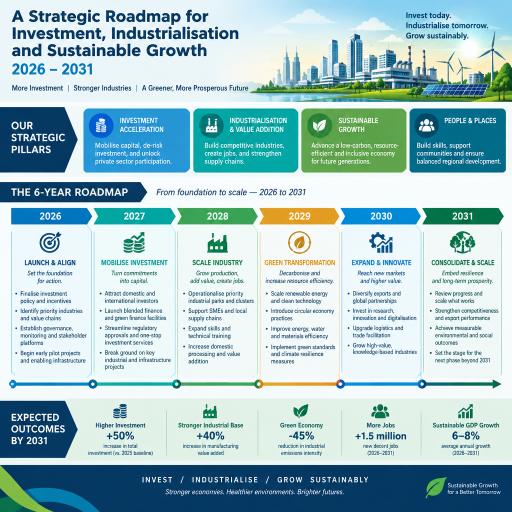
A Strategic Roadmap for Investment, Industrialisation and Sustainable Growth, 2026-2031
Bangladesh has an opportunity to convert international cooperation into a new generation of productive, low-carbon industries. A focused partnership with Japan could mobilise capital, technical expertise and workforce training across five strategic areas: mobility, clean energy, advanced technology, transport infrastructure and food processing.
The priority for 2026-2031 should not be the volume of investment announcements, but their measurable results. New projects must create skilled employment, strengthen domestic suppliers, increase exports and improve environmental performance.
Developing a Modern Mobility Industry
Bangladesh’s large consumer market and expanding workforce offer a foundation for domestic vehicle production. Instead of remaining dependent on imported finished vehicles, the country can progressively develop assembly plants, component manufacturing and engineering services.
Initial investment could target motorcycles, commercial vehicles, electric cars, batteries, charging equipment and components such as wiring, tyres and electronic systems. Dedicated industrial areas would help manufacturers share utilities, logistics and testing facilities.
- Introduce stable incentives tied to production, employment and local sourcing.
- Support partnerships between Japanese manufacturers and Bangladeshi enterprises.
- Train technicians in robotics, automotive electronics, quality assurance and electric-vehicle maintenance.
- Adopt safety, battery-recycling and charging standards before the market expands.
A successful mobility sector could reduce imports while positioning Bangladesh as a supplier to regional markets. Environmental safeguards will be essential, particularly for battery materials, industrial waste and end-of-life vehicles.
Building a Reliable, Cleaner Energy System
Industrial expansion cannot succeed without dependable and competitively priced electricity. Bangladesh therefore needs an energy strategy that improves security while limiting exposure to volatile imported fuels.
Japanese investment could accelerate rooftop and utility-scale solar, battery storage, smart grids, efficient machinery and modern transmission networks. Industrial parks are especially suitable for rooftop generation, energy-management systems and shared storage.
- Use competitive procurement for large renewable-energy projects.
- Reduce transmission and distribution losses.
- Require energy audits for major industrial facilities.
- Create predictable rules for private power producers and storage operators.
- Assess affordability, foreign-currency exposure and ecological impacts throughout each project’s lifetime.
Conventional generation may continue to play a transitional role, but new capacity should not lock the country into costly, high-emission infrastructure. Greater efficiency and renewable generation can improve both industrial resilience and national energy security.
Moving Up the Technology Value Chain
Future competitiveness will increasingly depend on digital skills, research and advanced manufacturing. Cooperation can extend into electronics, artificial intelligence, cybersecurity, automation, cloud infrastructure and selected semiconductor-related services.
Technology parks should be connected to universities and vocational institutes rather than functioning only as real-estate projects. Investment agreements can include workforce training, research partnerships and supplier-development programmes.
Satellite and geospatial tools also have practical value. They can support crop monitoring, flood forecasting, coastal management, fisheries oversight and disaster response. These applications would combine economic development with stronger climate resilience.
Modernising Railways and Freight Logistics
Congestion, slow cargo handling and weak connections between ports and factories increase the cost of trade. Before committing to expensive high-speed passenger rail, Bangladesh should compare demand, debt exposure and lifecycle costs with more immediate transport needs.
Modern signalling, safer tracks, freight corridors and improved links to ports may deliver faster economic returns. Inland container terminals and multimodal logistics centres could reduce pressure on roads and lower emissions from goods transport.
- Digitise cargo tracking and customs procedures.
- Upgrade rail connections serving ports and industrial zones.
- Apply transparent risk-sharing rules to public-private partnerships.
- Include long-term maintenance and technical training in project contracts.
All major infrastructure proposals should undergo environmental assessment, including their effects on land, waterways, communities and biodiversity.
Creating More Value from Agriculture
Modern agro-processing could raise rural incomes and reduce the substantial value lost after harvest. Investment opportunities include cold storage, refrigerated transport, seafood processing, dairy products, packaged foods and climate-smart agricultural technology.
Processing centres located near farming regions would shorten supply chains. Contract farming can provide reliable markets, but agreements must protect producers through transparent pricing and fair quality requirements.
Laboratories, traceability systems and internationally recognised food-safety controls are necessary for reaching demanding export markets. Smaller enterprises will also need affordable finance, efficient equipment and training in packaging, water conservation and waste management.
A Three-Stage Delivery Plan
Stage One: Coordination and Project Screening
A joint investment task force should identify viable proposals, assign a lead institution to each project and publish clear implementation schedules. Early screening must cover financing, land availability, infrastructure requirements and environmental risks.
Stage Two: Investment Readiness, 2026-2027
Projects should proceed to detailed feasibility studies, community consultation and environmental review. Public incentives must be transparent and conditional on outcomes such as jobs, training, exports, technology transfer and local value creation.
Stage Three: Construction and Expansion, 2028-2031
Implementation should focus on completing priority infrastructure, developing domestic suppliers and expanding technical education. Annual public reporting would allow delays, cost overruns and unmet sustainability commitments to be identified early.
Reforms That Support Responsible Investment
Investors require consistent regulations, efficient approvals and dependable contract enforcement. Digital one-stop services could simplify permits, while transparent procurement and credible dispute resolution would reduce uncertainty.
Foreign-exchange procedures should be predictable, and technical education should reflect industry demand. Stronger environmental regulation is equally important: factories must use resources efficiently, control pollution and account for climate risks.
Measuring Progress
Success should be judged through capital actually deployed, projects entering operation, skilled jobs created, exports generated and domestic suppliers engaged. Additional indicators should track renewable capacity, energy savings, logistics costs, cargo-processing times, post-harvest losses and technology-transfer programmes.
By linking investment to industrial capability, social benefit and environmental responsibility, Bangladesh can move beyond short-term commitments. The goal is a resilient economy that produces more value domestically, competes in advanced markets and grows without compromising its natural resources.



Leave a Reply