

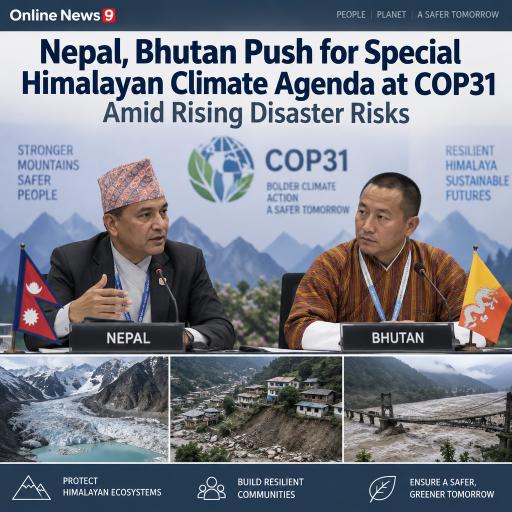
Nepal, Bhutan Push for Special Himalayan Climate Agenda at COP31 Amid Rising Disaster Risks
Nepal and Bhutan are joining forces to demand greater international attention for the Himalayas as rising temperatures intensify floods, glacier loss and other climate-related hazards across the mountain region.
Ahead of COP31, scheduled for November 9–20 in Antalya, Turkey, the two countries have requested a formal agenda item focused on the consequences of a 1.5°C temperature increase in the Himalayas. Their proposal seeks to place mountain ecosystems and communities more firmly within global climate negotiations.
A fragile region under growing pressure
The Himalayan cryosphere is warming rapidly, accelerating glacier retreat and increasing the instability of high-altitude lakes and slopes. These changes can contribute to glacial lake outburst floods, avalanches, landslides and sudden surges in river systems.
Nepal and Bhutan warn that further warming could produce irreversible ecological losses. Mountain forests, wetlands and alpine habitats support exceptional biodiversity while sustaining agriculture, tourism, hydropower and local livelihoods.
The risks also extend far beyond national borders. Rivers originating in the Himalayas supply water, food and energy systems serving more than two billion people downstream. Disruption to snow and ice reserves could initially increase flooding before eventually reducing reliable dry-season water flows.
Proposal calls for science, finance and sustained dialogue
The joint submission was made through the procedural mechanism available for adding issues to the conference agenda. Nepal presented it on behalf of both Himalayan countries.
Among the central demands is stronger scientific research into how global warming affects high mountain regions. Nepal and Bhutan want coordinated assessments of glacier retreat, permafrost thaw, changing rainfall, ecosystem disruption and the risks created when temperature thresholds are exceeded.
They have also proposed an annual high-level dialogue on mountains and climate change. Such a forum would give Himalayan and other mountain nations a regular opportunity to raise concerns rather than relying on occasional discussions during wider negotiations.
Another recommendation is the development of a dedicated Himalayan ecosystem action plan under the United Nations climate framework. The countries want mountain priorities integrated into decisions on adaptation, climate finance, early-warning systems, technology and arrangements addressing loss and damage.
Recent disasters sharpen the warning
The appeal comes after destructive events demonstrated the region’s exposure to cascading hazards. Flooding in Nepal’s Bhotekoshi and Trishuli river systems on August 26, 2026, caused widespread damage after an avalanche reportedly obstructed a river and contributed to a sudden release of water.
A government assessment placed the resulting damage at about $2.7 billion. Estimated recovery and reconstruction needs reached approximately $4.7 billion, illustrating how a single disaster can impose enormous costs on a developing mountain economy.
Bhutan has faced similar threats. A flash flood linked to the reported failure of the Shintaphu glacial lake damaged infrastructure around the Gasa Tshachu hot springs. Although no deaths were initially reported, the incident highlighted the vulnerability of settlements and public assets located below unstable high-altitude lakes.
Seeking climate justice for mountain communities
Nepal and Bhutan argue that mountain countries contribute relatively little to global greenhouse gas emissions but endure severe consequences from warming. Difficult terrain, limited infrastructure and high reconstruction costs can make adaptation especially challenging.
Their COP31 initiative therefore seeks more accessible climate funding, improved monitoring of glaciers and lakes, stronger disaster-warning networks and locally led adaptation measures. It also calls for international decisions to reflect the cross-border importance of Himalayan water systems and biodiversity.
Whether the requested agenda item is accepted will help determine how prominently mountain risks feature at COP31. For Nepal and Bhutan, however, the broader objective is clear: the Himalayas must be treated as a global climate priority before mounting ecological damage becomes impossible to reverse.



Leave a Reply