

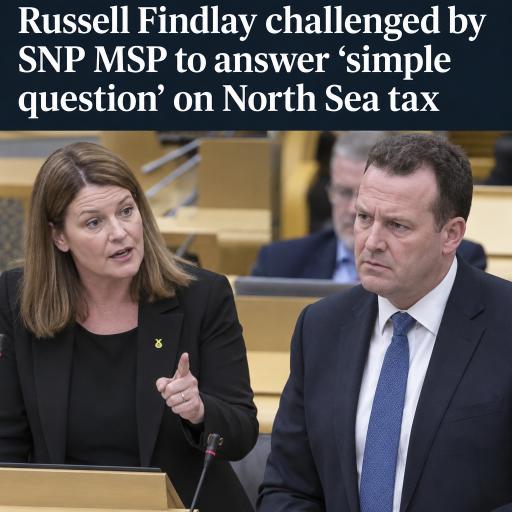
Russell Findlay challenged by SNP MSP to answer ‘simple question’ on North Sea tax
SNP MSP Jack Middleton has challenged Scottish Conservative leader Russell Findlay to say whether all tax revenue generated by the proposed Rosebank oil field and the Jackdaw gas development should be reinvested in north-east Scotland.
The Aberdeen Central representative posed the question before Findlay’s visit to the region, arguing that communities and workers at the centre of the offshore energy industry should receive a direct economic benefit from new production.
Middleton, who supports approval of Rosebank, said Scotland still requires oil and gas during the transition to a low-carbon economy. He maintained that using domestic resources would be preferable to importing fossil fuels from overseas suppliers with potentially higher production emissions.
“The North East produces the wealth and the North East should reap the rewards,” Middleton said, calling for “every single penny” of tax raised from Jackdaw and Rosebank to be reserved for the region.
He argued that the money could support offshore energy workers, protect employment and help secure the area’s economic future. His challenge to Findlay was framed as a direct yes-or-no question: should North Sea tax revenue remain in the North East?
Rosebank decision remains unresolved
The intervention comes amid continuing political disagreement over the future of North Sea production. Jackdaw, a gas field near Aberdeen, has been permitted to proceed, while Rosebank remains subject to a UK Government decision.
Rosebank, located west of Shetland, has become a focal point in the debate over energy security, regional employment and the UK’s legally binding climate targets. Supporters say the project would sustain jobs, investment and domestic supplies. Opponents warn that opening major new oil fields risks prolonging fossil-fuel dependence and making the transition to net zero more difficult.
The Scottish Government has not given an unconditional endorsement of the development. First Minister John Swinney has said any decision must consider carbon emissions, climate commitments and the consequences of replacing domestic production with imported energy.
During questions at Holyrood, Findlay repeatedly asked Swinney whether he supported Rosebank. The First Minister responded that applications must undergo the required legal assessment to determine whether their emissions are compatible with the pathway to net zero.
Swinney also said the climate impact of domestic extraction must be weighed against that of imported supplies. He maintained that the formal assessment was a matter for the UK Government, which holds responsibility for the final decision.
Parties divided over jobs and climate policy
The Scottish Conservatives responded to Middleton by questioning whether his support for Rosebank reflected the position of the wider SNP. They urged him to persuade his party colleagues to support further North Sea drilling.
Scottish Labour also pressed the First Minister over Rosebank and the economic consequences of delaying or withholding support for energy investment. The Scottish Greens took the opposite view, expressing concern that the field could be approved under a climate-compatibility assessment.
The dispute illustrates the competing pressures facing policymakers. North-east Scotland remains heavily connected to offshore oil and gas, but the region must also prepare for declining fossil-fuel production and the expansion of renewable energy, grid infrastructure and low-carbon industries.
Middleton’s proposal would direct future petroleum tax receipts towards that transition and the local workforce. However, it also raises broader questions about public finances, since North Sea revenues are collected at UK level and are not automatically assigned to the communities where extraction is based.
With Rosebank still awaiting a final determination, the political argument now extends beyond whether the field should proceed. It also concerns who should benefit from any revenue, how workers can be protected and whether new extraction can be reconciled with Scotland’s climate responsibilities.



Leave a Reply