

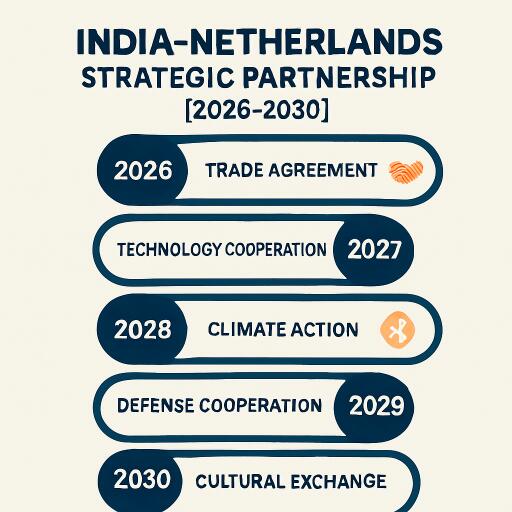
Roadmap of India-Netherlands Strategic Partnership [2026-2030]
India and the Netherlands have unveiled a five-year plan that elevates their ties into a Strategic Partnership built around climate resilience, clean energy, innovation, secure supply chains and people-centric cooperation. The roadmap aligns Dutch strengths in water, maritime and high-tech with India’s scale, manufacturing depth and renewable ambition—setting the stage for a decade-defining green transition across both economies.
Diplomacy with a Purpose
- Regular summits and ministerial visits will provide political momentum, including at multilateral gatherings.
- An annual Foreign Ministers’ review will track progress and steer next steps.
- Line ministries will hold intensified exchanges to convert intent into measurable outcomes.
Trade, Investment and Supply Chain Resilience
- The Joint Trade and Investment Committee will target growth in priority sectors: renewable energy, telecom, maritime and ports, infrastructure and urban development, semiconductors and electronics, agriculture, pharmaceuticals and medtech, chemicals, textiles and metals.
- Business forums and trade fair participation will be scaled up, backed by industry associations.
- A fast-track mechanism will address investment bottlenecks.
- New cooperation across the critical raw materials value chain will diversify supplies, advance research and circularity, and raise ESG standards.
- Two-way investment will focus on SMEs and public–private partnerships, linking knowledge institutions with industry to create jobs and robust value chains.
Water Security, Agriculture and Public Health
- The Strategic Partnership on Water will be renewed and monitored ministerially.
- Joint work will advance integrated river-basin planning, flood resilience, coastal and urban water management, and water quality—especially in the Ganga basin.
- A Centre of Excellence will share expertise, build capacity and nurture water-tech startups.
- Urban River Management Plans will adopt “Water as Leverage” approaches, turning strategy into demonstration projects.
- Disaster-resilient urban water infrastructure will be strengthened through global capacity building.
- In agriculture, the Joint Working Group will deepen collaboration on centers of excellence, market access, climate-resilient farming, responsible value chains and food security.
- Ag-tech and biotech exchanges will support skills, clean plant centers and startup-led innovation.
- Health cooperation will address infectious diseases, antimicrobial resistance, non-communicable diseases, digital health (including AI and cybersecurity), climate–health linkages and One Health surveillance.
- Pharma and medical-device partnerships will reinforce global supply chains and joint R&D, supported by regulatory and academic collaboration.
- Food safety authorities will share best practices on standards and electronic certification systems.
Emerging Tech, Innovation, Education and Space
- A research and innovation agenda will prioritize semiconductors, AI, cybersecurity, energy materials and biomolecular/cell technologies, connecting government, academia and industry.
- A semiconductors pact will foster trusted supply chains, joint R&D in AI, photonics, quantum and cyber, and link Dutch competence centers with India’s semiconductor mission to support startups, SMEs and talent.
- Leading universities and institutes from both countries will create a talent “brain bridge” in chips and related technologies, with support from major industry players.
- Higher education cooperation will expand, with emphasis on STEM and institutional partnerships.
- Space collaboration will explore applications for climate resilience, water security, food systems and air quality monitoring.
Energy Transition, Circularity and Green Maritime Corridors
- A new Joint Working Group on Renewable Energy will align industrial ecosystems and share best practices on green hydrogen, bioenergy, circular feedstocks, renewables integration and storage.
- An action plan for renewable hydrogen includes a green corridor linking producers and off-takers across both countries.
- A climate-focused working group will exchange know‑how on adaptation and mitigation—critical to resilient cities, coasts and agriculture.
- Partnerships will scale biofuels, integrated biorefineries, the circular economy and waste-to-energy initiatives.
- Maritime decarbonization will accelerate through cleaner ports, inland waterways and shipping—anchored by a “Green and Digital Sea Corridor” and deeper cooperation under a refreshed maritime pact. This aims to connect India’s green hydrogen and e-fuels to European markets.
- A dedicated roadmap will guide the corridor’s rollout, targeting sustainable, digitally integrated and efficient logistics.
- Sustainable urban development will focus on solid waste and water management, circular design, active mobility, zero-emission transport and charging infrastructure, and urban governance.
Defense and Security
- Tri-services dialogues will coordinate defense cooperation, including industry and research linkages.
- Naval collaboration will expand through exercises and information-sharing in the wider Indo-Pacific.
- Technology partnerships and an industrial roadmap—via sectoral organizations—will promote co-development.
- Logistics support for training exercises will be explored through a potential mutual support accord.
Cyber, Counterterrorism and Legal Cooperation
- Regular exchanges will cover maritime, economic and knowledge security, critical tech, and cyber resilience.
- Enhanced cyber cooperation will bolster capacity building, joint threat responses and multilateral coordination.
- Counterterrorism collaboration will deepen through intelligence-sharing and support for a comprehensive global convention.
- Negotiations will continue on mutual legal assistance and extradition agreements.
Mobility, Migration and Consular Dialogue
- Both sides will facilitate fair and orderly mobility while tackling irregular migration.
- Channels for students, researchers and highly skilled professionals—including young talent—will be expanded.
- A mobility and migration accord will be implemented, backed by regular consular consultations.
Culture, Heritage and People-to-People Ties
- Cultural exchanges will grow through joint programs, heritage preservation and restoration projects.
- Cooperation will deepen across design, visual and performing arts, museums and cultural heritage.
- Requests related to the return and restitution of cultural artifacts will continue to be handled cooperatively.
- Exhibitions, museum partnerships and tourism will expand mutual understanding.
- The vibrant Indian and Dutch communities—including a significant diaspora—are recognized as bridges strengthening long-standing bonds.
Viewed through an ecological and clean-energy lens, this plan is more than diplomacy; it’s an operational blueprint for greener growth. From a hydrogen corridor and low-carbon shipping to resilient river basins and circular industry, the partnership fuses technology, finance and policy to speed the transition while creating skilled jobs and durable supply chains. If executed with urgency, it can become a model North–South collaboration for a climate-safe future.



Leave a Reply