

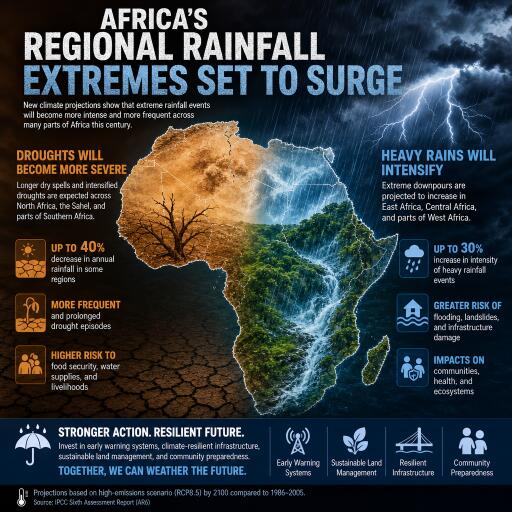
Africa’s Regional Rainfall Extremes Set to Surge
A sweeping new climate analysis warns that extreme rainfall is on track to intensify across much of Africa through this century, heightening flood risk, stressing water systems, and reshaping how communities farm, build, and prepare for disasters. The findings carry urgent implications for a continent where weather swings already cut deep into economies, food supplies, and public safety.
What’s driving the upturn in deluges
The study points to two main forces working together. First, a warmer atmosphere can hold more moisture, priming the skies for heavier downpours when storms develop. Second, shifts in large-scale circulation and local feedbacks—such as how land surfaces heat up and influence winds—are altering when and where storms form and intensify. By teasing apart these thermodynamic and dynamic drivers, the researchers show that the physical ingredients for severe rain are becoming more potent and more frequently aligned.
Sharper projections from finer-scale modeling
To capture Africa’s patchwork of climates—from Sahelian drylands to equatorial rainforests—the analysis leans on ensembles of high-resolution regional climate models. These models are downscaled from multiple global simulations, a design that better resolves coastlines, mountains, and monsoon boundaries where extreme storms often explode. Bias-correction techniques and rigorous checks against satellite and ground-based observations bolster confidence, ensuring that historical extremes are credibly reproduced before peering into the future. Quantifying uncertainty across many models and emissions pathways helps decision-makers see what’s robust—and what remains contingent—across different warming scenarios.
One continent, many futures
While the overall signal is clear—more intense extremes—Africa’s regions diverge in how, when, and how much:
- West Africa: Heavy rainfall is projected to become more frequent and more intense, closely tied to shifts in the West African monsoon and enhanced moisture convergence. Short-lived but powerful bursts are expected to drive flash flooding in cities and overwhelm rural drainage.
- Southern Africa: A more complex response emerges. Some areas may see fewer rainy days overall but stronger cloudbursts when storms do occur, reflecting the interplay between circulation changes and local land–atmosphere feedbacks.
- Other hotspots: East Africa and parts of Central Africa show signs of intensifying wet extremes, though local topography and lake and ocean influences create highly localized patterns, underscoring the need for place-based adaptation.
Beyond rainfall: Floods, erosion, and water quality
Intensified downpours ripple through river basins and cities. Expect more frequent flash floods, bank overtopping, and drainage failures. On farms, heavier bursts can strip topsoil, degrade fertility, and damage crops. In rivers and reservoirs, muddy runoff and pollutant surges degrade water quality, challenging treatment plants and ecosystems already under stress. For biodiversity that depends on relatively stable flow regimes, more frequent hydrological whiplash could fragment habitats and reduce resilience to droughts that follow.
Teleconnections that tip the balance
The analysis also connects African rainfall extremes to large-scale ocean–atmosphere patterns. Variations in Atlantic and Indian Ocean temperatures—through modes such as multidecadal Atlantic swings or Indian Ocean dipole events—can amplify or dampen the background trend driven by human-caused warming. Understanding these teleconnections offers a pathway to better seasonal-to-decadal outlooks that help planners window critical works—like dam operations or urban drainage upgrades—into high-risk periods.
Emissions pathways matter
The magnitude of intensification strongly depends on future greenhouse gas emissions. High-emissions trajectories yield a sharper escalation in extreme rainfall statistics, while strong mitigation moderates both the frequency and intensity of the heaviest events. This link translates the abstract language of global targets into concrete, local benefits: every fraction of a degree avoided reduces the odds of catastrophic cloudbursts and the costs they impose.
What adaptation looks like on the ground
Because extremes are shifting in different ways across the continent, adaptation must be tailored. Priority actions include:
- Upgrading urban drainage and flood defenses, with designs tested against new intensity–duration–frequency curves that reflect a wetter, more volatile future.
- Protecting and restoring wetlands, floodplains, and upstream forests that buffer peak flows, trap sediment, and recharge groundwater.
- Strengthening early warning systems that integrate improved forecasts with last-mile communication and evacuation planning.
- Climate-proofing agriculture through diversified cropping, soil conservation, and water harvesting that can handle both deluges and dry spells.
- Revising building codes and land-use planning to keep critical services and housing out of high-risk corridors.
Closing Africa’s data gap
Many of the hardest-hit places still lack dense observation networks. Expanding rain gauges, modernizing hydrometric stations, and maintaining satellite calibration are essential to track extremes, validate models, and steer investments. The study also calls for weaving socio-economic data into climate analyses—so flood maps account for informal settlements, transport chokepoints, and the realities of service provision on the ground. Downscaled hydrological models, paired with these datasets, can reveal where limited resources save the most lives and livelihoods.
A narrowing window, a clear direction
Africa’s climate is not just getting wetter or drier; it is getting more volatile. The strongest storms are poised to get stronger, and their impacts will increasingly be felt by cities, farms, and ecosystems that were designed for a gentler past. The science now offers sharper tools to anticipate where risks will surge. Acting on that foresight—through emissions cuts, resilient infrastructure, better data, and inclusive governance—can turn a looming threat into a mandate for smarter, safer development.



Leave a Reply