

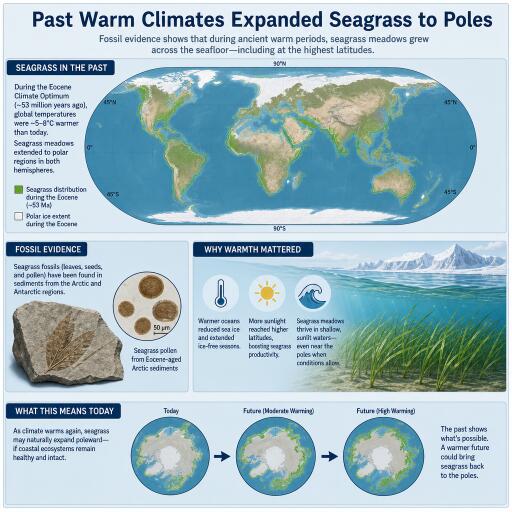
Past Warm Climates Expanded Seagrass to Poles
As the planet warms, a fresh look at the geological record reveals a surprising storyline: when oceans were warmer in the past, seagrass meadows pushed toward the poles. That poleward surge, traced through ancient sediments, reframes what we might expect in the coming decades for coastal biodiversity and blue carbon storage.
Why seagrass matters
Seagrasses are flowering plants anchored to sandy and muddy seabeds, where they weave dense underwater meadows. These habitats shelter juvenile fish and invertebrates, hold sediments in place, filter water, and dampen waves. Crucially, seagrasses lock away carbon in their soils for centuries—one of the most effective natural climate buffers in coastal waters. Knowing where these ecosystems can live—and where they may move—is central to anticipating ecological change and carbon cycle feedbacks.
Clues from the seafloor
Researchers reconstructed the deep history of seagrass distributions by probing coastal sediments across a range of latitudes. Fossil pollen, plant fragments, and other biological traces embedded in cores were paired with geochemical indicators and radiometric dating to map past presence through multiple warm intervals of the Quaternary. The pattern was clear: during interglacials, seagrass species extended far beyond their present-day poleward limits, taking root in coastlines once considered too cold.
This overturns the long-held assumption that chilly waters permanently fence seagrasses into temperate and tropical belts. When higher-latitude seas warmed, thermal barriers weakened. Meadows followed the isotherms, seizing new habitat and forming nurseries in places that today sit beyond their typical ranges.
More than temperature alone
Heat set the stage, but other ocean changes helped the expansion. Shifts in currents can ferry seeds and fragments to new shores. Altered salinity and nutrient patterns reshape the suitability of coastal zones. The paleo-record suggests these physical drivers acted together with warming to open migration pathways and sustain new meadows once they arrived.
Winners, losers, and limits
Not all seagrasses respond alike. Some cold-tolerant species show notable flexibility, adjusting growth and reproduction as conditions change. Others are less adaptable, facing local collapse if thermal limits are exceeded and no cooler refuges or dispersal routes exist. That mix of resilience and vulnerability means future shifts are likely to be patchy—thriving meadows may appear in some high-latitude embayments while sensitive species retreat elsewhere.
Consequences for coasts and carbon
When seagrasses move, they carry a suite of services with them. Their meadows stabilize sediments, improve water clarity, and provide living space for commercially valuable fish and shellfish. Poleward expansion could reconfigure local food webs and fisheries, alter nutrient cycling, and change the physical character of shorelines. If meadows establish and persist at higher latitudes, the area available for long-term carbon burial may grow, adding to nature’s blue carbon capacity. The net effect, however, will depend on whether gains at the edges outpace ongoing losses in regions where heatwaves, pollution, or mechanical damage continue to erode seagrass beds.
Emerging “novel” ecosystems
As meadows advance into subpolar and polar coasts, they may create community types that have few modern analogs. New mixes of grazers, predators, and competitors can reshape biogeochemical cycles and habitat structure in unforeseen ways. Early detection and long-term monitoring will be essential to anticipate tipping points and guide local responses.
Tools from the past for tomorrow’s decisions
The reconstruction of ancient range shifts offers managers practical intelligence. Knowing historical thermal thresholds, dispersal distances, and colonization patterns can help identify future strongholds and climate corridors. This evidence can support:
- Site selection for protection and restoration in places most likely to remain suitable under future warming.
- Design of buffer zones that reduce sediment runoff and nutrient pollution, improving the odds that new meadows persist.
- Cautious use of translocation or assisted recovery where natural dispersal is unlikely, aligned with ecological risk assessments.
The broader redistribution
Seagrasses are part of a larger reorganization underway in the ocean. Many marine species are tracking shifting isotherms toward the poles. Because seagrasses are foundation species that engineer habitat, their movements can trigger outsized, cascading effects across food webs. Watching where meadows appear—and where they vanish—offers an early warning for wider ecological change.
What to watch now
- Temperature and salinity trends along high-latitude coastlines that have suitable light, substrate, and shelter.
- Connectivity via currents that could transport seeds and rhizome fragments to new habitats.
- Local stressors—dredging, eutrophication, boat scarring—that may block establishment even when climate becomes favorable.
- Carbon burial rates in newly formed meadows to refine blue carbon accounting.
The past tells us seagrasses can surge poleward when oceans warm. Whether that future expansion bolsters coastal resilience and carbon storage—or yields fragile, unstable meadows—depends on choices made now. Protecting water quality, curbing physical damage, and planning for shifting habitat boundaries can help turn a geological tendency into a modern climate solution.



Leave a Reply