

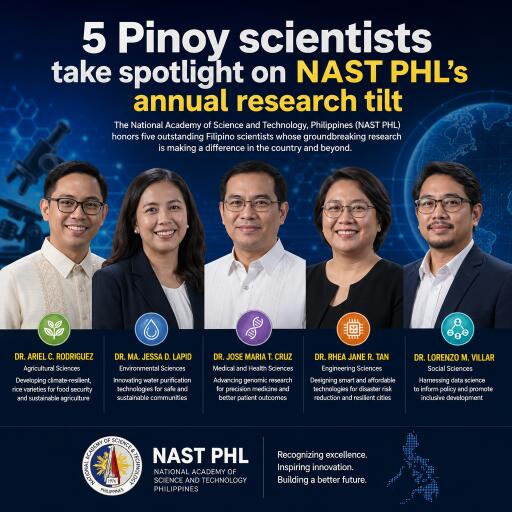
5 Pinoy scientists take spotlight on NAST PHL’s annual research tilt
At a packed final round of the National Academy of Science and Technology – Philippines (NAST PHL) Talent Search for Young Scientists, five early-career researchers stepped forward with work that fuses ecological urgency and technological ingenuity. Held on April 22 at the Admiral Hotel in Manila, the event narrowed a field of 19 contenders to five finalists whose projects span resilient infrastructure, cancer therapeutics from native flora, environmental safety, freshwater health, and food security.
AI-guided drones for safer, more resilient infrastructure
De La Salle University’s Timothy Scott Chu unveiled an inspection system that marries unmanned aerial vehicles with computer vision to spot micro-cracks in concrete—precursors to catastrophic failure in bridges and buildings. Leveraging convolutional neural networks such as AlexNet and real-time detectors like YOLOv4, the platform posted validation accuracies above 90 percent. By shifting hazardous, time-consuming manual checks to autonomous flights, the approach promises faster post-disaster assessments and a data-rich way to prioritize repairs—vital in a country frequently battered by typhoons and earthquakes.
Drug discovery potential from a Philippine endemic plant
From the University of Santo Tomas, Joe Anthony Manzano presented evidence that the endemic Voacanga globosa (locally known as bayag-usa) could yield compounds with anticancer potential. His team isolated the alkaloid globospiramine and found strong cytotoxic activity across multiple cancer cell lines in laboratory assays. While clinical translation remains a long road, the study underscores the biomedical promise of native biodiversity and the value of conserving habitats that may harbor future therapeutics.
Mapping toxic metals in Marinduque’s soils
Environmental scientist Ronnel Nolos of Marinduque State University conducted the province’s first broad assessment of potentially toxic elements in soil—an overdue baseline for a community with a legacy of mining impacts. The survey flagged cadmium, chromium, copper, nickel, and lead in various locations, with risk modeling indicating heightened vulnerability among children. The findings support urgent risk communication, evidence-based zoning for agriculture, and targeted remediation to break exposure pathways from soil to food and water.
Reading lake health through phytoplankton
University of the Philippines Los Baños researcher John Vincent Pleto evaluated the ecological condition of San Pablo City’s Seven Lakes using a phytoplankton Index of Biotic Integrity (IBI). By translating microscopic community shifts into a single, digestible score, the IBI helps local governments and stakeholders quickly detect nutrient pollution, algal bloom risks, and changing watershed dynamics. The method simplifies recurring monitoring—critical for tourism-reliant communities and for aligning lake management with water quality and fisheries goals.
Faster food safety testing with LAMP
From the University of the Philippines Diliman, Rance Derrick Pavon developed a rapid, low-cost loop-mediated isothermal amplification (LAMP) assay for detecting Salmonella in meat. Unlike PCR, LAMP runs at a constant temperature, slashing equipment costs and turnaround times while remaining highly sensitive. In resource-limited labs and field settings, this enables earlier detection of contamination, fewer recalls, and safer supply chains—especially important as climate variability and warming storage conditions raise microbial risks.
Why these projects matter now
- Climate resilience: Autonomous inspections can guide triage after storms and earthquakes, reducing downtime and averting failures.
- Biodiversity to biomedicine: Philippine flora remain an underexplored reservoir for new drugs; sustainable discovery hinges on conservation.
- Health safeguards: Soil metal mapping and lake bioindicators transform diffuse environmental problems into actionable public health insights.
- Food security: Field-ready diagnostics for pathogens protect consumers and small producers alike, keeping markets open and trust intact.
Together, the finalists demonstrate how locally rooted science can tackle national priorities: keeping infrastructure safe, translating biodiversity into health innovations, tracking pollution before it harms communities, and ensuring the food on the table is clean.
Winners of the NAST PHL Talent Search for Young Scientists will be named during the 48th Annual Scientific Meeting on July 9, 2026. The top awardee will receive a plaque, a P100,000 cash prize, and a P500,000 research grant from the Department of Science and Technology to scale their work from promising prototype to public impact.



Leave a Reply