

Emergent temperature sensitivity dominates phytoplankton growth and dampens net primary production seasonal variations on the Northeast US Shelf – Communications Earth & Environment
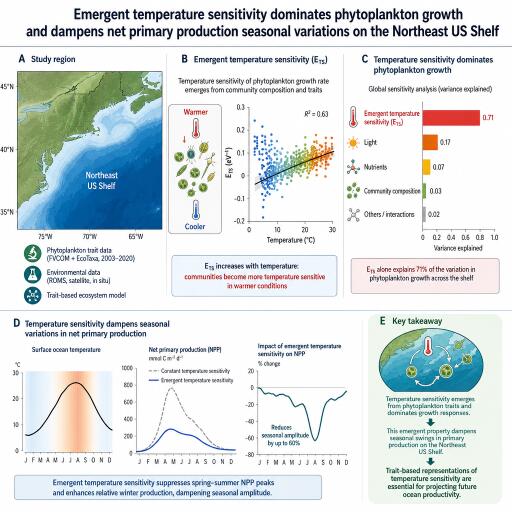
Warming seas along the Northeast U.S. Shelf are reshaping the rhythms of microscopic marine life that fuel coastal food webs. New analysis combining extensive field observations with numerical modeling indicates that phytoplankton growth is primarily steered by direct temperature effects on their physiology and community makeup—more so than by declines in nutrients typically caused by stronger stratification. The result: faster growth as temperatures rise, and surprisingly muted seasonal swings in net primary production.
For decades, the prevailing assumption has been that warmer conditions strengthen water-column layering, curbing nutrient delivery from deeper waters and suppressing productivity at the surface. This work challenges that one-way storyline. While stratification still matters, the temperature-sensitive traits of phytoplankton—how quickly they metabolize, divide, and compete—play a decisive role across seasons on the shelf. In essence, who the phytoplankton are and how fast they can run in warm water can outweigh what’s on the nutrient menu.
How the assessment was made
The researchers merged surface-layer measurements from the Northeast U.S. Shelf with process-based models to isolate two intertwined drivers: (1) thermal-trait-mediated responses that alter physiology and community composition as temperatures change, and (2) nutrient effects tied to seasonal stratification. By constraining both influences with observational data, the team identified which factor best explains shifts in phytoplankton growth rate and net primary production over the year.
What stands out
- Temperature-driven traits dominate: Across models and observations, warming reliably boosts phytoplankton growth rates, indicating that physiological acceleration and community turnover in warmer waters outweigh concurrent nutrient reductions.
- Seasonal production is buffered: Despite colder, nutrient-richer winters and warmer, often nutrient-poorer summers, total net primary production stays comparatively steady. As temperatures climb into summer, phytoplankton biomass tends to drop, yet faster growth compensates—flattening what would otherwise be a pronounced seasonal peak-to-trough.
- Community matters: Shifts in species and size classes aligned with temperature help sustain growth even when nutrients tighten, underscoring the adaptive and compositional nature of the response.
Why it matters
Phytoplankton are the ocean’s primary producers, anchoring coastal fisheries and sequestering carbon. The finding that emergent temperature sensitivity can override nutrient constraints complicates predictions of ecosystem change under warming. It implies that:
- Productivity under warming may not follow a simple decline in stratified seasons, at least on the Northeast U.S. Shelf.
- Timing and intensity of blooms—and the transfer of energy to zooplankton and fish—could depend more on temperature-driven growth dynamics than previously assumed.
- Carbon uptake and export may be regulated by shifting balances between biomass and turnover rates, with consequences for regional carbon budgets.
Implications for management and modeling
Management strategies that rely on fixed relationships between temperature, nutrients, and productivity may underestimate the resilience or reorganization of the phytoplankton community. Incorporating temperature-dependent traits and realistic community shifts into ecosystem and fisheries models will be essential for:
- Forecasting lower-trophic-level food availability for commercially important species.
- Anticipating changes in harmful algal bloom risk as warmer conditions favor faster-growing or opportunistic taxa.
- Refining carbon cycle projections, particularly the balance between production, respiration, and export.
Caveats and next steps
- Regional specificity: These dynamics are shown for the Northeast U.S. Shelf; other regions with different mixing regimes, light environments, or grazer communities may respond differently.
- Beyond growth rates: Grazing, viral lysis, and vertical mixing also shape biomass and productivity. Untangling these alongside temperature-driven traits will sharpen projections.
- Extreme events: Marine heatwaves and rapid freshening can push systems beyond typical seasonal envelopes; understanding whether compensation persists under extremes is a priority.
- Trait diversity: Linking in situ measurements of thermal performance curves to modeled communities could improve realism and identify thresholds where nutrient limitation overwhelms temperature benefits.
Bottom line
On the Northeast U.S. Shelf, phytoplankton are not simply victims of nutrient shortfalls as waters warm. Instead, their temperature-sensitive physiology and shifting community composition accelerate growth enough to counterbalance biomass declines, keeping net primary production comparatively steady from winter’s chill to summer’s heat. Recognizing this emergent temperature sensitivity is crucial for predicting how coastal ecosystems, fisheries, and carbon cycling will respond to continued ocean warming.



Leave a Reply