

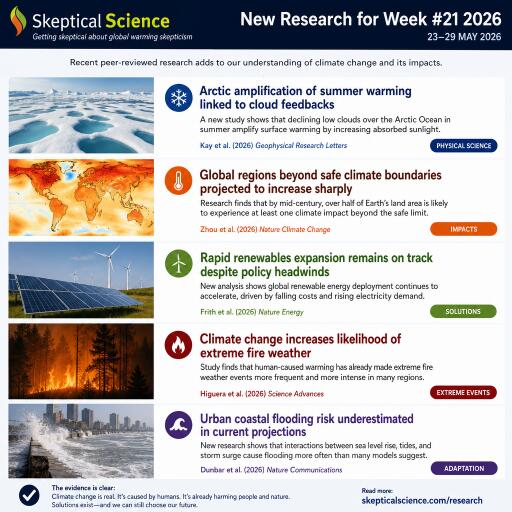
Skeptical Science New Research for Week #21 2026
This week’s research and reports trace clear fingerprints of human influence on climate, sharpen projections of near-term risks, and probe how our energy and information systems can rise to the challenge—or fall short.
Climate signals grow sharper
New detection-and-attribution work using the UK’s exceptionally long temperature records isolates greenhouse gases as the dominant driver of recent national warming, while also detecting a mid-20th-century cooling tug from pollution, consistent with sulfate aerosols. The result: human influence is unambiguously visible even at country scale.
Global rivers are steadily losing oxygen. Satellite-informed estimates spanning nearly four decades indicate a sustained decline in dissolved oxygen across most flowing waters, largely due to warming and basic solubility physics, with heatwaves and dams adding pressure. Projections suggest average river oxygen could drop about 1% under a low-warming pathway and roughly 5% under a high-warming path by century’s end—small percentages with large ecological consequences.
Wetlands’ methane output is poised to climb with rising land temperatures. An emergent constraint across advanced models indicates roughly a 24 teragram per year increase in natural wetland methane for each degree Celsius of land warming, implying a 50–60% rise by the 2090s under strong warming. Alarmingly, the projected methane jump through the 2030s could offset a sizable share of today’s pledged human-caused methane cuts. Gaps in tropical observations and uncertain future inundation still widen the range, but the feedback is tightening into focus.
Extremes: more intense and more resolvable
Across Africa, multiple lines of modeling point to robust intensification of regional precipitation extremes. Other studies detail how internal climate variability shapes future global surface temperature projections, how moist wave activity in a warmer world may amplify local deluges, and how machine-learning climate emulators can generate huge ensembles to map “tail” risks in heat and rainfall with unprecedented statistical power.
Work on the Indian Ocean Dipole suggests mean-state changes under greenhouse warming shrink its asymmetry by eliciting different responses in strong positive versus negative events. Seasonal temperature swings emerge as key drivers of permafrost behavior across interglacials, informing both paleo reconstructions and future thaw trajectories. And wildfire-driven pyrocumulonimbus smoke with large particle sizes and thick coatings appears to strongly perturb radiation and contribute to stratospheric warming—another pathway by which megafires reshape climate.
People, ecosystems, and food systems
Public perceptions continue to register climate change as a greater threat to future generations than to oneself, a cross-cultural pattern that aligns with expanding evidence linking climate exposure to mental health burdens. In agriculture, continental-scale analyses highlight how farm practices can materially boost soil carbon, while new field data complicate the assumption of universal pest proliferation with warming—pointing to crop- and region-specific outcomes. Research also underscores that the growing likelihood of record-smashing downpours will fall disproportionately on lower-income countries, compounding vulnerability.
Health at the climate frontier
Experts warn that a warming, wetter, and more volatile climate is reorganizing the ecology and geography of infectious diseases. Priorities include longer-term attribution studies, proactive workforce training, modern diagnostics and treatments, and far better surveillance—so health systems can move from reacting to anticipating. Related work highlights how climate-driven disruptions complicate access to essential health services and broaden “social health” risks linked to heat, storms, and displacement.
Energy transition: momentum, bottlenecks, and choices
In the United States, wind, solar and geothermal supplied over a fifth of retail electricity sales in 2025, with utility-scale battery storage expanding rapidly and electric vehicles multiplying on the roads. Yet demand is surging faster: electricity use is projected to jump more than 55% by 2050, with data centers shouldering an outsized share this decade and EV electricity consumption rising steeply. Grid modernization and flexible resources will determine whether reliability and affordability keep pace.
Analyses of large new electricity loads find rate impacts hinge on timing, available capacity, and how costs and risks are shared—tools like minimum bills and reservation charges can curb cost shifts to existing customers. Manufacturing data from early 2026 show a mixed picture: some facility cancellations and pauses alongside new investments, with electric vehicles facing notable headwinds.
Firm clean power options are gaining traction. Next-generation geothermal is scaling from pilots toward commercial deployment, with supply-chain readiness, technology transfer from oil and gas, and equipment standardization as critical levers. Broader “electrotech” supply chains remain concentrated in a handful of countries, raising resilience and security concerns for grids and AI-era demand. Policy choices matter now: debates in Europe over whether new backup capacity locks in gas or unleashes batteries illustrate how auction design can tilt the transition.
Reliability assessments for summer 2026 point to strengthened preparedness from record resource additions, while cautioning that elevated regional risks persist. Proposals for keeping power affordable emphasize building a bigger, better grid, short-term rate relief tied to cost-reducing investments, and ensuring large data centers cover the infrastructure costs they impose so households aren’t left paying the bill.
Sport, heat, and worker safety
Heat-risk analysis for the 2026 North American football tournament projects that more than two dozen matches may occur at or above wet-bulb globe temperatures where cooling breaks are recommended, with some venues lacking active cooling. Safety guidance from player representatives sets precautionary thresholds below current rules, signaling a need to reconcile policy with physiological risk.
Built environment and urban justice
Buildings and construction remain far off track for climate goals, still responsible for well over a third of global emissions and nearly half of material extraction. While codes, certifications, and efficiency investments have expanded, rapid construction is outrunning decarbonization. Research on urban “heatscapes” documents how infrastructure legacies and governance gaps produce inequitable heat exposure—and offers pathways for fair adaptation. Integrated pilots show that synchronizing mitigation and adaptation can speed city-level low-carbon transitions.
Information integrity and the AI footprint
Social media experiments and large-scale analyses show that invoking “science-y” cues can make dubious claims seem more accurate and more shareable—an uncomfortable irony in an era that depends on scientific guidance. Parallel assessments of AI-and-climate claims argue that many touted benefits rest on weak evidence and largely reflect conventional analytics, while the energy expansion linked to consumer-facing generative tools grows rapidly. The takeaway: rigorous, transparent accounting must accompany digital deployment to avoid green gloss over rising footprints.
National risk and global preparedness
Fresh national risk assessments identify the most acute climate threats across economies, ecosystems, and communities, setting the stage for the next round of adaptation planning. At the global scale, pandemic risk monitoring emphasizes that outbreaks are arriving more often and hitting harder; rebuilding trust, finance, and equitable access to countermeasures is essential in a warming, more interconnected world.
Across these threads, the message is consistent: the science is clarifying, the extremes are intensifying, and the policy and market levers are at hand. Whether societies use them with speed and fairness will define the decade.



Leave a Reply