

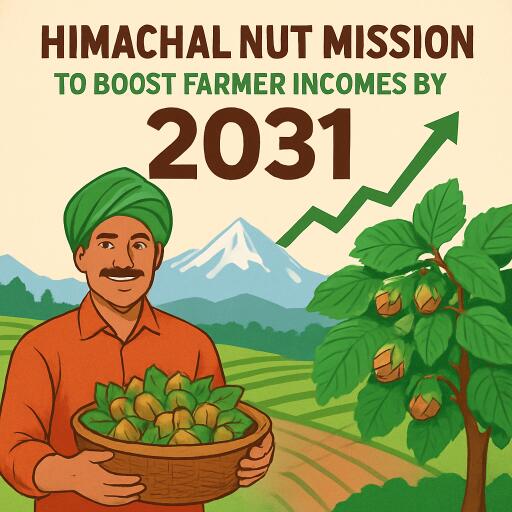
Himachal Nut Mission to Boost Farmer Incomes by 2031
Himachal Pradesh is preparing a new push for horticulture with a dedicated nut development programme scheduled to run from 2026 to 2031. The planned High Value Nut Mission is designed to raise farm earnings, modernize orchard practices and build a stronger supply chain around premium temperate nuts such as walnut, almond, apricot and chilgoza.
The programme targets some of the structural problems that have held back growers for years. In many hill districts, orchards are ageing, yields have weakened and farmers often lack access to quality planting stock, efficient irrigation, storage, grading and processing facilities. By combining scientific cultivation methods with better infrastructure, the state aims to turn nut farming into a more productive and climate-resilient income source.
1,000 hectares targeted for revival and expansion
At the heart of the mission is a plan to cover around 1,000 hectares. Most of this area, about 900 hectares, will focus on reviving old and low-performing orchards. The strategy includes canopy management, top-working, replacement of worn-out trees, soil improvement and better water-use systems. These upgrades are expected to help existing farms recover productivity without requiring farmers to abandon established orchards.
The remaining 100 hectares are expected to be developed as model high-density plantations. These demonstration plots would use improved planting material, micro-irrigation and cultivation techniques better suited to changing weather conditions. High-density systems can increase output per unit of land, an important factor in mountainous regions where farm area is limited and every hectare matters.
Technology and nursery support
A major challenge in horticulture is the availability of healthy, certified plants. To address this, the mission includes plans for four hi-tech nurseries in key nut-growing zones. These nurseries are intended to supply disease-free planting material, a crucial step for improving both yield and orchard longevity.
Two Centres of Excellence are also expected to be set up under the programme. These facilities would go beyond plant production, serving as hubs for research, training, field demonstrations and farmer outreach. In effect, they could become the technology backbone of the mission, helping growers adopt updated orchard management practices rather than relying solely on traditional methods.
Reducing waste after harvest
Nut cultivation does not end in the orchard. A large share of value is often lost between harvest and sale due to poor sorting, storage, handling and packaging. To close that gap, the mission proposes 10 modern units for collection, grading, sorting, packaging, processing and value addition.
For farmers, that could mean better prices and more stable market access. For the wider rural economy, it opens the door to local processing, branding and possibly premium marketing opportunities. Value addition is especially important in hill agriculture, where transport costs can be high and raw produce often captures only a fraction of its potential market value.
Building market strength through farmer groups
The initiative also plans to support Farmer Producer Organisations, encourage private investment and connect growers with institutional funding channels for infrastructure. This approach reflects a wider shift in Indian agriculture: individual smallholders often struggle to compete alone, but collective marketing and shared facilities can improve bargaining power and lower operating costs.
If implemented effectively, these measures could help nut growers move from fragmented production toward a more organized value chain, with stronger links to wholesale buyers, processors and possibly export markets.
Special focus on chilgoza in tribal regions
One of the mission’s most notable environmental dimensions is its emphasis on chilgoza, the high-value pine nut associated with tribal landscapes in Himachal Pradesh. Unlike more conventional orchard crops, chilgoza sits at the intersection of ecology, forest livelihoods and conservation.
The programme proposes targeted work for chilgoza regeneration in tribal areas, including assisted natural regeneration, community-based forest management and propagation systems to improve seed germination. This is significant because chilgoza ecosystems face pressure from overexploitation, weak regeneration and environmental stress. Supporting the species could therefore serve two goals at once: protecting biodiversity and strengthening the incomes of communities that depend on forest-linked produce.
Jobs, resilience and a new horticulture model
State leaders have presented the mission as more than a crop scheme. The larger ambition is to reshape horticulture into a more technology-driven, market-oriented and resilient sector. That includes better productivity in orchards, improved profitability for growers and fresh employment opportunities in rural areas, especially for young people seeking work in nursery management, processing, logistics and farm services.
The mission’s design also suggests a broader transition in Himalayan agriculture. Rather than focusing only on production, the state is pairing farm renewal with infrastructure, extension support, conservation and market development. In ecological terms, that integrated approach is important. Mountain farming systems are increasingly exposed to erratic rainfall, temperature variability and land constraints. Investments that improve water efficiency, planting quality and post-harvest management could make nut cultivation more adaptable over the long term.
What success will depend on
The real test will lie in execution. Rejuvenating ageing orchards requires technical follow-up, not just one-time announcements. High-density plantations need reliable inputs and training. Processing units require efficient operations and buyer networks to be financially viable. And chilgoza conservation will only work if local communities are placed at the center of management.
Still, the mission signals a clear strategic direction: treating temperate nuts as a high-value, climate-aware opportunity for Himachal Pradesh. If the state can translate plans into functioning orchards, nurseries, processing hubs and community conservation efforts, the initiative could become a model for linking ecological stewardship with rural prosperity by 2031.



Leave a Reply