

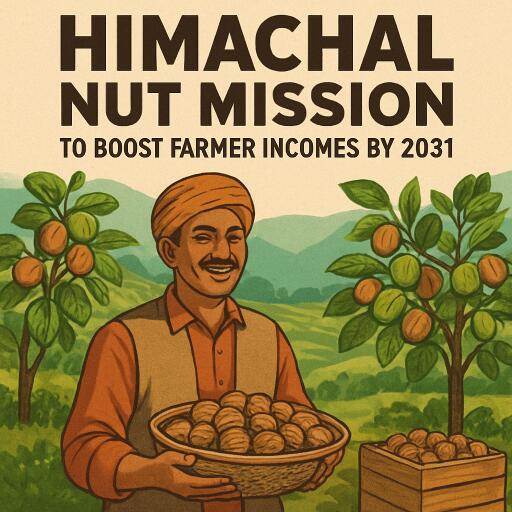
Himachal Nut Mission to Boost Farmer Incomes by 2031
Himachal Pradesh is preparing a major horticulture push with a new nut-focused programme scheduled to run from 2026 to 2031, aiming to raise farm earnings, modernize orchards and build a stronger rural value chain. The planned High Value Nut Mission will target temperate nut crops such as walnut, almond, apricot and chilgoza, with the state seeking to turn underperforming orchards into more productive and climate-aware assets.
The strategy comes at a time when many hill farmers face a familiar mix of problems: ageing trees, weak yields, limited processing capacity and too few opportunities to capture better prices after harvest. By combining orchard renewal with modern infrastructure, the government wants to shift the sector from traditional low-efficiency production toward a more technology-driven and market-ready model.
At the heart of the mission is a plan to cover about 1,000 hectares. Most of this area, around 900 hectares, will be dedicated to reviving older and low-yielding orchards. The approach is expected to include scientific canopy management, top-working, replacement of unproductive trees, better soil care and improved water-use practices. Rather than relying only on expansion, the programme is designed to extract more value from land that is already under cultivation.
The remaining 100 hectares are set to be developed as model high-density plantations. These demonstration areas are expected to showcase quality planting material, micro-irrigation, climate-resilient cultivation methods and other advanced farm technologies. In ecological terms, high-density systems can improve output per unit area when managed well, though their long-term success depends on careful water management, disease control and farmer training.
A major pillar of the mission will be the production of reliable planting stock. The state plans to set up four hi-tech nurseries along with two Centres of Excellence in key nut-growing belts. These facilities are intended to supply certified, disease-free plants while also serving as hubs for research, field demonstrations, technical guidance and grower training.
This institutional layer could prove crucial. One of the biggest constraints in horticulture transitions is not just access to land or markets, but access to trustworthy plant material and practical know-how. If implemented effectively, the nurseries and excellence centres could help farmers adopt better orchard management techniques and improve productivity without compromising crop health.
The mission also reaches beyond cultivation into post-harvest management, an area where farm income is often lost. Ten modern units are proposed for collection, grading, sorting, packaging, processing and value addition. These facilities are expected to reduce wastage, improve consistency in quality and help growers connect with stronger markets. For small and medium farmers, this kind of infrastructure can make the difference between selling raw produce quickly at lower prices and entering premium or processed segments with better margins.
The programme will also encourage collective business models through Farmer Producer Organisations, while seeking private sector participation under public-private partnership frameworks. Institutional finance is expected to play a role as well, especially for infrastructure and supply-chain development. Together, these steps indicate that the state is not treating nut cultivation purely as an agricultural activity, but as a broader rural enterprise ecosystem.
One of the mission’s most distinctive features is its emphasis on chilgoza, the high-value pine nut associated with tribal landscapes in Himachal Pradesh. Beyond its commercial importance, chilgoza holds ecological value because it is tied to fragile mountain habitats and community-based resource systems. The state plans to prioritize its conservation and regeneration through measures such as assisted natural regeneration, community-led forest stewardship and propagation support for seed germination.
This focus signals an important blend of economics and ecology. In mountain regions, income generation strategies can fail if they ignore biodiversity and local forest realities. Chilgoza conservation offers a chance to link livelihood support with landscape restoration, particularly in tribal areas where communities are closely connected to forest resources. If carefully executed, such interventions could help protect native species while opening new income streams rooted in sustainable use.
State leaders have presented the mission as a way to diversify horticulture, create rural jobs and improve resilience in the face of changing climate and market conditions. The broader expectation is that better orchards, higher-quality planting material, upgraded infrastructure and stronger branding could increase profitability across the nut sector.
The mission is also expected to support women, tribal households and farmer collectives, reflecting an effort to make horticultural growth more inclusive. For rural youth in particular, expanded opportunities in nursery management, orchard services, processing, packaging and marketing could help create employment beyond conventional farming.
If the programme meets its goals, Himachal Pradesh could emerge with a more modern nut economy by 2031: one shaped not only by production gains, but also by better storage, processing, conservation and market integration. Much will depend on implementation, training and local participation, but the roadmap suggests the state is betting that high-value nuts can become a stronger pillar of both farm prosperity and ecological stewardship in the hills.



Leave a Reply