

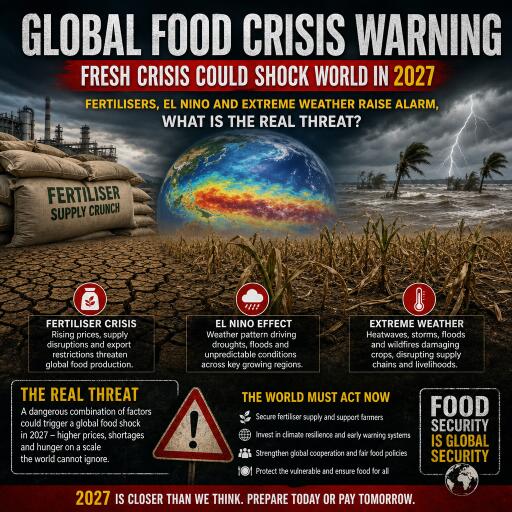
Global Food Crisis Warning: Fresh crisis could shock world in 2027, fertilisers, El Nino and extreme weather raise alarm, what is the real threat?
A new warning from market analysts suggests the world could face another jolt in food prices by 2027, as fertiliser constraints, energy volatility, and climate-driven extremes intersect. Global food inflation, which is expected to average around 2.8% in the first half of 2026, could climb toward 5% in early 2027 if current risks intensify. This is not a forecast of outright shortages, but a sign that farmers may be squeezed by costlier inputs and unpredictable weather at precisely the wrong time.
Fertilisers: the pivot between energy and food
Fertiliser production sits at the nexus of energy, trade routes, and food security. Nitrogen fertilisers like urea and ammonia depend heavily on natural gas, both as a feedstock and energy source. Any disruption to gas supply or price surges can quickly ripple into higher costs for farmers and, ultimately, consumers.
Geography amplifies the risk. Roughly 42% of global urea exports and about 27% of ammonia exports originate in West Asia. Tensions or shipping disruptions in key chokepoints—particularly around the Strait of Hormuz—could constrict supply just as planting windows open. If fertiliser isn’t available when needed, farmers either pay more, reduce application, or miss critical timing, all of which can depress yields.
The resilience of these supply chains isn’t instantaneous. Industry estimates suggest repairing damaged fertiliser capacity could take one to four years, while recovery for certain natural gas facilities could stretch three to five years. That long tail leaves little margin for error if climate stresses intensify.
El Niño’s potential to amplify price pressures
Overlaying the fertiliser challenge is a climate system primed for more volatility. A strengthening El Niño can reshape rainfall and temperature patterns across major breadbaskets, shifting the odds toward droughts, floods, heat waves, and pest outbreaks. Analysts see a high likelihood that El Niño conditions will persist into 2027, with a significant chance of becoming “very strong” by late 2026.
Historically, powerful El Niño events have dented crop yields in parts of South and Southeast Asia, Australia, and the Americas, while occasionally boosting production elsewhere. On balance, a very strong El Niño could add roughly 0.7 percentage points to global food inflation at its peak, with the combined effect of higher energy prices potentially pushing that to around 1.3–1.5 percentage points. The timing matters: if adverse weather hits planting or pollination windows, the price impact can be sharp and swift.
Why this isn’t a shortage story—yet
Global stocks of staple crops ebb and flow, but the core risk here is cost-push inflation rather than a collapse in supply. Farmers can and will adapt—by switching crops, adjusting input rates, or shifting to more resilient practices—but those adaptations often come with transitional costs. When energy and fertiliser both become more expensive, and weather risk rises, the margin of error narrows for producers and consumers alike.
India’s monsoon sensitivity
India’s food system is particularly exposed to monsoon behavior. El Niño years often correlate with weaker or more erratic southwest monsoons, though the relationship is not guaranteed. An uneven or delayed monsoon can strain key crops—rice, pulses, oilseeds, cotton, and sugarcane—tightening domestic availability and pushing prices higher. Given India’s size in global rice and sugar markets, domestic shortfalls can also reverberate internationally through export restrictions or altered trade flows.
Mitigating the shock: what can be done now
- Diversify fertiliser supply: Broaden sourcing, invest in regional production, and build strategic reserves to buffer short-term disruptions.
- Use nutrients more efficiently: Scale up precision application (the “right source, right rate, right time, right place” approach) to maintain yields with fewer inputs.
- Strengthen climate resilience: Expand drought- and heat-tolerant seed varieties, adopt water-saving irrigation, and improve soil health to boost moisture retention.
- De-risk farming: Increase access to weather-indexed insurance, advisory services, and early-warning systems tailored to smallholders.
- Cut food loss and waste: Invest in storage, cold chains, and logistics to preserve harvests when weather disrupts timing and quality.
- Coordinate trade and transparency: Avoid panic measures that exacerbate volatility; share data on stocks, flows, and weather risks to stabilize expectations.
The bottom line
The ingredients for a 2027 food price spike are assembling: vulnerable fertiliser supply chains tied to volatile energy markets, and a climate system capable of swinging rapidly into damaging extremes. The world is not on the brink of running out of food, but it is on notice. Smart policy, smarter inputs, and climate-ready farming can blunt the blow—if action begins before the next planting season, not after prices spike.



Leave a Reply