

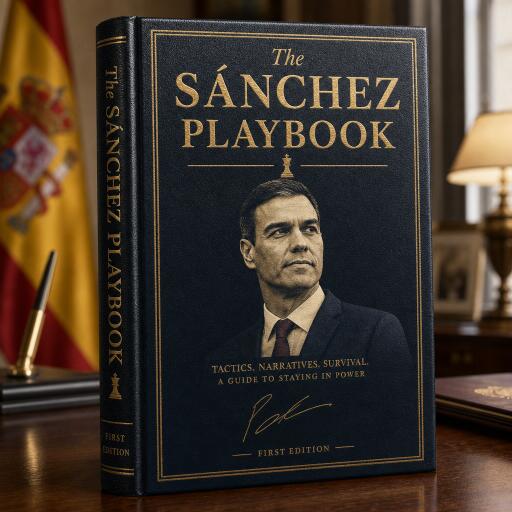
The Sánchez playbook| First Edition
How does a leader stitch together a progressive coalition in an age of fragmentation? In Spain, the answer has often been pragmatic politics tethered to tangible policies—especially on climate and the cost of living. Over the past decade, Pedro Sánchez navigated a volatile landscape by anchoring his party to the left while governing through deals, delivery, and relentless message discipline. The result is a blueprint that blends social protections with an unapologetic green transition—one that rivals across Europe, including in the UK, have struggled to replicate.
From outsider to operator
After a bruising internal battle, Sánchez returned to lead his party and then the country in 2018, recasting himself beyond the Madrid bubble as a can-do outsider with a commonsense progressive pitch. His core insight was less ideological than operational: a broad left-of-center alliance is the only stable route to power in a fragmented parliament—and you earn that alliance by delivering material gains.
Delivering a policy cascade
In 2019, Sánchez’s government set out to knit social justice with climate action and pocketbook support. The program mixed redistribution with rights and regulatory reform, including:
- Accelerated investment in renewable energy and grid upgrades to cut emissions and lower bills
- Sharp increases in the minimum wage
- Expanded reproductive rights
- A ban on coercive “conversion” practices
- Rent increase caps in high-pressure markets
- Higher taxes on top earners alongside relief for low- and middle-income households
Crucially, the climate agenda wasn’t siloed as “environmentalism”—it was framed as economic security, industrial renewal, and public health. That changed the politics: cleaner air, cheaper power, and local jobs are easier to defend than abstract carbon targets.
Headwinds at home
The path has been far from smooth. Allegations touching family members and associates created political turbulence—charges the prime minister has repeatedly dismissed as partisan. A thin parliamentary margin further constricted room for maneuver; a fresh budget has remained elusive since 2023, and local contests brought setbacks for his party. Yet the government leaned into the advantage it did have: the power to set the agenda.
Projecting abroad to steady the base
In recent years, foreign policy became a stage for moral clarity and strategic independence. Madrid refused to green-light certain U.S. military uses of joint bases, arguing that unlawful responses invite catastrophe. Spain formally recognized a Palestinian state in 2024, condemned the devastation in Gaza, and criticized Europe’s hesitancy. The government also convened a gathering of global progressives in Barcelona to revive a cross-border program centered on rights, climate, and social security.
That posture rallied parts of the domestic coalition, even if it didn’t dramatically move headline approval ratings. It reinforced an image of a government with purpose—vital when legislative arithmetic stalls.
A 2023 lesson in political contrast
Heading into the 2023 election, polls pointed to a right–far-right pact. The response was stark: make the choice unmistakable. The campaign argued that social protections, climate plans, and wage gains were on the line. Polarization alone rarely suffices; polarization with a receipt-filled ledger can. Voters were shown what would disappear, not just what might arrive.
Elsewhere, attempts to copy the “us versus the hard right” frame faltered when not paired with clear, delivered benefits. Vague calls for national renewal without concrete stakes lacked traction.
What the UK’s Burnham can take from this
With the next general election on the horizon, Britain’s leadership faces similar dilemmas. Early signals hinted at boldness—like a headline promise to end homelessness—but momentum soon ebbed, and clarity on two defining issues of our era, migration and the climate crisis, has been thin.
Migration: values plus management
Sánchez chose a values-forward approach tethered to competence. One of his first acts was offering safe harbor to a rescue ship turned away elsewhere. Later, the government advanced regularization pathways for undocumented residents. When a surge of arrivals created headlines, Madrid refused to chase rightward narratives or outsource responsibility, prioritizing orderly processing and cooperation with neighbors. Public concern over immigration remained comparatively muted, suggesting that consistent framing and visible management can dull the politics of fear.
Climate: make it the economic story
Spain’s line could not be clearer: climate change kills, and delay is deadly. Billions have been steered toward offshore wind, solar build-out, storage, grid modernization, heat-resilient infrastructure, and industrial decarbonization. The message stresses cheaper energy, domestic supply chains, and protection from extreme heat, drought, and wildfire. By contrast, hedging on fossil exploration while policing barbecues invites ridicule rather than trust. If the green transition is presented as jobs, bills, and resilience—not scolding—voters reward it.
Consolidating the progressive lane
By grabbing the initiative on climate, wages, and rights, Spain’s governing party squeezed space to its left. Smaller allies that once flirted with double-digit support now scrape low single digits. In the UK, recent local results suggested the opposite dynamic: far more voters drifted to the Greens than to a hard-right alternative. Ceding the climate and cost-of-living narrative is an open invitation to lose your base from the left while failing to persuade the center.
The wider ecological calculus
Europe is entering a decade defined by heat emergencies, water stress, biodiversity loss, and energy volatility. Leaders who treat climate as infrastructure, industry, and health policy—instead of a cultural wedge—can build strange-bedfellow coalitions: farmers who want water security, manufacturers who want stable power prices, renters who want cooler homes, and commuters who want affordable transit. Spain’s experiment shows that when the green deal is local and measurable, it is governable.
The playbook, distilled
- Define the stakes in concrete terms: bills, jobs, protections, and safety from climate extremes.
- Be values-forward on migration while demonstrating control and capacity.
- Use foreign policy to clarify principles when domestic gridlock looms.
- Polarize only if you can point to delivered gains; contrasts without receipts ring hollow.
- Own the climate transition as an economic backbone, not an afterthought.
Whether Britain’s leadership adopts this script remains uncertain. But the lesson from Madrid is simple: courage paired with competence can still beat cynicism—especially when the sun is hotter, the water is scarcer, and every delay grows costlier.



Leave a Reply