

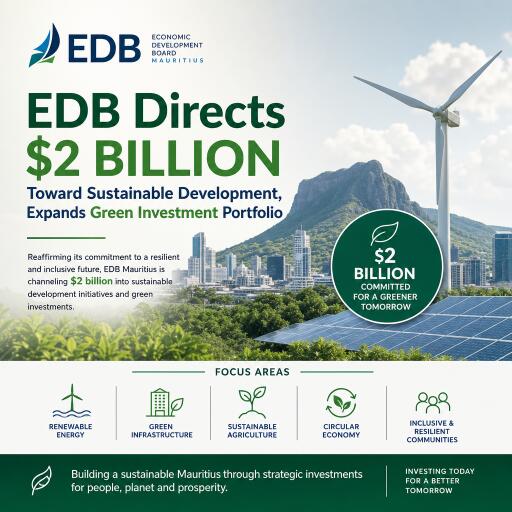
EDB Directs $2 Billion Toward Sustainable Development, Expands Green Investment Portfolio
The Eurasian Development Bank (EDB) has stepped up its climate and sustainability agenda, channeling a cumulative $2 billion into sustainable development and lifting its active green investment portfolio to $1.08 billion in 2025. The figures, unveiled alongside the bank’s Annual Meeting and Business Forum in Almaty on June 26, signal an accelerated push into renewable energy, climate resilience, and low-carbon infrastructure across member states.
Stronger disclosure and climate-risk scrutiny
In its latest Sustainability Report, the EDB emphasized that robust environmental, social and governance (ESG) disclosure has become central to how it plans, measures, and refines its operations. Bank leadership framed sustainability reporting as both a transparency commitment and a tool for institutional learning—one that drives methodological upgrades and sharper evaluation of outcomes. The bank also noted it received an A- assessment from the international ESG rating agency CCXGF, reflecting progress in aligning its strategy and practices with global standards.
A notable step in 2025 was the EDB’s first comprehensive climate risk review of its investment portfolio. The analysis examined four potential climate futures across the full life cycle of loans and flagged water scarcity as the most material threat, with potential losses estimated at $36 million. Extreme heat and drought followed, with expected losses of $26 million and $14 million, respectively. Overall, the bank estimated that climate-related losses would not exceed 1.23% of its current portfolio—a manageable exposure that nonetheless underscores the urgency of adaptation measures.
Investing in resilience and clean energy
The EDB continued deepening partnerships to build climate resilience in the region. In Kazakhstan, the bank joined forces with the United Nations Development Programme and the Ministry of Water Resources and Irrigation to spur a business ecosystem for sustainable irrigation—an intervention aimed at shoring up water security and supporting farmers’ adaptation to shifting climate conditions. Complementing these efforts, the EDB collaborated with the CAREC Institute on a study assessing how Central Asian countries and Azerbaijan could prepare for carbon pricing mechanisms, a policy lever increasingly used to steer investment toward low-carbon pathways.
Green financing volumes continued their upward trajectory in 2025. The bank’s active green portfolio reached $1.08 billion, while cumulative green investments climbed to $2 billion, with the bulk directed to renewable energy and energy-efficiency projects. Among the flagship initiatives is a 300-megawatt solar facility in Kyrgyzstan’s Issyk-Kul Region—one of the largest solar undertakings in the post-Soviet space—designed to cut emissions, diversify power supply, and strengthen energy security.
By year-end 2025, more than a quarter of the EDB’s total portfolio was aligned with the United Nations Sustainable Development Goals. Bank officials highlighted that demand from member states for green transformation is expanding rapidly. Over the past seven years, active green financing more than tripled, while the emissions intensity of the portfolio—measured as emissions per dollar invested—fell by over 15% year on year, indicating improved climate efficiency even as overall investment grows.
Adaptation financing: the widening gap
Discussions at a forum “warm-up” session zeroed in on adaptation finance, now recognized as essential to protect lives, livelihoods, and ecosystems as climate impacts intensify. Experts pointed to a persistent shortfall: global adaptation needs are estimated at $310–$365 billion annually, while current flows hover around $26 billion. In Central Asia, less than a quarter of climate finance goes to adaptation; roughly three-quarters targets emissions reductions. Private investment in mitigation projects across the region already exceeds $3.7 billion, but adaptation continues to lag due to higher perceived risks, fragmented pipelines, and limited bankable projects.
Participants outlined several measures to close the gap:
- Expand guarantee instruments to de-risk private capital participation in adaptation projects.
- Increase technical assistance to prepare, structure, and scale resilient infrastructure and nature-based solutions.
- Establish a unified regional climate platform to aggregate investment opportunities, harmonize evaluation standards, and facilitate cross-border initiatives.
Such a platform could streamline project origination, mobilize blended finance, and strengthen regional cooperation on adaptation, from water management to resilient agriculture and climate-smart urban systems.
Regional development with an integration lens
The EDB, a multilateral development bank focused on Eurasia, reported a cumulative portfolio of 326 projects totaling $19.6 billion as of the end of 2025. Its investments span transport corridors, digital infrastructure, green energy, agriculture, and industrial modernization, with an emphasis on cross-border benefits and economic integration. Against the backdrop of growing climate risks, the bank’s pivot toward deeper ESG integration, climate-risk assessment, and green finance signals a broader shift in regional development: building prosperity and connectivity while reducing emissions and safeguarding communities from a warming world.



Leave a Reply