

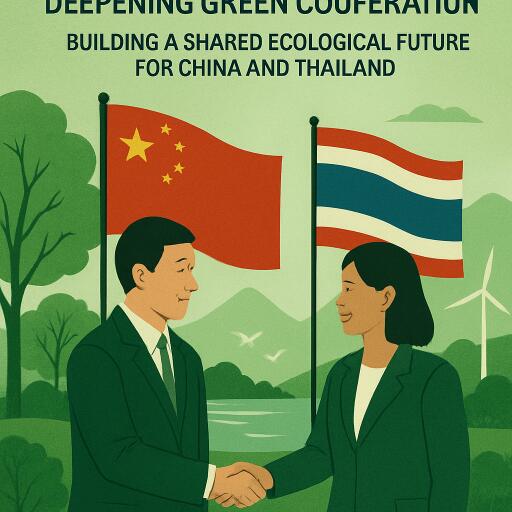
Deepening green cooperation: Building a shared ecological future for China and Thailand
China and Thailand are expanding their partnership in one of the most urgent arenas of the 21st century: ecological protection and low-carbon development. As climate risks intensify across Asia, the two countries are strengthening cooperation in pollution control, renewable energy, biodiversity monitoring and community resilience, creating a model of regional collaboration built on practical results.
The relationship has moved well beyond diplomatic statements. In recent years, both sides have increased policy coordination, technical exchanges and joint projects aimed at addressing shared environmental pressures. From urban air quality to marine ecosystems, the partnership reflects a broader shift toward linking economic modernization with environmental safeguards.
Sharing policy tools for greener development
A central feature of this cooperation has been the exchange of governance experience. Thailand has promoted its Bio-Circular-Green economic approach as a framework for combining growth with resource efficiency, while China has shared lessons from its nationwide push for ecological restoration and greener urban development. These dialogues have helped both countries compare policy tools, refine institutional approaches and identify areas for joint action.
Such exchanges matter because China and Thailand face overlapping challenges: rising emissions, pressure on ecosystems, rapid urbanization and greater exposure to climate extremes. By learning from each other’s environmental planning and regulatory strategies, they are building a more coordinated response to those shared risks.
Air pollution cooperation gains practical momentum
Haze and particulate pollution remain a serious concern in parts of Southeast Asia, especially during seasonal burning periods. In response, China and Thailand have supported joint efforts to improve monitoring and develop stronger evidence-based air quality management systems.
One notable area of progress has been the development of advanced atmospheric observation capacity in Bangkok. Enhanced monitoring tools are helping authorities improve pollution assessment, strengthen forecasting and support more targeted intervention strategies. Technical cooperation has also extended to workshops and symposiums focused on reducing agricultural burning and encouraging the reuse of crop residues and farm waste.
These efforts are significant because they connect science with policy. Better data allows cities and regions to move beyond emergency reaction and toward long-term prevention, a crucial step for improving public health and reducing cross-border pollution impacts.
Clean energy and electric mobility deepen industrial ties
Green cooperation between the two countries is increasingly anchored in industry. Renewable energy, electric vehicles and battery manufacturing are becoming major pillars of the partnership, reinforcing Thailand’s industrial transition while creating new opportunities for Chinese technology and investment.
Chinese companies have taken part in Thailand’s solar energy buildout, including floating photovoltaic projects on reservoirs and dams. These installations not only generate low-carbon electricity but also demonstrate how land and water resources can be used more efficiently in the clean energy transition. Large-scale solar deployment is expected to help Thailand diversify its power mix and cut future emissions.
At the same time, Thailand has emerged as an important base for electric vehicle production in Southeast Asia, and Chinese automakers and battery manufacturers have become key participants in that shift. Their investments are helping to expand local manufacturing capacity, strengthen supply chains and accelerate the move toward cleaner transport. The convergence of industrial policy and climate goals gives this cooperation strategic importance for the wider region.
Protecting coasts, seas and biodiversity
Beyond energy and industry, ecological cooperation has extended into land-sea conservation. China and Thailand are working together on marine ecosystem research, coastal monitoring and biodiversity protection, fields that are becoming increasingly important as coral reefs, shorelines and fisheries come under stress from warming waters and human activity.
Joint scientific platforms and monitoring systems have improved the tracking of reef conditions and marine life. Real-time observation technologies are helping researchers gather continuous information on fragile habitats and endangered species, providing a stronger basis for conservation planning. Coastal monitoring stations and specialized equipment are also supporting efforts to assess vulnerability and guide restoration work in affected zones.
This scientific dimension is especially valuable in tropical marine environments, where ecological decline can be rapid and expensive to reverse. By investing in monitoring, the two countries are emphasizing prevention and early intervention rather than delayed response.
Climate resilience reaches local communities
An important aspect of the relationship is its focus on people living on the front lines of climate disruption. Joint initiatives have helped support Thai communities vulnerable to storms, floods and other extreme weather events through preparedness measures and adaptation training.
Programs at the household level have included the distribution of emergency supplies and community instruction on evacuation, risk awareness and self-protection during climate-related disasters. While modest in scale, this type of cooperation shows how bilateral environmental policy can translate into direct local benefits.
It also highlights a larger truth about climate governance: resilience is not only built through major infrastructure or national targets, but through communities having the knowledge and resources to respond when disasters strike.
A broader regional role
Looking ahead, China and Thailand appear set to broaden their green agenda in several strategic areas, including watershed protection, climate adaptation, marine management, clean technology and green finance. Their cooperation is also likely to carry growing regional weight as both countries work with neighboring states on shared environmental challenges in the Mekong and across Southeast Asia.
The next phase will depend not only on investment, but on maintaining systems for knowledge-sharing, research collaboration and technical training. Stronger links among governments, scientists and industry could help turn bilateral projects into scalable models for wider adoption.
For both countries, green cooperation is becoming more than a diplomatic theme. It is evolving into a practical framework for cleaner growth, stronger resilience and better ecosystem stewardship. If that momentum continues, the partnership could play a meaningful role in shaping a more sustainable future for mainland Southeast Asia and beyond.



Leave a Reply