

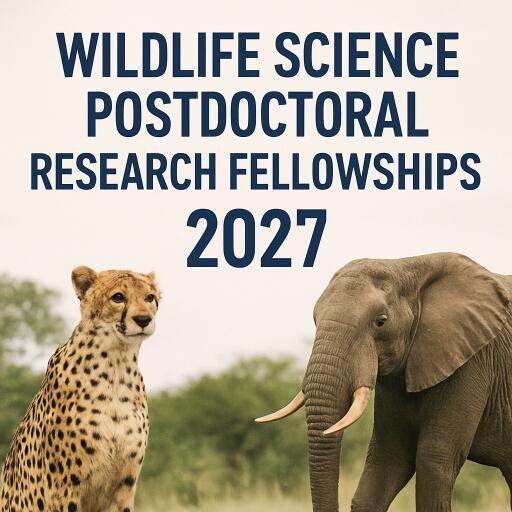
University of the Free State Wildlife Science Postdoctoral Research Fellowships 2027
The University of the Free State is set to open applications for a postdoctoral research fellowship in Wildlife Science for 2027, offering an opportunity for recent doctoral graduates to build advanced research experience in conservation, ecology, and wildlife management.
Based at the Bloemfontein campus, the fellowship is hosted within the Department of Animal Science in the Faculty of Natural and Agricultural Sciences. It is aimed at scholars whose work aligns with African wildlife research, especially those interested in large herbivores, habitat use, biodiversity conservation, and sustainable land management.
Fellowship snapshot
- Institution: University of the Free State
- Department: Animal Science
- Position: Postdoctoral Research Fellow
- Campus: Bloemfontein, Free State, South Africa
- Start date: 1 January 2027
- Application deadline: 21 August 2026
- Initial term: 1 year
- Possible extension: Up to 3 years in total, subject to performance and funding
- Annual fellowship value: R270,000
- Research support: R30,000
What the programme focuses on
This fellowship forms part of a broader multidisciplinary research effort examining the forces that shape African wildlife populations. The selected fellow will contribute to studies that combine ecological fieldwork, biological analysis, conservation planning, and resource management.
Key areas of interest include:
- Wildlife science and management
- Conservation biology
- Rangeland ecology
- Large herbivore ecology
- Habitat assessment and utilisation
- Wildlife population monitoring
- Sustainable natural resource management
- Evidence-based conservation strategies
Research and academic expectations
The fellowship is designed for early-career researchers seeking to strengthen both their scientific profile and university-level academic experience. In addition to conducting original research, the successful candidate is expected to contribute to teaching, student development, and research growth within the department.
Main responsibilities are expected to include:
- Leading and supporting wildlife and conservation research projects
- Taking part in habitat and ecological field assessments
- Publishing scientific papers in peer-reviewed journals
- Presenting findings at academic conferences
- Assisting with undergraduate teaching and practical training
- Supporting postgraduate supervision and mentoring
- Contributing to curriculum development
- Helping prepare research proposals and grant applications
Technology in wildlife research
The role also offers exposure to modern environmental and wildlife-monitoring tools. Depending on project needs, the fellow may work with technologies such as GPS telemetry, geographic information systems, remote sensing platforms, drones, spatial analysis software, and AI-assisted monitoring systems.
This reflects a growing trend in conservation science, where digital tools are increasingly used to map habitats, track animals, and guide better land-use decisions.
Publication and conference output
A strong publication record is central to the fellowship. The selected postdoctoral researcher will be expected to maintain steady scientific output, including at least two peer-reviewed journal papers per year. Conference participation also forms part of the role, with presentations at scholarly events expected as research progresses.
Applicants with previous publications and a history of academic presentations will likely be more competitive.
Who should apply
The opportunity is suited to candidates who have completed a PhD in a relevant field within the five years leading up to the application. Suitable academic backgrounds may include:
- Wildlife Science
- Wildlife Management
- Conservation Biology
- Ecology
- Zoology
- Rangeland Science
- Animal Science
- Related disciplines with matching research experience
Beyond the doctorate, applicants should be able to show experience in field-based wildlife or ecological research, scientific writing, teaching support, and student training. Because fieldwork is part of the position, a valid driver’s licence is also required.
Eligibility and working conditions
The fellowship is open to both South African and international applicants, provided they are available to work full time at the university. The successful fellow will be required to register and reside as a postdoctoral researcher at the institution.
Because this is a full-time academic fellowship, it cannot be held alongside full-time salaried employment. Renewal beyond the first year will depend on research performance, annual reporting, publication output, and the availability of funding.
Application requirements
Candidates are expected to prepare a complete application package. This should typically include a motivation letter, full CV, academic transcripts, doctoral certificate, publication list, record of conference participation, identification documents, driver’s licence, and the names of three academic referees.
The motivation letter should clearly explain the applicant’s research background, field experience, teaching exposure, technical skills, publication history, and how their expertise fits the wildlife research programme.
Selection process
The fellowship will be awarded on a competitive basis. The review process is expected to consider academic merit, research independence, publication quality, teaching experience, technical skills, and overall fit for the programme’s conservation and wildlife science priorities.
The university may also apply equity considerations in line with its institutional transformation objectives.
Why this fellowship stands out
For researchers interested in the intersection of ecology, wildlife management, and conservation technology, this postdoctoral position offers more than a funding package. It creates a platform to work on real environmental challenges affecting African ecosystems while building experience in publishing, teaching, and applied conservation science.
With pressure mounting on habitats and wildlife populations across the region, opportunities like this play an important role in developing the next generation of researchers who can combine field ecology with data-driven conservation practice.
Important date
Applications close on 21 August 2026. The fellowship is scheduled to begin on 1 January 2027.



Leave a Reply