

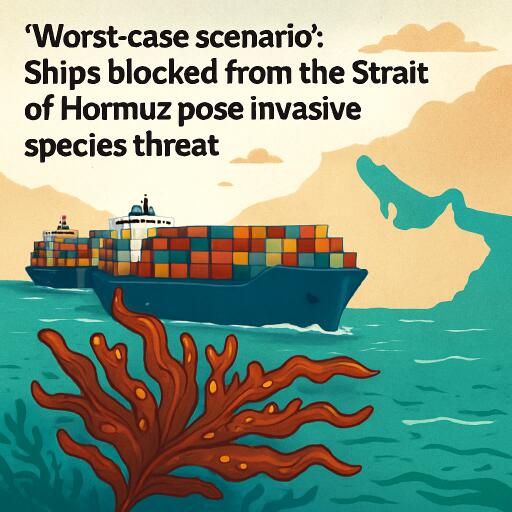
‘Worst-case scenario’: Ships blocked from the Strait of Hormuz pose invasive species threat
A prolonged shipping standstill near the Strait of Hormuz could trigger a major ecological chain reaction, as marine organisms attached to vessel hulls may be transported across the globe once traffic resumes.
Scientists are warning that hundreds to thousands of ships left waiting in the Persian Gulf and Gulf of Oman may become powerful carriers of invasive species. The concern centers on biofouling — the buildup of algae, barnacles, tunicates and other sea life on the outside of ships, including hulls, propellers and submerged equipment.
Under normal conditions, commercial vessels usually move frequently, spending limited time in one place. But when ships remain idle for extended periods, marine growth can accelerate. Experts say the current situation creates unusually favorable conditions for organisms to settle, multiply and eventually hitch a ride to distant ports.
Researchers describe this kind of mass delay as a near-perfect setup for spreading species across ecosystems. Large numbers of vessels are clustered in warm waters at the same time of year when many marine organisms are actively growing and reproducing. That combination, they say, sharply raises the odds that ships will leave with dense biological buildup attached to their surfaces.
Another complication is that anti-fouling coatings, which are designed to reduce the settlement of marine life on ships, are generally less effective when vessels are not regularly moving. A ship sitting still for weeks can become far more attractive to opportunistic species than one that is traveling on schedule.
The danger does not end when the ships depart. Once vessels reach ports in other parts of the world, attached organisms may detach, release eggs or larvae, or otherwise establish themselves in new habitats. If local conditions are suitable, those newcomers can spread rapidly and compete with native species.
Marine biologists warn that species adapted to the Gulf’s extreme heat and salinity could be especially resilient invaders. As oceans warm in many regions, organisms that can survive harsh conditions may find it easier to colonize new coastlines.
Removing this growth before ships leave is not a simple solution. Cleaning large numbers of vessels in a short window would require significant specialized capacity, and in-water hull cleaning operations may be difficult or unsafe in a tense conflict zone. That means many ships could resume international travel without full decontamination.
The issue highlights a lesser-known side of global shipping’s environmental footprint. Public attention has often focused on ballast water, which has long been recognized as a pathway for moving non-native species between marine ecosystems. But biofouling on ship exteriors is also a major transmission route, and one that experts say still does not receive enough regulatory attention worldwide.
Once invasive species gain a foothold, eradication is rare. The long-term consequences can include ecosystem disruption, damage to fisheries, reduced biodiversity and costly management efforts. In some cases, invasive organisms outcompete native life for food and habitat, alter food webs or interfere with aquaculture operations.
Tunicates, sometimes called sea squirts, are one example of the kind of organism that can spread through shipping activity. These animals can blanket underwater surfaces and create problems for shellfish farms by competing with commercially important species. Similar marine hitchhikers have caused persistent headaches in ports and coastal industries around the world.
Experts often describe global shipping as a network in which major ports act like hubs. A species introduced at one destination can then spread again through regional vessel traffic, creating a cascading pattern of invasion. In that sense, a concentrated event involving many delayed ships could have consequences far beyond the Gulf itself.
What makes the current situation particularly alarming is not just the number of vessels involved, but the possibility that each one could carry a varied mix of organisms to multiple destinations. Even if only a fraction of those species survive abroad, the event could reshape marine invasion risks on an international scale.
Environmental fallout from geopolitical crises is often discussed in terms of oil, emissions or damaged infrastructure. But ecologists say this episode is a reminder that conflict-driven disruptions can also create slower-moving biological effects that continue unfolding long after ships begin moving again.
The full scale of the risk remains uncertain, and much will depend on how long vessels stay immobilized and what precautions are taken before they return to normal routes. Still, scientists caution that the ecological consequences could persist for years, making this maritime bottleneck not only a commercial crisis, but a potential global biosecurity threat.



Leave a Reply