

Holistic approach to forest management is needed – Timberbiz
Australia’s forests are under mounting pressure from climate change, more intense bushfires, prolonged drought, invasive species, pests and disease. In this context, forestry specialists are urging a more nuanced approach to management, arguing that forest policy should focus on ecological condition, carbon storage and long-term resilience rather than falling into simplistic debates about whether forests should be used or left entirely untouched.
A proposed carbon-focused framework has been put forward to support measurable improvements in the health and recovery of native forests. The central idea is that carbon finance should back actions that clearly increase carbon retention while also improving ecosystem function. Supporters say such a model is not intended to encourage extra timber extraction, but to fund interventions that are scientifically justified and environmentally beneficial.
This approach reflects the reality that forests are not all the same. Australia’s wooded landscapes include conservation reserves, Indigenous-managed Country, private bushland, state forests and mixed-use areas, each with different ecological histories and pressures. A single rule for every forest is unlikely to succeed when conditions vary so widely between alpine ash stands, dry inland woodlands and fire-prone coastal systems.
Advocates of the proposal say good forest stewardship must be adaptive. In some areas, natural recovery may be enough. In others, direct intervention may be necessary to help ecosystems rebound after repeated fires, restore damaged habitat, or reduce threats that are preventing regeneration. This can include assisted revegetation, ecological thinning in overstocked stands, weed and pest control, cultural burning, prescribed fire, protection of old habitat trees and targeted post-fire recovery work.
Such measures are increasingly relevant as forests struggle to recover from compounding disturbances. Repeated severe fires, for instance, can wipe out seed sources and prevent some tree species from regenerating naturally. In dense cypress pine stands, excessive competition can stunt growth and weaken the forest over time. Under these conditions, carefully designed management may improve both biodiversity outcomes and the capacity of forests to store carbon.
A key principle behind the proposal is that carbon credits should be granted for proven climate benefits, not for a specific ideology about land use. In practice, this means any project would need to show that its actions produce genuine and additional carbon gains beyond what would have happened anyway. Those gains would also need to be measured conservatively and backed by transparent methods.
For a carbon system to have environmental credibility, several safeguards are essential. These include realistic baselines, rigorous accounting of emissions and sequestration, transparent modelling, long-term monitoring, and proper attention to permanence and leakage. Safeguards must also ensure that carbon projects do not undermine biodiversity, water values, habitat complexity or cultural priorities.
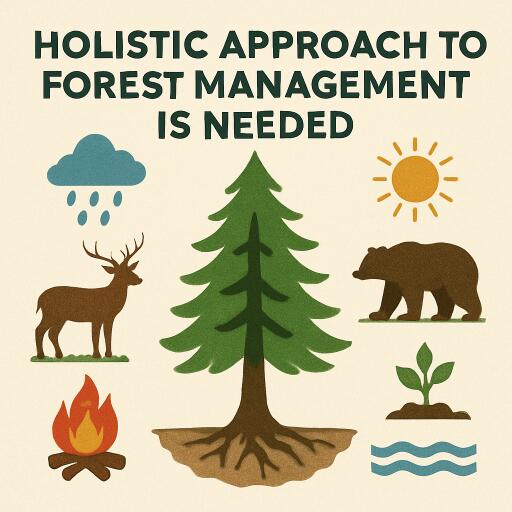
This broader view is especially important because forests provide far more than carbon storage. They are habitat for wildlife, regulators of water catchments, places of cultural significance, spaces for recreation and, in some regions, sources of renewable materials. Managing forests only for a single outcome can overlook the interconnected nature of these values.
Ecologists and forest managers therefore argue for a landscape-scale perspective. Rather than asking whether all intervention is good or bad, they say the more useful question is what a particular forest needs to remain healthy and resilient over time. In some places, this may mean minimal disturbance. Elsewhere, it may mean active restoration guided by ecological evidence and local knowledge, including Indigenous land management practices.
The wider debate over native forests often becomes polarised, but specialists warn that this can obscure the real issue: how to maintain functioning ecosystems in an era of escalating environmental stress. Framing every decision as a choice between harvesting and non-intervention does little to address the complexity of forest decline, fire vulnerability and biodiversity loss.
A more effective path would be to judge management actions by outcomes. Do they improve regeneration? Do they protect habitat? Do they strengthen resistance to future fire, drought or pests? Do they increase carbon storage in a durable and scientifically defensible way? If the answer is yes, then targeted investment may help forests recover and adapt in a changing climate.
At its core, the argument is for science-led management that responds to conditions on the ground. Forests are living systems shaped by disturbance, succession and human influence. As those pressures intensify, experts say policy must become more flexible, evidence-based and ecologically literate. Carbon finance may have a role to play, but only if it supports real gains for climate, biodiversity and forest resilience together.



Leave a Reply