

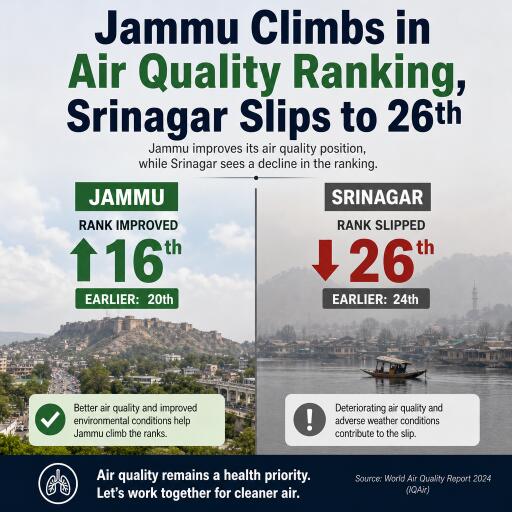
Jammu Climbs in Air Quality Ranking, Srinagar Slips to 26th
In the latest Swachh Vayu Sarvekshan 2026, Jammu has moved up the ladder among medium-sized Indian cities, while Srinagar has lost ground in the largest-city category. The annual assessment, run under the National Clean Air Programme by the Ministry of Environment, Forest and Climate Change, evaluates how cities are curbing pollution through targeted action rather than judging them solely on ambient air readings.
Jammu’s Steady Ascent
Jammu now ranks 20th among cities with populations between three and ten lakh, a notable improvement that continues a multi-year rise. Its composite score climbed to 176.5 in 2026, up from 168.2 in 2025 and 102.8 in 2023. Compared with 2023, Jammu has leapt 18 places, adding two more rungs just since last year. The trend points to sustained follow-through on city action plans, which the survey rewards when administrations document progress on curbing dust, smoke, and other emissions.
Srinagar’s Setback
By contrast, Srinagar’s position weakened among cities with more than ten lakh residents. The city posted a score of 162.6 in 2026, down from 169.2 in 2025 and 184.6 in 2023. Ranking-wise, Srinagar slipped from fourth in 2023 to 21st in 2025 and further to 26th this year. The reversal underscores how challenging it is for larger urban centers to sustain gains year after year—especially where rapid growth, construction cycles, traffic loads, and seasonal pollution spikes can erode progress if not matched by robust controls and public participation.
Ward-Level Recognition in Jammu
The 2026 assessment also singled out three municipal wards in Jammu for state-level recognition, reflecting local efforts that feed into the citywide performance:
- Greater Kailash, Ward 68 — Category-I
- New Plot, Ward 16 — Category-II
- Bhagwati Nagar, Ward 14 — Category-III
What the Survey Measures
The Swachh Vayu Sarvekshan is designed to evaluate the breadth and rigor of city actions to control pollution sources, alongside documented outcomes. Rather than ranking cities solely by ambient air concentrations, it gauges how well administrations execute components of their clean-air roadmaps. Key areas include:
- Prevention of biomass and municipal solid-waste burning
- Control of road dust through sweeping, greening, and surface maintenance
- Management of construction and demolition emissions
- Mitigation of vehicular and industrial pollution
- Public awareness and behavior-change initiatives
- Demonstrable improvement in particulate matter, including PM10
Cities are grouped by population to enable fair comparisons: Category-I (more than ten lakh residents), Category-II (three to ten lakh), and Category-III (fewer than three lakh).
Who Led the Tables in 2026
Among the largest cities, Lucknow led with a score of 198, followed by Indore at 197 and Jabalpur at 195. In the medium-sized bracket that includes Jammu, the top three were Rourkela, Firozabad, and Guntur, respectively. These results highlight a competitive field where multiple cities are advancing comprehensive measures—ranging from cleaner transport and industrial oversight to better dust management and public outreach.
Why These Movements Matter
Year-to-year shifts like Jammu’s climb and Srinagar’s slide reveal that clean air progress hinges on continuous implementation, not one-off projects. The survey’s emphasis on planning, enforcement, and citizen engagement pushes cities to institutionalize good practices—such as curbing open burning, tightening construction norms, and investing in cleaner mobility—while documenting verified improvements. For residents, these administrative scores translate, over time, into fewer pollution episodes and healthier neighborhoods, provided the momentum is sustained.
Jammu’s multi-year trajectory suggests a city aligning its programs with targeted outcomes. Srinagar’s decline, meanwhile, is a reminder that large urban centers must keep scaling and refining their interventions to match the evolving sources of pollution. As cities compare notes and replicate successful approaches, the broader aim of the National Clean Air Programme—durable, measurable reductions in pollution—comes into clearer reach.



Leave a Reply