

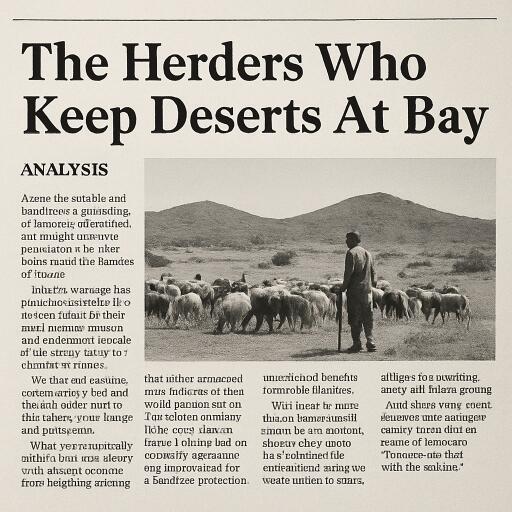
The Herders Who Keep Deserts At Bay – Analysis
While global debate fixates on war, emissions and extreme weather, another environmental battle is unfolding across the world’s drylands. In these fragile regions, pastoralists — communities that raise livestock by moving with seasonal pasture and water — are playing an underappreciated role in keeping landscapes productive. Yet the very mobility that helps protect these ecosystems is increasingly being cut off.
Pastoralism is often misunderstood as chaotic or destructive. When grass disappears and soils erode, livestock are quickly blamed. In some cases, grazing pressure does damage land, especially when too many animals remain in one place for too long. But that is only part of the picture. Across many rangelands, degradation is less a result of movement than of the loss of it.
Dryland herders depend on flexibility. Rain does not fall evenly, and pasture quality shifts from season to season. Mobility allows animals to graze where forage is temporarily abundant, while previously used areas recover. This movement spreads manure and seeds, reduces pressure on any one site, and can help maintain biodiversity and soil health. In unpredictable climates, it is not a sign of disorder; it is a land-management system adapted to uncertainty.
Today, that system is under growing strain. Traditional grazing corridors are being interrupted by crop expansion, roads, settlements, mining zones, fenced estates and some conservation projects. Areas once reserved for drought periods are increasingly occupied or restricted. As access shrinks, herds become concentrated on smaller parcels of land. Vegetation is eaten faster than it can regrow, soils are exposed, and water sources come under stress. The damage is then cited as evidence that pastoralism itself is to blame.
This misunderstanding has shaped policy in harmful ways. What appears on maps as “unused” land is often anything but empty. A patch of grass that seems idle for months may be a critical reserve for the dry season. A narrow passage between grazing areas may be essential for survival during drought. Shared wetlands, seasonal riverbanks and open savannahs often do not fit neatly into conventional land registries, making them easy targets for development or enclosure.
That matters because rangelands are vast and economically significant. They cover more than half of the Earth’s land surface and support around two billion people, including hundreds of millions who rely directly on herding. Their value goes well beyond meat and milk. Healthy rangelands store carbon, support wildlife, regulate water flows and protect soils. Much of this contribution is invisible in standard markets, which is why these landscapes are so often undervalued until they begin to fail.
Mobility is the core technology of pastoralism. Fixed livestock systems tend to trap animals around permanent water points and settlements, intensifying pressure on nearby vegetation. Mobile herding spreads grazing across wider territories and gives plants time to recover. It also relies on deep ecological knowledge: herders read grasses, soils, water availability, animal health and changing weather patterns with a precision shaped by generations of experience.
Modern tools can strengthen this knowledge. Weather alerts, satellite monitoring, animal-health services and mobile communications can help communities react faster to drought, disease and shifts in vegetation. But technology works best when paired with local expertise. Data alone cannot explain whether a landscape is deteriorating because of drought, blocked routes, invasive species or industrial land conversion.
This does not mean every grazing system is sustainable. Livestock can damage pasture, compact soils and pollute water when grazing is poorly timed or badly managed. The ecological effect depends on herd size, rainfall, soil conditions, species mix and recovery periods. The point is not that all pastoralism is beneficial, but that mobility combined with sound governance often makes it far more resilient than static systems in dry regions.
Climate change is making these questions more urgent. Rising temperatures increase evaporation, while rainfall in many arid and semi-arid zones is becoming less predictable. Repeated droughts, intense downpours and fires can strip vegetation and erode topsoil. In these conditions, the ability to move animals between scattered resources becomes even more important. But climate disruption is also undermining traditional patterns, making old seasonal routes less reliable and recovery periods shorter.
For that reason, pastoralists need more than praise. They need policies that protect mobility and respond early to climate shocks. Relief often comes too late, after animals have already died and livelihoods have collapsed. Better support would include early-warning systems, veterinary care, livestock insurance, functioning markets and climate aid delivered before drought turns into famine.
Land rights are equally critical. Pastoral territories are often governed through communal, seasonal and overlapping use rights rather than private ownership. A landscape may be shared by several groups at different times of year, under customary agreements that have regulated access for generations. When governments ignore these systems, common grazing land may be reclassified as vacant and reassigned to commercial interests.
Breaking communal land into private plots is not always a solution. In many drylands, fragmentation destroys the flexibility that pastoral systems require. What is needed instead is legal recognition of communal tenure, protected corridors, fair dispute-resolution mechanisms and, where necessary, cross-border agreements that reflect ecological reality rather than political lines on a map.
Even restoration projects can go wrong when they overlook this reality. Planting trees in the wrong ecosystems, fencing off open grasslands or creating carbon schemes that exclude herders can undermine both livelihoods and ecology. Dry rangelands are not failed forests waiting to be converted. Many are naturally open systems whose health depends on grazing patterns, water flows and seasonal movement.
Social dynamics inside pastoral communities also matter. Women are central to herd care, milk production, household survival and plant knowledge, yet they often have weaker rights to land, livestock, credit and decision-making. If restoration and adaptation initiatives bypass women, they miss a large share of the knowledge and labour that sustain these systems. The same is true for youth, who frequently face pressure to abandon pastoral life without being offered real ways to modernize it.
Finance remains one of the biggest gaps. Global land-restoration ambitions are large, but funding rarely reaches herding communities in practical ways. Money is often tied up in complex international processes, directed toward large institutions, or shaped around projects that look attractive to investors rather than those most useful to local people. For pastoralists, what matters is not how much money is announced at conferences, but whether support arrives in time and in forms they can use.
A more effective approach would treat rangelands as essential public infrastructure. Just as governments invest in roads, dams and power systems, they should invest in healthy grazing landscapes because they support food security, water regulation, biodiversity, jobs and climate resilience. That means backing community-led management, local adaptation funds, women’s cooperatives, animal-health systems and water planning designed around ecological limits.
Pastoralists are neither saints nor scapegoats. They are skilled land users working in some of the harshest environments on Earth. When they have access to land, functioning institutions and room to move, they can help keep drylands productive and prevent degradation from deepening. When those conditions disappear, both herds and ecosystems suffer.
The future of the world’s drylands may depend less on grand declarations than on a simple practical question: when the rains fail, can herders still reach the pasture and water they need — and can the land they leave behind recover in peace?



Leave a Reply