

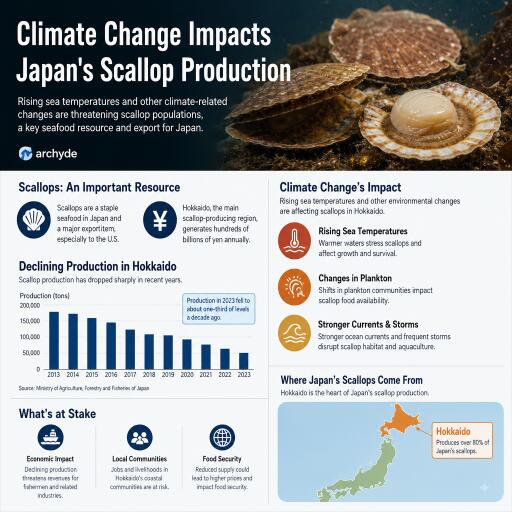
Climate Change Impacts Japan’s Scallop Production – Archyde
Unusually warm seas around Hokkaido are pushing Japan’s prized scallop industry into crisis. Prolonged marine heatwaves have triggered mass die-offs in key growing areas, slashing harvests, lifting prices, and reshaping trade flows. What began as a localized biological shock is now a full-spectrum supply chain challenge—from hatcheries and coastal cooperatives to processors, exporters, and high-end dining rooms abroad.
Key takeaways
- Severe supply squeeze: Large-scale mortality in bays and coastal farms is shrinking output and pushing wholesale prices higher.
- Export recalibration: Trade friction with major buyers, coupled with lower production, is redirecting product toward domestic and alternative Asian markets—and, where feasible, to Western buyers.
- Rising operational risk: Growers face new costs for monitoring, deeper-water gear, and farm relocation to escape heat stress.
Heat stress undermines a cold-water icon
Japan’s yesso scallop thrives in cold, nutrient-rich waters. That ecological contract is breaking down. Persistent summer temperatures above roughly 20°C in northern coastal zones can be lethal for this species, and recent seasons have delivered exactly that: longer, hotter spells that leave juveniles and adults weakened and vulnerable. Warmer, more stratified water holds less oxygen, alters plankton communities, and can intensify harmful algal blooms—an array of stressors that compound mortality events.
In places like Uchiura Bay, growers report catastrophic losses that echo a broader pattern across Hokkaido’s nearshore aquaculture sites. Even farms that escaped the worst die-offs face stunted growth and reduced meat quality. Because scallops are cultivated on multi-year cycles, a single bad season can leave a “missing cohort” that suppresses landings for years, not months. The signal is clear: these are no longer one-off anomalies but symptoms of a warming trend reshaping the Sea of Japan and the North Pacific rim.
Economic shock along the value chain
When biology falters, balance sheets follow. Processors dependent on steady inflows from northern Japan are now paying more for fewer scallops, while absorbing higher energy and logistics costs. Inventories are tighter, contract fulfillment is harder, and margins are squeezed. Small cooperatives—the backbone of the fishery—are especially exposed. Operating on thin margins and with limited access to hedging or credit, many face difficult choices: invest in new technology, consolidate with larger players, or scale back production.
For coastal communities, the stakes extend beyond spreadsheets. Scallops anchor local employment, fuel ancillary businesses, and support regional brands. As mortality events repeat, banks and insurers reassess risk, potentially hiking premiums or tightening lending standards. The result is a feedback loop in which ecological volatility begets financial volatility.
Trade routes and menu changes
Historically, Japan has been a heavyweight in the premium scallop trade. That position is now complicated by two forces: climate-driven scarcity and geopolitical friction with top importers. With fewer scallops to sell and some traditional markets constrained, exporters are pivoting. Domestic buyers and Southeast Asian customers are taking a larger share, while firms with robust cold-chain capacity are probing opportunities in North America and Europe.
But distance carries a cost. Frozen handling, air freight, and specialized packaging can erode gains from higher prices. Downstream, chefs are adapting—substituting local shellfish, shrinking portion sizes, or rotating scallops into seasonal specials rather than year-round staples. For consumers, the net effect is fewer Japanese scallops on offer and more frequent price swings.
Adaptation is possible—but costly
Producers are not standing still. A new playbook is emerging, one that treats heat as an operational hazard rather than a rare shock:
- Deeper-water cultivation: Moving longlines and lantern nets into cooler, more stable layers to buffer temperature spikes.
- Real-time monitoring: Deploying sensors and ocean forecasting tools to anticipate heatwaves and time stocking or harvest windows.
- Selective breeding and husbandry: Sourcing hardier broodstock, adjusting stocking densities, and refining feed strategies to reduce stress.
- Farm relocation and diversification: Shifting sites toward cooler currents, experimenting with polyculture, and integrating seaweed to improve habitat and water quality.
- Cold-chain upgrades: Investing in rapid chilling and handling to preserve quality when harvests are uneven or transport distances increase.
These measures can cut losses, but they demand capital and coordination. For smaller operators, public support, cooperative investment, or strategic partnerships may be crucial to bridge the transition.
The road ahead
Volatility is poised to define Japan’s scallop sector for the near term. Even if a cooler season offers temporary relief, the longer climate trajectory points to more frequent marine heatwaves and shifting currents—conditions that favor proactive adaptation over business as usual. Industry guidance is already changing, with firms emphasizing climate-adjusted production targets and tighter risk management. Analysts expect a persistent “risk premium” to shadow seafood businesses tied to heat-sensitive species in warming hotspots.
Still, there is a viable path forward. Success will likely hinge on three levers: accelerating climate-smart farming, rebalancing export portfolios to match new logistics realities, and sustaining coastal communities through targeted finance and policy support. If those pieces come together, Japan can preserve a hallmark of its seafood heritage—even as the ocean it depends on continues to change.



Leave a Reply