

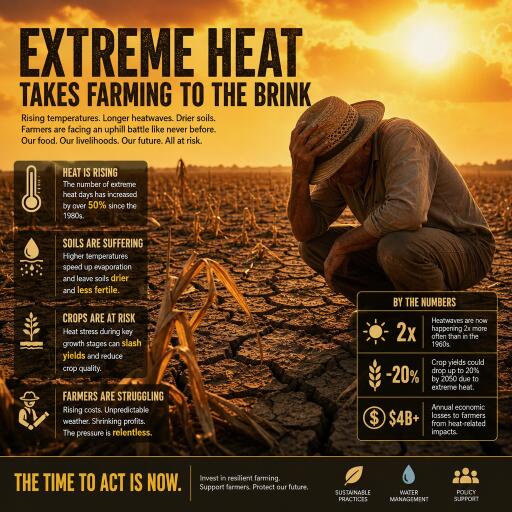
Extreme Heat Takes Farming to the Brink
A decade after the world pledged deep emissions cuts, the reality is starkly different: heat-trapping pollution has continued to climb, and with it, the temperatures that drive crop failures, livestock losses, and eroding food security. Atmospheric carbon dioxide reached a record of roughly 432 ppm by May 2026. Instead of easing the planetary fever, humanity has stoked it—pushing agriculture toward a dangerous edge.
Farmers, unlike factories, cannot relocate. Fields are rooted in place, bound to local soils, seasons, and water. As extreme heat tightens its grip, those constraints are turning into existential risks for the world’s food supply.
Heat as a Risk Multiplier
Most staple crops begin to falter above about 30°C (86°F). Once temperatures consistently breach that threshold, pollination can fail, plant tissues weaken, and yields slide. Heat-stressed livestock—especially pigs and poultry—struggle to regulate body temperature, with reduced growth, lower fertility, and heightened mortality. What was once an occasional shock is fast becoming the new baseline.
The oceans, which supply a fifth of global animal protein, are suffering parallel stress. Warmer waters hold less oxygen, leaving marine life gasping. Intense marine heatwaves—some lasting well over a year—have triggered mass fish kills and coral bleaching across multiple basins, undermining coastal fisheries and aquaculture.
On land, the heat is also eroding human labor capacity. In some of the hottest parts of South Asia, sub-Saharan Africa, and Latin America, “too-hot-to-work” days are projected to climb steeply, in some locales approaching hundreds of days per year by mid-century. Fewer safe hours in the field mean delayed planting, missed harvest windows, and higher costs just to protect workers.
Europe’s Warning Shot
Early-summer heat across western Europe recently delivered a jarring preview. In France—an agricultural powerhouse—scorching temperatures baked soils and torched canopies. Preliminary tallies pointed to steep losses: a large share of corn damaged, about half of carrot production affected, significant hits to hops and orchards, and mass poultry deaths from heat stress. Heat waves pushed daytime highs into the 40°C range and kept nights warm, compounding stress over a punishing two-week stretch. Even hardy crops stalled as soils dried and leaves scorched on the branch.
A Global Squeeze
From India’s grain belts to Australia’s wheat regions, and across rice fields in Southeast Asia and palm oil estates in the tropics, hot, dry spells have already thinned yields and discouraged new planting. El Niño conditions have sharpened the edge of drought and heat, arriving on top of high input costs tied to recent geopolitical turmoil. When fertilizer and diesel are scarce or expensive, farmers plant less and gamble more on marginal rains.
These shocks land atop a broader vulnerability: roughly half of the world’s ice-free land supports human food and feed. As droughts, floods, and wildfires intensify, past performance is no longer a reliable guide to future harvests. At the same time, global crop losses to pests and diseases have climbed over recent decades—from about a quarter of production to nearer two-fifths—nudged upward by warmer winters, shifting ranges of insects and pathogens, and stressed plants that are easier targets.
Signals We Can’t Ignore
- In 2016, unusually warm seas around southern South America fueled massive algal blooms that killed an estimated 100,000 metric tons of farmed salmon and trout—one of the largest aquaculture die-offs on record.
- During the brutal 2021 Pacific Northwest heat dome, entire raspberry and blackberry crops were lost in some areas, Christmas tree farms saw dramatic losses, and the mix of extreme heat, dry vegetation, and wind supercharged wildfire area burned across North America.
- After a record heat wave in 2022, several Indian states reported wheat yields dropping by roughly 9–34%, milk output down as much as 15% due to heat-stressed dairy herds, and sharp declines in some cool-season vegetables.
- In parts of Central Asia, an exceptionally warm spring contributed to locust outbreaks and poor cereal harvests, underscoring how heat can ripple through ecosystems and food systems alike.
The Food–Fuel Trap
Modern agriculture is astonishingly productive—but it is also energy-hungry. Nitrogen fertilizers, pesticides, irrigation pumps, tractors, refrigeration, and long-haul transport all lean heavily on fossil fuels. In many cases, the energy embedded in our food—measured in fossil-fuel calories—exceeds the nutritional calories we eat, especially for meat and highly processed foods. For some products, several units of fossil energy are required to deliver a single unit of dietary energy. On a heating planet, that dependency is a liability.
Despite rapid growth in wind and solar power, fossil fuels still supply roughly four-fifths of total global energy across electricity, transport, heating, and industry—a proportion that has shifted only modestly in decades. Swapping coal and gas for renewables on the grid is essential, but extreme heat will not relent unless total fossil fuel combustion falls decisively and quickly across the entire energy system.
What It Will Take
Heat-resilient farming is possible, but it demands speed and scale:
- Shift planting calendars, adopt heat- and drought-tolerant crop varieties, and diversify rotations to spread risk.
- Invest in soil moisture management—cover crops, mulches, reduced tillage, composts—to cool fields and hold water longer.
- Expand shade, windbreaks, and agroforestry to buffer heat for both crops and livestock; upgrade cooling, water access, and ventilation in animal facilities.
- Secure water through on-farm harvesting, efficient irrigation (drip, scheduling), and watershed restoration that slows, stores, and recharges flows.
- Protect farmworkers with heat safety plans: rest–water–shade protocols, early/late shifts, and real-time alerts.
- Strengthen early-warning systems for heatwaves, drought, pests, and disease; pre-position insurance and safety nets to speed recovery.
- Cut loss and waste along cold chains; localize and shorten supply routes where feasible.
- Accelerate clean energy for pumps, cold storage, and machinery; develop low-carbon fertilizers and precision application to curb nitrous oxide.
Above all, the fastest relief from escalating heat will come from slashing fossil fuel use. Every tenth of a degree matters for a wheat head filling in June, a pregnant sow in July, or a coral reef in August. The heat is here. Whether it becomes unmanageable will depend on how fast we cool the system that feeds us.



Leave a Reply