

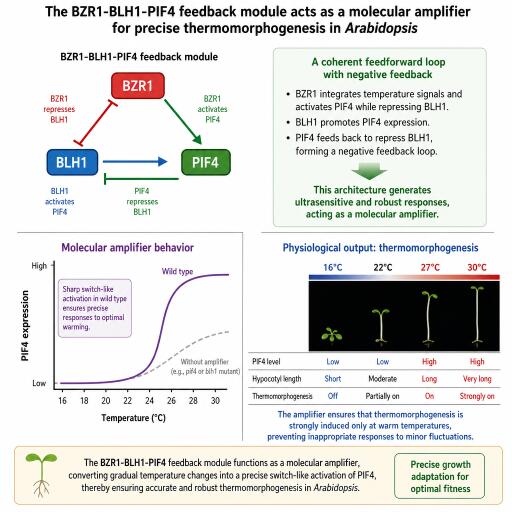
The BZR1-BLH1-PIF4 feedback module acts as a molecular amplifier for precise thermomorphogenesis in Arabidopsis
As heatwaves grow more frequent and intense, plants must rapidly adjust their form to keep cool and continue growing. In Arabidopsis, this heat-induced reshaping—thermomorphogenesis—relies on a finely tuned network of growth signals. New findings reveal a central “amplifier–brake” system that calibrates these responses with remarkable precision: a feedback module formed by the growth regulator BZR1, the homeodomain factor BLH1, and the light- and temperature-responsive hub PIF4.
Why plant shape-shifting under heat matters
Warm conditions trigger changes such as longer stems and more open leaf angles, which can help plants dissipate heat and reduce water loss. But pushing these changes too far can sap resources, weaken stems, and compromise yields. The challenge is balance—mount a swift response to elevated temperature without overshooting. The newly characterized BZR1–BLH1–PIF4 circuit appears to provide that balance by amplifying beneficial signals while preventing runaway growth.
A surprising brake on heat-driven growth
The study spotlights BLH1 (a BEL1-like homeodomain transcription factor) as a key negative regulator of thermomorphogenesis. When BLH1 or its close relatives are overexpressed, plants become largely unresponsive to high temperatures, resisting the typical heat-triggered elongation. Conversely, plants lacking multiple BLH genes show exaggerated sensitivity to warmth, elongating more than normal. This positions BLH1 as a powerful brake on heat-induced morphological change.
Direct control over PIF4 at two levels
PIF4 is a master switch for growth responses to warmth and light. BLH1 reins in PIF4 in two complementary ways:
- Transcriptional repression: BLH1 binds directly to the promoter region of the PIF4 gene, dialing down its expression.
- Protein activity inhibition: BLH1 physically interacts with the PIF4 protein, limiting its ability to activate growth programs.
These dual mechanisms allow BLH1 to reduce both the supply of PIF4 and the potency of any PIF4 that is present, delivering robust restraint when conditions would otherwise drive strong elongation.
BZR1 sets the sensitivity, heat sets the context
BZR1, a central player in brassinosteroid signaling, directly represses BLH1. Elevated temperatures further reduce BLH1 expression. Together, these inputs lower the brake at warm temperatures, enabling PIF4 and downstream growth pathways to respond. When BLH1 is experimentally overexpressed, it can override this heat-primed state—suppressing the elongated hypocotyl phenotype even in plants with hyperactive BZR1 (bzr1-1D) or excessive PIF4. That rescue underscores BLH1’s leverage in the network and its capacity to veto overgrowth.
The amplifier explained: a tuned feedback loop
At the heart of this system is a positive feedback motif: BZR1 and PIF4 jointly amplify growth signals via auxin and brassinosteroids, which in turn feed back to sustain BZR1 activity. Such loops are powerful—they can rapidly boost small signals—but they are also prone to overshoot. BLH1 integrates into this loop as a counterweight, forming a BZR1–BLH1–PIF4 axis that sets the gain on the amplifier:
- Heat activates the BZR1–PIF4 growth program.
- BZR1 represses BLH1, relieving inhibition on PIF4.
- BLH1 pushes back by silencing PIF4 transcription and dampening PIF4 activity.
The result is a calibrated response: sufficient growth to adapt to warmth without tipping into detrimental elongation.
Implications for climate-resilient crops
As agricultural regions face rising temperatures, the ability to fine-tune thermomorphogenesis could prove crucial. Overly strong elongation can lead to lodging, inefficient resource use, and reduced reproductive success. Modulating BLH1 or its crop homologs offers a promising route to “dial in” the right amount of heat-induced reshaping. Strategies might include tissue-specific or temperature-inducible control of BLH-like genes to preserve adaptability while protecting yield and structural integrity.
How the case was built
The conclusions rest on a suite of genetic and molecular approaches: overexpression and higher-order mutant analyses that revealed BLH1’s role in heat sensitivity; promoter-binding assays confirming direct repression of PIF4; and protein–protein interaction experiments showing BLH1’s inhibition of PIF4 activity. Phenotypic rescue in genotypes with elevated BZR1 or PIF4 further demonstrated BLH1’s capacity to override pro-growth signals under warm conditions.
The take-home message
Thermomorphogenesis is not just an on–off switch—it’s a precision system. The BZR1–BLH1–PIF4 feedback module operates as a molecular amplifier with built-in gain control, empowering Arabidopsis to respond to heat swiftly yet sensibly. By defining BLH1’s central role as a brake within a powerful pro-growth loop, this work provides a roadmap for engineering climate-smart plants that remain productive as temperatures climb.



Leave a Reply