

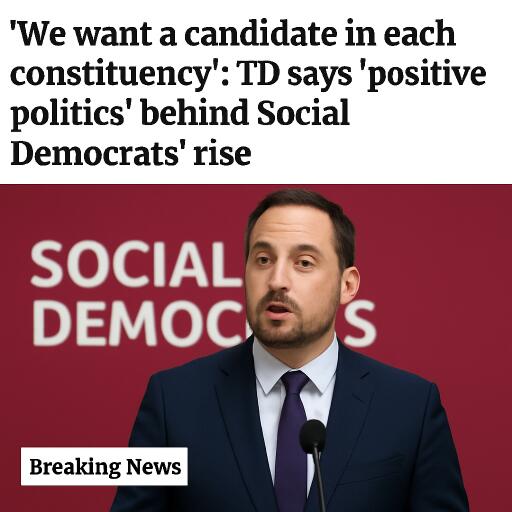
‘We want a candidate in each constituency’: TD says ‘positive politics’ behind Social Democrats’ rise | BreakingNews
After a decisive byelection gain in Dublin Central and a strong showing in recent opinion polling, the Social Democrats say they will put a name on the ballot in every constituency at the next general election—pitching a platform of “positive politics,” stronger public services and faster delivery of affordable renewable energy.
The party’s momentum was underlined by Daniel Ennis taking a seat in Dublin Central, lifting the number of sitting TDs to 12. A recent national survey placed the party in the low double digits, within touching distance of one of the country’s traditional heavyweights, while Holly Cairns continues to register high personal approval.
Nationwide slate aims to give every voter a choice
Party TD Jennifer Whitmore said many voters have told canvassers they would consider backing the Social Democrats if a candidate was on their local ballot. With that in mind, she said, the party intends to field contenders in every constituency to meet that demand and convert interest into votes when the country next goes to the polls.
Whitmore, first elected in 2020 and re-elected this year, believes the party can draw support from disenchanted voters across the spectrum—those moving away from Fianna Fáil and Fine Gael as well as some who had previously gravitated to Sinn Féin. She frames the pitch as a practical, solutions-first approach that resists the pull of personality politics and internal party wrangling.
“Positive politics” and holding the centre-left line
Whitmore argues that the party’s growth reflects a hunger for constructive, values-driven politics. She says the party’s core principles have not shifted even as debates grow more combative and some rivals tack right. Voters, she contends, want a steady hand and clarity about what a party stands for—delivering on services and focusing on outcomes rather than blame.
Services, not scapegoats
Addressing tensions around migration, Whitmore says the anger surfacing in communities is rooted less in who is arriving than in what is missing—GP access, timely assessments for children, disability supports, reliable public transport, and other basics that a wealthy state should be able to provide. She argues that the shortfall in delivery has created space for bad-faith actors to stoke division, and that the proper response is to fix services rather than target people who are often filling critical roles in health care and childcare.
With household budgets under strain, she says the party’s focus is on pushing for immediate, practical measures that ease the cost of living for families and small businesses, while keeping a long-term eye on system-wide improvements.
Internal unity and a smoother handover
Whitmore highlights the party’s relative cohesion. When the previous co-leaders stepped back in 2023, there was no public contest, and the handover during Holly Cairns’ maternity leave to deputy leader Cian O’Callaghan was described as seamless. She portrays that stability as an asset for a party that wants to project competence and teamwork over personality drama.
Climate, energy and biodiversity: from penalties to benefits
As the party’s spokesperson on climate, energy and biodiversity, Whitmore says she is concerned by what she sees as a recent slowing or reversal of climate measures. She argues that policy was previously framed as punitive instead of empowering, which undermined public support. Done well, she says, climate action is about warmer homes, cheaper power and cleaner air—benefits people can feel as well as see on their bills.
With energy and food costs still biting, she calls for a sharper focus on accelerating affordable renewables, grid upgrades, and home energy improvements that cut demand and costs. In her view, the fastest route to cost relief and emissions cuts is to scale up clean generation and ensure ordinary households can access it without prohibitive upfront costs.
Coalition arithmetic and a bigger footprint
On the question of government formation, Whitmore says the party’s preference is for a left-leaning coalition that prioritises public services and climate ambition, but that they will talk to all parties after the election. The aim, she adds, is to enter any negotiations as a larger force with a clear mandate.
Ultimately, Whitmore boils the appeal down to tone and outcomes: voters are weary of rancour, want to know problems can be fixed, and are looking for a party willing to fight for workable solutions. The Social Democrats, she argues, intend to be on every ballot to make that choice available to all.



Leave a Reply