

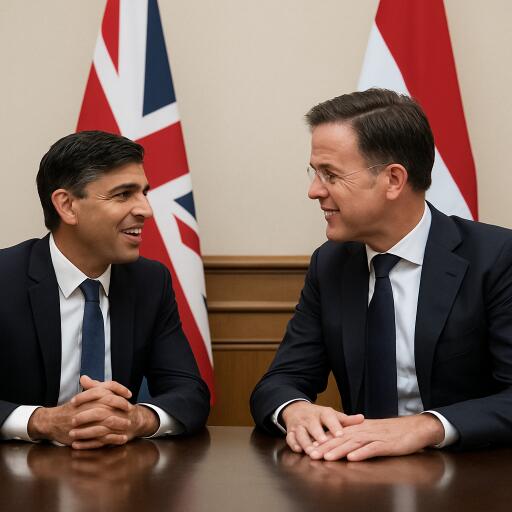
PM holds official talks with Prime Minister of Netherlands
In The Hague’s historic Catshuis, Prime Minister Narendra Modi and Dutch Prime Minister Rob Jetten advanced a sweeping agenda that reframes India–Netherlands ties for a climate-stressed century. The two leaders agreed to elevate their engagement to a Strategic Partnership and endorsed a comprehensive roadmap spanning trade and investment, critical and emerging technologies, maritime cooperation, renewable energy, and education—anchored by a strong emphasis on water, agriculture, and health.
At the heart of the talks was water security. With both nations grappling with rising seas, erratic rainfall, and urban flood risks, the leaders committed to intensifying collaboration on large-scale water projects. Priorities include delta management, river basin restoration, flood resilience, drought-proofing, and wastewater reuse—areas where Dutch engineering depth can complement India’s nationwide urban and rural water missions. The agenda links water stewardship with agriculture and health, aiming to improve food safety, reduce pollution loads, and advance a “one-water” approach to public well-being.
Clean energy and maritime decarbonization formed another major pillar. The two sides outlined cooperation on green hydrogen and its derivatives, sustainable biofuels, and green shipping, including cleaner ports and low-carbon maritime logistics. With the Netherlands a global leader in offshore wind and port innovation, and India rapidly scaling solar, wind, and green hydrogen capacity, the partnership seeks to build shared standards, pilot corridors, and bankable projects that can cut emissions while spurring green jobs.
To secure the materials needed for the energy transition, the leaders affirmed plans to deepen cooperation on critical minerals and resilient, transparent supply chains. They also reviewed prospects for advancing an India–EU trade agreement, noting its potential to unlock investment and innovation while aligning sustainability standards across markets.
On technology, both governments spotlighted joint work in artificial intelligence and semiconductors—fields that increasingly underpin climate modeling, smart grids, precision agriculture, and port logistics. They encouraged youth-led innovation through binational hackathons, aiming to seed climate-tech solutions from early-stage ideas to commercial prototypes. The intent is clear: pair digital infrastructure with ecological intelligence to accelerate a just transition.
Education and mobility featured prominently, reflecting the talent demands of a low-carbon economy. The leaders backed deeper academic exchanges, smoother mobility pathways, and collaborative research. A new agreement between Nalanda University and the University of Groningen was highlighted as a marker for co-created curricula, dual degrees, and joint labs focused on sustainability, heritage studies, and future-ready engineering.
The talks also celebrated cultural stewardship. Prime Minister Modi thanked the Dutch government for facilitating the return of 11th‑century Chola copper plates—artefacts that enrich the shared historical tapestry between the two nations. Collaboration between the Leiden University Library and the Archaeological Survey of India will help conserve and study these materials, fusing scholarship with public access and cultural renewal.
Fourteen agreements and memoranda of understanding were concluded across technology, green energy, trade, mobility, water–agriculture–health programs, education, and culture. A joint statement and a detailed roadmap for the Strategic Partnership were adopted to translate commitments into measurable action, milestones, and financing pathways.
Beyond official protocol, the meeting underscored converging climate realities. The Netherlands’ low-lying polders and India’s vast coastal and riverine systems face similar threats—from storm surges to salinity intrusion—while also holding immense potential for blue economy innovation. The new partnership envisions shared learning on nature-based solutions like wetlands restoration, adaptive urban design, and circular water economies that reclaim, recycle, and recharge at scale.
The leaders agreed to further engage on green corridors for shipping, advanced biofuels for hard-to-abate sectors, and port electrification, with a focus on creating replicable models for emerging markets. Parallel efforts aim to align standards for green hydrogen production and certification, fostering trade and investment while avoiding fragmented markets.
As a practical next step, Prime Minister Modi invited Prime Minister Jetten to visit India, an invitation that was accepted. The visit is expected to catalyze pilot projects, industry partnerships, and academic exchanges that link labs, ports, farms, and cities.
India and the Netherlands have long built on shared democratic values and a tradition of ingenuity. With this upgrade to a Strategic Partnership, they are betting on a future where clean energy, resilient water systems, and open innovation drive prosperity—grounded in the recognition that ecological stability is now the bedrock of economic security.



Leave a Reply