

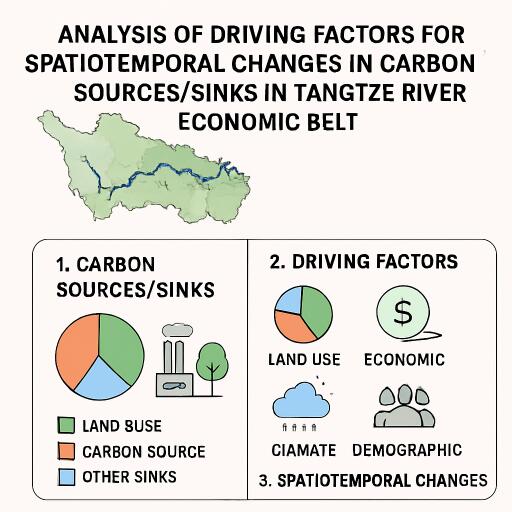
Analysis of Driving Factors for Spatiotemporal Changes in Carbon Sources/Sinks in Yangtze River Economic Belt – Urban Informatics
Climate change and the steady rise of greenhouse gases have pushed carbon management to the center of environmental policy and scientific research. In China, the long-term objectives of peaking carbon emissions and achieving carbon neutrality have intensified interest in how land ecosystems absorb and release carbon. This is especially important in the Yangtze River Economic Belt, a vast and strategically important region where rapid urbanization, industrial activity, and ecological restoration are unfolding at the same time.
Terrestrial ecosystems are a major part of the carbon cycle. Through photosynthesis, vegetation removes carbon dioxide from the atmosphere and stores it in plant tissues. At the same time, carbon is returned to the air through plant respiration, soil processes, and microbial decomposition. The balance between these inputs and outputs determines whether an area acts as a carbon sink, absorbing more carbon than it emits, or as a carbon source, releasing more than it stores.
Several indicators are commonly used to measure this balance. Gross primary production reflects the total amount of carbon captured by plants through photosynthesis. Net primary production adjusts that figure by subtracting the carbon used by plants for their own respiration. Net ecosystem production goes further by accounting for both plant respiration and the respiration of soil organisms. Because of this, net ecosystem production is one of the most useful indicators for judging an ecosystem’s real carbon sequestration capacity.
Recent advances in remote sensing have transformed the way researchers estimate carbon budgets across large areas and over long periods. Satellite observations now make it possible to track vegetation growth, leaf area, absorbed solar radiation, and environmental conditions with much greater consistency than traditional field-only approaches. These data can be combined with ecological models to simulate how much carbon is being fixed and how much is being released.
Among the best-known approaches are light-use efficiency models, which estimate plant productivity by linking absorbed sunlight to photosynthetic performance. Another widely used framework is the CASA model, which is often applied to estimate regional net primary production using satellite and climate inputs. Together with meteorological information and soil respiration modeling, these tools provide a stronger basis for evaluating ecosystem carbon dynamics over space and time.
In the Yangtze River Economic Belt, this type of analysis is particularly valuable. The region includes densely populated cities, intensive agricultural land, mountain ecosystems, forests, wetlands, and major transportation corridors. That mix of natural and human systems makes carbon behavior highly uneven from place to place. Some landscapes may be strengthening their sink function because of forest recovery or improved vegetation cover, while others may be losing carbon storage capacity due to land conversion, heat stress, or changing precipitation patterns.
Climate is one of the most influential drivers behind these changes. Temperature affects plant growth, respiration rates, and soil microbial activity. Precipitation influences water availability, photosynthesis, and the decomposition of organic matter. Their effects are rarely uniform. In some areas, warmer conditions may lengthen the growing season and increase carbon uptake. In others, excessive heat or drought may reduce vegetation productivity and intensify carbon release. This spatial heterogeneity is why broad regional averages often hide important local differences.
Topography and land use also shape the carbon balance. Elevation, slope, and terrain influence moisture retention, soil formation, vegetation type, and exposure to climatic stress. Human activities such as urban expansion, agriculture, ecological engineering, and infrastructure development can dramatically alter the capacity of landscapes to function as carbon sinks. In a policy-sensitive region like the Yangtze River Economic Belt, these pressures and interventions often overlap, making it necessary to examine multiple factors together rather than in isolation.
A growing challenge in carbon research is that many studies identify drivers of ecosystem productivity but stop short of fully measuring how these drivers interact. Understanding whether climate, terrain, or human activity is dominant in one place is useful, but the real picture is often shaped by combinations of forces. For example, the impact of rainfall may depend on land cover, while the effect of temperature may vary with elevation or urban intensity. Without quantifying these interactions, it is difficult to design effective ecological policies.
To address this gap, the proposed analysis focuses on vegetation net ecosystem production in the Yangtze River Economic Belt from 2001 to 2023. By integrating remote sensing datasets with soil microbial respiration modeling, the study aims to estimate the region’s changing carbon sink and source patterns over more than two decades. This long time span is important because it captures not only short-term environmental fluctuations, but also the cumulative effects of development, restoration programs, and climate variability.
The study also examines the mechanisms behind these shifts using Geodetector, a spatial analysis tool designed to identify the explanatory power of different variables and their interactions. This method can help reveal which factors most strongly influence carbon source-sink patterns, where those effects are concentrated, and how combinations of drivers produce distinct outcomes across the region.
The broader significance of this work lies in its policy relevance. A clearer picture of where carbon sinks are strengthening or weakening can support ecological restoration planning, vegetation management, and land-use regulation. It can also help decision-makers target interventions more precisely, whether by protecting high-value carbon sink areas, improving degraded ecosystems, or adapting regional strategies to changing climate conditions.
As pressure grows to align economic development with environmental resilience, understanding the spatiotemporal behavior of carbon in the Yangtze River Economic Belt is no longer just a scientific exercise. It is a practical requirement for building credible sustainability strategies in one of China’s most dynamic regions.



Leave a Reply