

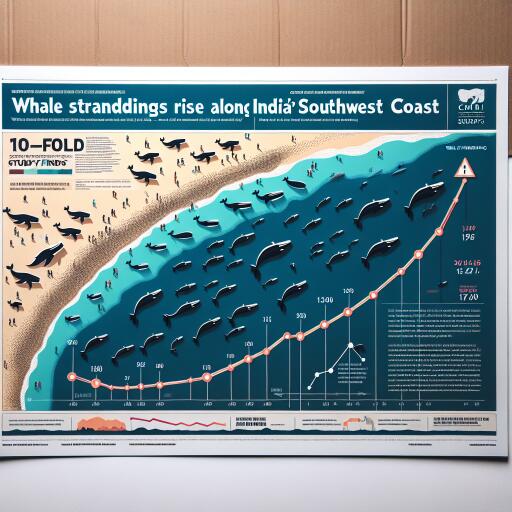
Whale Strandings Rise 10-fold Along India’s Southwest Coast, CMFRI Study Finds
In an alarming revelation, researchers have identified a significant increase in whale strandings along the southwest coast of India, accentuating the critical need for tailored conservation efforts amidst the challenges of climate change.
Analyzing data from a period stretching between 2004 and 2023, the study noticed that the incidence of whale strandings rose remarkably from a modest 0.3% between 2003 and 2013 to a concerning 3% in the subsequent decade (2014-2023). This sharp escalation has been linked to transformations in ocean ecosystems, environmental disturbances, and human-induced pressures.
The coastal regions of Kerala, Karnataka, and Goa have emerged as focal areas where most strandings have been documented. Factors such as busy vessel activity, aggressive fishing practices, environmental changes, and shallow coastal areas have been identified as major contributors. The burgeoning awareness among the public and increased citizen reporting through social media has led to a surge in detection and documentation of these incidents.
These endangered marine mammals face several threats, including noise pollution, vessel collisions, and the degradation of their natural habitats. Among the affected species, the Bryde’s whale has been most frequently observed, with occasional occurrences involving blue whales. Genetic analyses conducted during the study identified two distinct forms of Bryde’s whales present in the Indian waters.
The year 2023 alone witnessed nine such occurrences, primarily between the months of August and November, marking it as a peak period in recent times. The study highlighted a notable correlation between whale strandings and chlorophyll-a concentration, a key indicator of oceanic productivity during the southwest monsoon season. The upsurge in nutrient levels during this time fosters plankton and fish populations, which in turn, draws whales closer to the shore. However, increasing sea surface temperatures and strong currents have led to disruptions in marine ecosystems, resulting in more frequent stranding incidents.
To tackle this rising challenge, researchers underline the necessity of developing forecasting models utilizing satellite data like chlorophyll levels, wind patterns, and sea surface temperatures to predict strandings and facilitate anticipatory conservation measures.
An advocate for tailored conservation efforts highlighted the urgency for specific strategies to combat this marine biodiversity threat in one of India’s most resource-rich oceanic territories.
The study recommends implementing real-time alert systems and promoting conservation networks for marine megafauna. It calls for comprehensive training programs for fishers and government officials and urges the empowerment of citizen science platforms to enhance monitoring and response mechanisms.



Leave a Reply