

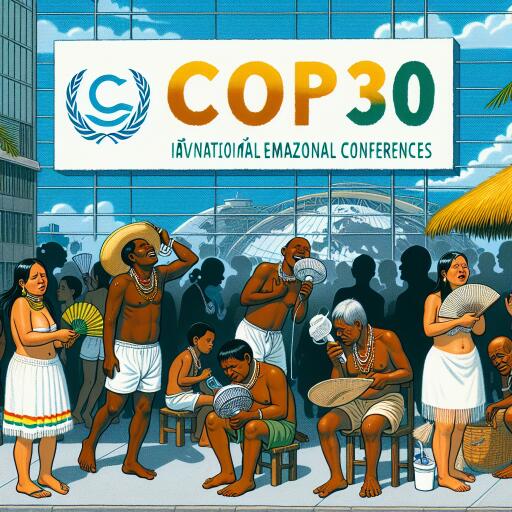
As COP30 opens, urban Amazon residents swelter
As negotiators converge on Belém for COP30, just a few kilometres from the summit halls, families in riverside neighbourhoods are battling relentless heat with little relief. In Vila da Barca, where wooden homes perch on stilts over tidal flats, a mother and child take turns slipping into a large plastic tub of water to cool their skin as midday temperatures press down like a lid.
The contrast is jarring: beyond the city’s edge, the rainforest canopy casts deep shade; inside Belém’s dense settlements, exposed walkways and cramped rooms amplify the sun. Residents say the heat now arrives earlier and stays longer. “By nine in the morning it’s already hard to breathe,” said Rosineide Santos, who has watched the climate shift over two decades in the community.
Belém’s name may evoke greenery and rivers, but life here is overwhelmingly urban. Across Brazil’s share of the Amazon, the majority of roughly 27 million inhabitants live in cities. In Belém, many crowd into working-class settlements where homes are close-packed, often built with thin walls and metal roofs that trap heat. Vila da Barca, founded by fishing families about a century ago, sits beside one of the city’s wealthiest districts, a daily reminder of the city’s stark inequalities. Around 7,000 people live in the favela, many of them Black or mixed-race, and many facing poverty.
The run-up to COP30 unleashed a wave of public works across Belém—new roads, facelifts for central squares, a rush to make the city showcase-ready. In Vila da Barca, those investments at first felt like a missed promise. Residents were angered by plans to site a sewage pumping station in their neighbourhood to serve a richer area nearby, while their own homes on stilts continued to discharge wastewater untreated. Community organizers pushed back, demanding that infrastructure serve the people living on the margins too.
After months of tense meetings, that effort yielded concrete commitments: a sewage network designed to connect the stilt houses and, crucially, a stable water supply. Until recently, many families had to purchase jugs of water to wash produce or bathe—an unthinkable expense during heatwaves. “You cannot ask people to endure these temperatures without clean water flowing at the tap,” one community leader said.
The science underscores what people feel on their skin. Between 1970 and 2023, Belém’s maximum temperatures climbed by nearly 2 degrees Celsius, according to researchers in Pará state—enough to elevate the risk of heat waves, strain healthcare systems, and stress infrastructure such as water and power networks. In low-lying settlements, the urban heat island effect layers onto flood exposure: trees are scarce, ventilation is poor, and tin roofs radiate heat late into the night.
State officials acknowledge the dilemma. The Amazon’s global climate role has long centred on forest protection, but the region’s cities face their own emergency. The challenge, they argue, is to match commitments to keep the forest standing with investments that make urban life safer and healthier—shade, water, sanitation, drainage, and housing fit for a warming climate.
For older residents, the stakes are tangible. Standing on a wobbling walkway, retiree Elizabeth Campos Serra says she dreams of trading her stilt house for a small place on firm ground. During the hottest months, the rooms feel airless; in heavy rains, the water rises beneath the floorboards. “I want a home that doesn’t flood and a place to plant a tree,” she said.
Urban adaptation in the Amazon is not a distant agenda item—it is a daily survival plan. Public health experts warn of compounding risks: heat stress, dehydration, water-borne disease, and the financial burden of buying water and cooling. Urban planners point to immediate fixes that dovetail with long-term resilience: public shade structures and trees, reflective or green roofs, insulated ceilings, cross-ventilation, reliable piped water, and decentralized sanitation. Protecting mangroves and restoring riverbanks can buffer floods while reducing heat, and doing so with the participation of local communities ensures solutions are rooted in lived realities.
As COP30 convenes in Belém, the credibility test will be whether declarations translate into delivery for places like Vila da Barca. That means adaptation finance reaching the neighbourhood scale; it means climate policy that counts the city as part of the forest’s future, not its opposite. The Amazon’s people—most of whom now live in cities—need heat-ready homes and basic services as surely as the world needs intact forests.
Back in the afternoon glare, the plastic tub on the veranda is still the coolest place around. For families here, the measure of success won’t be found in speeches, but in shade that lowers the fever of a street, in taps that never run dry, and in sturdy homes resting on solid, secure ground.



Leave a Reply