

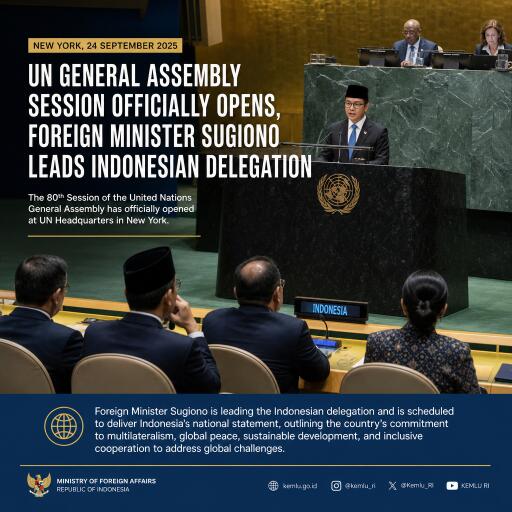
UN General Assembly Session Officially Opens, Foreign Minister Sugiono Leads Indonesian Delegation
The annual General Debate of the 81st United Nations General Assembly opened in New York with Indonesia’s Foreign Minister, Sugiono, at the helm of the national delegation. Arriving amid overlapping crises—from climate disruption to geopolitical tensions—the gathering sets the tone for a high-stakes week of diplomacy where the health of multilateralism itself is on trial.
Presiding over the session, UN General Assembly President Khalilur Rahman of Bangladesh framed this year’s theme—“Restoring Trust, Managing Transformation: A United Nations that Delivers for All”—as both a compass and a stress test. The focus speaks directly to a world unsettled by extreme weather, widening inequality, and digital upheaval, while demanding a system capable of translating promises into progress.
In his final address to the General Debate as UN Secretary-General, António Guterres underscored the volatility of the moment: power is shifting, conflicts are multiplying, and the climate emergency is quickening. He stressed that whether humanity steers this transition safely will depend on choices rooted in cooperation and law, not coercion—an argument for revitalizing multilateral norms so that influence is exercised within shared rules and responsibilities.
Echoing that urgency, Rahman called for credible reforms and tangible outcomes to repair confidence in the UN. The institution, he noted, remains indispensable but must prove it can deliver for people on the front lines of change—farmers in drought-stricken regions, communities facing rising seas, and urban centers grappling with heat and air pollution.
The High-Level Week accompanying the debate will spotlight issues central to climate and environmental justice: the Right to Development, climate action and a just transition, sea-level rise, pandemic preparedness and response, the fight against racism, and the elimination of nuclear weapons. For archipelagic nations like Indonesia, sea-level rise is not an abstraction but a fast-approaching line in the sand, threatening coastlines, food security, and cultural heritage. The just transition agenda—shifting from fossil fuels while safeguarding jobs and communities—remains equally pivotal for emerging economies seeking to grow without locking in high emissions.
Indonesia enters the week positioning itself as a bridge-builder. Jakarta’s priorities include efforts to reduce tensions and support conflict resolution—particularly regarding Palestine—while pressing for reforms that make the UN more representative and responsive to the Global South. The delegation is also set to highlight national development progress and climate-focused priorities, situating them within a broader call for cooperation that is inclusive, effective, and anchored in measurable results.
- Advancing peace and humanitarian pathways in protracted crises, while reinforcing diplomacy to curb escalation and protect civilians.
- Elevating climate ambition with a focus on adaptation finance, resilient infrastructure, and equitable decarbonization—so that the path to net zero creates jobs, cuts pollution, and protects nature.
- Centering sea-level rise as a direct risk to livelihoods, ecosystems, and infrastructure, and underscoring the need for support to vulnerable coastal and island communities.
- Engaging in pandemic preparedness to strengthen health systems, supply chains, and early-warning capacities that can withstand climate-driven shocks.
- Championing UN reforms that amplify Global South perspectives and enhance delivery on development, peace, and climate goals.
The delegation’s approach reflects Indonesia’s view that climate action is inseparable from development: clean energy investment, sustainable land use, and ocean stewardship can simultaneously cut emissions, safeguard biodiversity, and expand opportunity—if international cooperation provides reliable finance, fair technology access, and capacity building. That includes mobilizing resources for adaptation where extreme rainfall, heat waves, and saline intrusion are already reshaping daily life.
Amid the diplomatic choreography of High-Level Week, the question is less about declarations and more about implementation: Can states align trade, finance, and security policies with a science-based climate pathway; can they protect nature at scale; and can they ensure that the benefits of transition reach those who have contributed least to the problem yet face its worst impacts?
By leading the Indonesian delegation, Foreign Minister Sugiono signals Jakarta’s intent to keep these priorities at the center of multilateral negotiations. The opening day’s messages—from renewing trust in global institutions to managing transformation responsibly—set a clear benchmark. What follows will determine whether the United Nations can convert consensus into concrete gains for people and planet alike.



Leave a Reply