

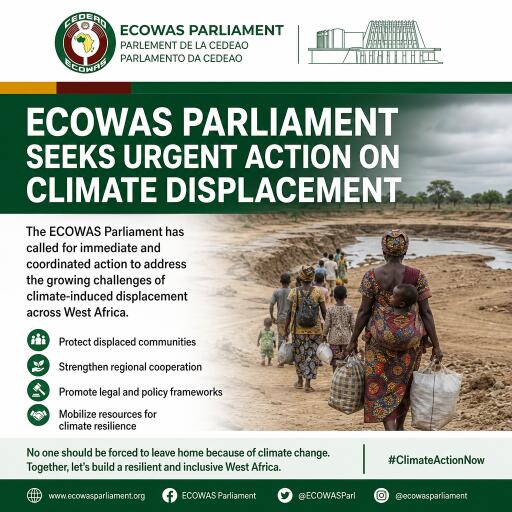
ECOWAS Parliament seeks urgent action on climate displacement
West Africa’s regional lawmakers have sounded the alarm on climate-driven upheaval, urging rapid, people-centered action to confront environmental degradation, population displacement, and the security risks that follow. Meeting in Accra, Ghana, at the ECOWAS Parliament’s 2026 Second Extraordinary Session Seminar, legislators and technical experts are mapping out how the region can better protect lives and livelihoods as the climate crisis deepens.
With the seminar focused on “Climate Change, Environmental Degradation, Population Displacement and Growing Insecurity in the ECOWAS Region,” participants are assessing how rising temperatures, erratic rainfall, sea-level rise, and ecosystem decline are already reshaping daily life across the subregion. The gathering underscores a clear message: climate disruption is no longer a distant projection but a lived reality measured in lost harvests, collapsing coastlines, flooded neighborhoods, and communities pushed to move.
Parliamentary leadership emphasized that effective responses must be grounded in the experiences of people on the front lines. Scientific models and technical briefings remain essential, but lawmakers stressed their role in translating expert knowledge into policies that reflect community needs—from smallholder farmers coping with failing rains to fishers confronting coastal erosion and urban families contending with repeated flood disasters.
That bridge between evidence and experience is at the heart of the seminar’s approach. By creating space for dialogue between researchers, practitioners, and representatives closely tied to their constituencies, the Parliament aims to generate proposals that are both technically sound and practically viable. This is a bid to move beyond general statements of concern and toward a slate of regional measures that can be implemented in diverse local contexts.
Why it matters now
Across West Africa, climate hazards are accelerating pressures that force people from their homes. In the Sahel and savannah zones, prolonged droughts and shifting rainfall patterns stress crops and grazing lands, heightening tensions over scarce resources. Along the Gulf of Guinea, rising seas and stronger storm surges are eating away at the coastline, destroying homes and infrastructure. Rapid-onset floods, amplified by urban sprawl and poor drainage, repeatedly disrupt schools, health services, and markets. These shocks do not occur in isolation; they compound existing vulnerabilities and can aggravate insecurity by undermining livelihoods and straining local governance.
Inside the seminar
The meeting, part of the ECOWAS Parliament’s Sixth Legislature, is designed to sharpen a collective understanding of how environmental change, displacement, and security are intertwined—and what a coordinated regional response should look like. Lawmakers and experts are weighing steps that member states and ECOWAS institutions can take together, recognizing that climate impacts often cross borders and require synchronized solutions.
Priority areas under discussion
- Protecting people on the move: Developing regional frameworks to identify, assist, and safeguard individuals and communities displaced by climate impacts, including cross-border movements.
- Early warning and rapid response: Strengthening climate and disaster risk monitoring, data sharing, and community-based alert systems to save lives before hazards escalate.
- Resilient livelihoods: Supporting climate-smart agriculture, water management, and diversified income strategies to reduce pressure to migrate and stabilize local economies.
- Coastal and urban resilience: Investing in nature-based defenses, improved drainage, and land-use planning to curb erosion, flooding, and infrastructure losses in fast-growing cities and along vulnerable shorelines.
- Ecosystem restoration: Rehabilitating degraded lands, wetlands, and forests to buffer climate extremes, secure water resources, and sustain biodiversity.
- Security and social cohesion: Integrating climate risk into conflict prevention, mediation, and community dialogue to reduce tensions over land and resources.
- Financing and governance: Facilitating access to climate finance, aligning national and regional plans, and ensuring that policies reflect on-the-ground realities.
A people-first approach
Throughout the deliberations, the emphasis remains on centering the needs and knowledge of affected communities. Participants cautioned against treating climate policy as a purely technical exercise; instead, they framed it as a social and economic imperative that must deliver tangible benefits—food security, safer settlements, sustainable jobs, and stronger local institutions. Lawmakers argued that durable solutions emerge when expert insights are tested against lived experience and refined with direct input from those most at risk.
What to expect next
Outcomes from the seminar are expected to inform a regional roadmap for addressing climate-related displacement and insecurity. The Parliament is seeking to consolidate proposals that can be advanced through ECOWAS mechanisms and national legislatures, including measures to standardize data collection, coordinate cross-border action, and prioritize investments where they can have the greatest impact. The process aims to convert shared diagnosis into implementable steps, with continued engagement between technical specialists and representatives from all member states.
The bottom line
By elevating climate displacement and environmental degradation as core security and development challenges, the ECOWAS Parliament is signaling a shift toward more integrated, community-grounded action. The Accra seminar sets the stage for policies that link science and local realities—so that responses are not only urgent, but also fair, feasible, and firmly rooted in the everyday struggles and strengths of West African communities.



Leave a Reply