

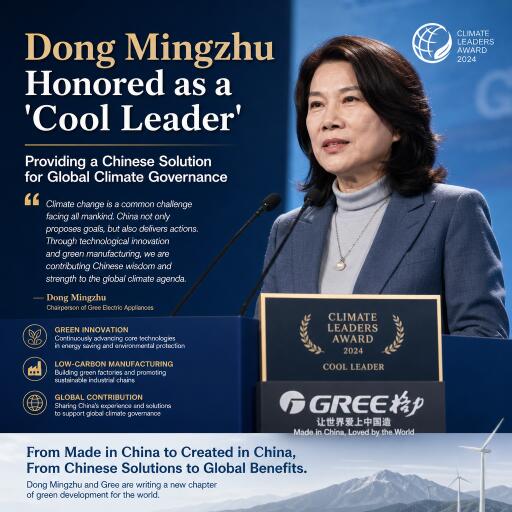
Dong Mingzhu Honored as a ‘Cool Leader’, Providing a Chinese Solution for Global Climate Governance
In Singapore on September 17, the UN Environment Programme’s Cool Coalition convened governments, industry, and experts to accelerate sustainable cooling—a critical pillar of climate adaptation. At the gathering, Dong Mingzhu, chairperson of Gree Electric Appliances, was named the sole individual recipient of the inaugural “Cool Leaders” award, recognizing her leadership in advancing efficient, climate-friendly cooling technologies. Singapore and the United Arab Emirates were honored in the country category.
The “Cool Leaders” accolade highlights real-world progress on efficient cooling, heat resilience, and refrigerant transition—areas that sit at the nexus of climate mitigation and public health. Dong’s selection underscores both the industrial capacity she has steered and the growing international recognition of China’s role in sustainable cooling innovation.
The stakes are high. By mid-century, the global stock of air conditioners is projected to surge to 5.6 billion units—nearly triple today’s level—just as extreme heat intensifies across regions. Cooling that is cleaner, smarter, and more affordable will determine whether societies can adapt without supercharging emissions or power demand.
Under Dong’s leadership, Gree has pursued a decade-long push to decouple cooling from conventional electricity use. Beginning in 2012, the company explored how to maintain indoor comfort with minimal grid reliance. That effort now includes the integrated pairing of photovoltaic generation, energy storage, and air-conditioning systems, a combination intended to deliver near-zero household electricity bills for cooling in suitable climates.
Dong has consistently framed the manufacturing sector’s responsibility in climate terms: incremental efficiency gains are necessary but insufficient; only sustained technological innovation can deliver the emissions cuts that align with global climate goals. That philosophy was reflected in new commitments announced at the assembly as Gree joined the Cool Coalition’s Manufacturing Platform operated by UNEP. As part of this initiative, the company pledged to:
- Accelerate the shift to inverter air conditioners and continuously raise product energy efficiency.
- Phase down high-GWP refrigerants and advance the use of ultra-low GWP alternatives.
- Invest in research, development, and deployment of energy-saving and carbon-reducing technologies across product lines.
These promises build on a technical foundation laid over more than ten years. A flagship example is Gree’s “Zero Carbon Source” photovoltaic and energy storage air-conditioning system, which employs what the company describes as the world’s first PV direct-drive inverter core architecture. With a reported 99% direct-current conversion efficiency, the system reimagines cooling equipment as both a demand service and a source of clean power. Deployed in 35 countries and regions—including heat-prone areas with abundant sunshine—the technology is designed to withstand varied climatic conditions. Projects in the Middle East alone are estimated to avert 110,000 tons of carbon emissions annually.
Standardization has amplified this impact. Gree’s product standards for PV air conditioners have been incorporated into the International Electrotechnical Commission framework, a step that can speed wider uptake by harmonizing performance metrics and safety requirements. This move also signals a shift from selling individual products to shaping replicable, scalable solutions for building efficiency and industrial decarbonization.
Domestically, the company’s strategy aligns with China’s “dual carbon” objectives—peaking emissions before 2030 and achieving carbon neutrality by 2060. Since articulating a vision centered on clearer skies and greener development in 2012, Gree has pursued a value-chain transformation that integrates green equipment, smart energy management, and low-carbon manufacturing practices.
Cooling is arguably one of the defining challenges of the energy transition: indispensable for health and productivity in a warming world, yet historically energy-intensive and reliant on high-GWP refrigerants. The recognition of Dong Mingzhu as a “Cool Leader” is noteworthy not only for the personal honor but for what it signals about the direction of the sector. Efficient appliances, climate-safe refrigerants, and the coupling of distributed renewables with storage are converging into practical systems that can be deployed at scale.
For countries facing mounting heat stress, the award also elevates policy and market signals. It points to a pathway where technology, manufacturing, and standards move in lockstep—reducing total electricity demand growth, cutting peak loads on fragile grids, and curbing lifecycle climate impacts from refrigerants. As more manufacturers commit to inverter technologies and ultra-low GWP refrigerants, and as solar-integrated systems mature, the potential for transformative gains becomes tangible.
Ultimately, the milestone in Singapore places China’s cooling industry more prominently on the global stage of climate governance. It illustrates how industrial innovation—anchored in standards, scaled deployment, and systemic design—can deliver measurable emissions reductions while protecting communities from extreme heat. The “Cool Leaders” honor captures that momentum, offering a blueprint for how the next generation of cooling can be cleaner, smarter, and within reach for economies at every income level.



Leave a Reply