

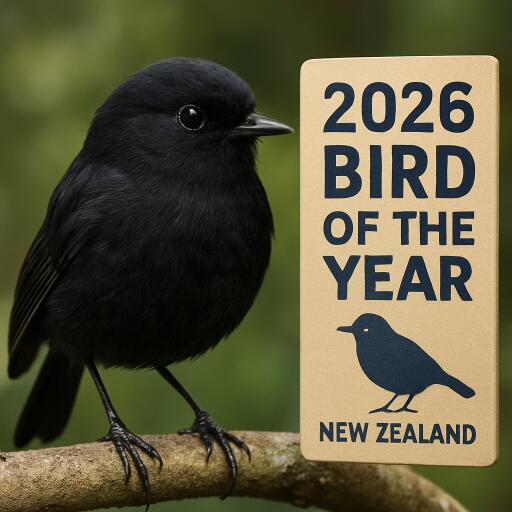
Endangered black robin wins 2026 Bird of the Year in New Zealand
New Zealand’s 2026 Bird of the Year contest has delivered a major moment for one of the country’s rarest birds: the black robin, known in the Chatham Islands as karure, has taken the top prize after a strong public campaign.
The tiny forest bird, found only in the Chatham Islands, secured victory with 25,610 votes in a nationwide poll that drew unprecedented attention. Organizers said the competition attracted a record 105,000 voters, with the overwhelming majority of ballots submitted from inside New Zealand.
The result places the black robin ahead of several high-profile native species. The kakapo, the much-loved flightless parrot, came in second with 19,445 votes, while the kārearea, or New Zealand falcon, finished third on 17,423.
Beyond the popularity contest, the win shines a spotlight on one of the most dramatic bird recoveries in New Zealand conservation history. By 1980, the black robin had been pushed to the edge of extinction. Just five individuals were left alive, including only one female capable of breeding.
From that desperate starting point, local residents in the Chatham Islands and conservation workers began an intensive rescue effort. The species’ survival ultimately depended on the success of a single breeding pair, making every nesting season critical.
That intervention worked. Today, the adult black robin population has climbed to about 350 birds. They now survive on two predator-free island reserves, a remarkable turnaround for a species that once seemed almost certain to disappear forever.
Even so, conservationists warn that the story is far from over. The bird’s recovery has reached a new challenge: space. Nearly all suitable territories on the two islands are already occupied, leaving little room for the population to expand further.
Because of that limit, experts say the establishment of a third population is now essential if the black robin is to continue growing and become more resilient. Expanding habitat onto another island would reduce the risk of a single disease outbreak, storm, or other ecological shock affecting too much of the population at once.
Attention is increasingly turning to Pitt Island, located between the two existing reserve islands. Conservation work there could open up safer habitat not only for the black robin, but also for the wider natural community of the Chatham Islands.
That matters well beyond one species. The Chatham Islands are a biodiversity stronghold, supporting a significant share of New Zealand’s threatened birdlife. Protecting and restoring habitat in the archipelago could therefore produce benefits across multiple species at risk.
The Bird of the Year result is likely to give fresh momentum to those efforts. Public voting campaigns around the annual contest often blend humor with fierce loyalty, but they also serve a serious purpose: drawing attention to native wildlife that still depends heavily on long-term habitat protection and pest control.
For the black robin, this year’s win is more than a symbolic crown. It is a reminder that conservation action can pull a species back from the brink — and that even a celebrated comeback remains fragile without space, security, and continued commitment.



Leave a Reply