

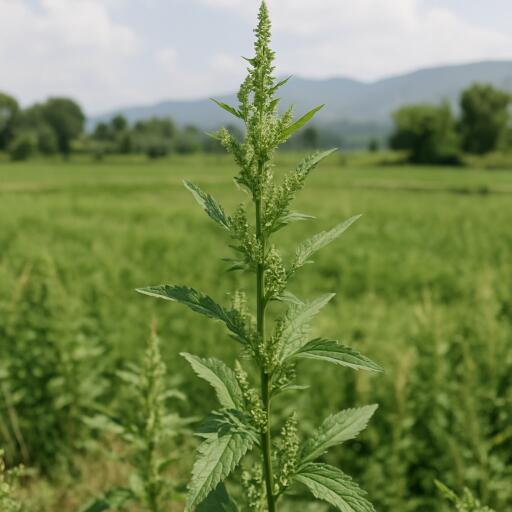
Invasive Weed Completes Life Cycle in Kashmir, Study Warns of Spread into Agricultural Ecosystems
A newly documented case of invasive weed establishment in Kashmir has raised alarms for farmers, agronomists and environmental managers. Researchers have reported that Parthenium hysterophorus, a highly aggressive weed known for damaging crops and disturbing native plant communities, has managed to survive the Valley’s harsh winters, regrow in spring and produce viable seeds before the return of severe frost.
The finding is significant because it shows the species is no longer appearing as an isolated outsider but has begun forming a self-sustaining population under Kashmir’s temperate conditions. That shift greatly increases the risk of spread into both farmland and surrounding non-crop habitats.
The population was detected in Pulwama district during a survey of rice-growing land. Plants were found on a well-drained path between fields rather than inside flooded paddy plots. Even so, scientists observed multiple growth stages at the same site, including seedlings, young rosettes, mature flowering plants and seed-bearing individuals. That pattern indicated active regeneration over time, not a one-time accidental introduction.
According to the study, the weed completes an annual cycle in Kashmir despite freezing winter temperatures. Above-ground parts die back after strong autumn frost, but seeds remain alive in the soil through the cold season. With the arrival of milder temperatures in spring, new seedlings emerge and continue developing through summer.
Under monitored conditions, mature seeds showed a germination rate of 65 percent, confirming that the reproductive cycle had been successfully completed. Field observations matched the laboratory results: plants emerged from late March to early May, flowered after roughly six months of growth and began producing seeds by October, before deep winter set in.
This timeline is especially troubling for agricultural landscapes because it gives the weed enough time to replenish its seed bank each year. Once that seed reserve builds up in field margins, roadsides, embankments and other disturbed ground, control becomes far more difficult.
Why the discovery matters
Parthenium hysterophorus is widely regarded as one of the world’s most troublesome invasive weeds. It can reduce crop productivity, interfere with grazing lands and alter the structure of plant communities. Its expansion into a new climatic zone suggests a level of ecological flexibility that could make containment more challenging in the years ahead.
In Kashmir, researchers did not find evidence that the weed had yet taken over large areas or displaced all surrounding vegetation. Instead, the infestation appears to be at an early stage. The plants were growing alongside common weeds and grasses typically found on field edges and pathways. Still, the fact that viable seeds are now being produced locally means the invasion process may already be underway.
The current distribution also offers an important clue: the species appears better suited to drier, better-drained strips adjacent to rice systems than to permanently waterlogged paddy fields. That means bunds, pathways, roadsides, drainage margins and foothill zones may serve as launch points for wider spread across the rural landscape.
Cutting may not be enough
The study also highlighted a major challenge for weed management. Some of the observed plants had been mechanically cut, yet several were able to regenerate by producing new side shoots. In at least one case, a cut plant recovered, flowered and went on to set seed.
That detail matters because routine trimming or brush-cutting, if done improperly or too late, may fail to stop reproduction. Instead of killing the weed, partial cutting can allow it to bounce back and complete its cycle. For land managers, this means removal strategies will need to be timely, thorough and carefully monitored.
Researchers also recorded wide variation in plant size and development, suggesting individuals were germinating and growing under slightly different conditions within the same site. Such variability can complicate eradication because not all plants respond the same way to disturbance or control measures.
Climate pressure could worsen the threat
The study links the weed’s successful establishment to broader environmental change. During the observation period, winter temperatures dropped well below freezing, yet the species still persisted through seed survival. At the same time, the season was unusually dry, creating conditions that may have favored germination and establishment in exposed, non-waterlogged areas.
Scientists warn that gradual warming could make more parts of Kashmir suitable for this weed. If temperatures rise and frost-free periods lengthen, the plant may gain a stronger foothold, spread faster and compete more effectively with local vegetation. Similar uphill and northward movement has already been observed in other Himalayan regions.
For now, severe autumn frost still limits the plant’s above-ground survival. But that natural brake may not be enough to prevent long-term persistence, because the seeds can lie through winter and restart the cycle in spring.
What should happen next
The researchers urge early intervention before the infestation expands. Their recommendations include systematic surveys, detailed mapping of occurrences, rapid removal of small populations and stronger precautions to prevent accidental spread through equipment, soil movement or contaminated seed material.
Because the weed was found in an agricultural setting, even if not inside standing paddy water, the concern extends beyond biodiversity alone. A species that can establish in field margins today may move into a wider network of crop and non-crop habitats tomorrow, increasing management costs and ecological disruption.
The key message from the study is clear: Kashmir may no longer be protected by climate alone from this invasive plant. Its ability to endure winter, regenerate and reproduce in the Valley marks a turning point that calls for immediate surveillance and preventive action.



Leave a Reply