

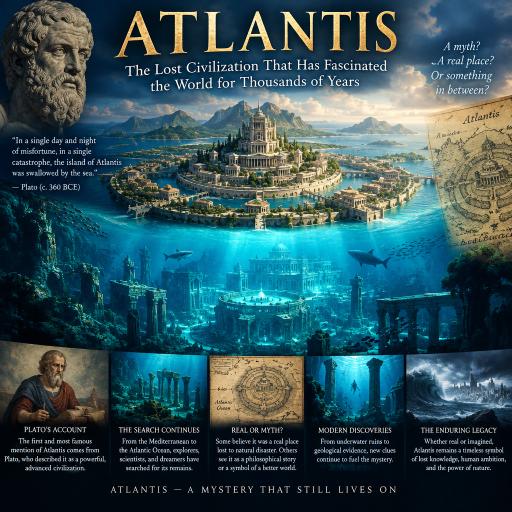
Atlantis: The Lost Civilization That Has Fascinated the World for Thousands of Year
Few legends have endured as powerfully as Atlantis. For thousands of years, the tale of a brilliant island civilization swallowed by the sea has inspired debate, expeditions, books, films, and endless speculation. Some imagine a dazzling maritime empire far ahead of its time. Others see a moral fable dressed in the language of history. What keeps Atlantis alive is not just the mystery of where it was, but whether it ever existed at all.
The enduring appeal of Atlantis lies in a simple tension: the world has known real disasters capable of destroying thriving societies, yet no evidence has definitively linked any lost settlement to the kingdom described in ancient texts. That gap between possibility and proof is where the legend continues to thrive.
The Origin of the Atlantis Story
The earliest detailed account of Atlantis comes from the Greek philosopher Plato, who introduced it in his dialogues Timaeus and Critias in the 4th century BC. In his telling, Atlantis was a wealthy and formidable island realm located beyond the strait now known as Gibraltar. It was said to possess fertile plains, forests, abundant resources, monumental architecture, powerful fleets, and a striking capital built in concentric rings of land and water.
According to the story, Atlantis grew strong but eventually became arrogant and expansionist. Its moral decline led to divine punishment: earthquakes and floods destroyed the island, which vanished beneath the sea in a catastrophic event.
This dramatic ending helped make Atlantis unforgettable. But there is a crucial fact often overlooked: Plato is the only ancient writer to describe Atlantis in such detail. No confirmed independent record has ever verified the story.
History, Myth, or Philosophical Warning?
Most scholars do not regard Atlantis as a proven historical civilization. Many see it instead as a literary device, created to explore political ambition, moral decay, and the collapse of powerful societies. Plato often used framed stories to make philosophical arguments, and Atlantis may have served as a cautionary example of what happens when wealth and military power outgrow wisdom.
Even so, myths rarely emerge in a vacuum. Ancient storytellers often blended memory, disaster, geography, and imagination. That is why Atlantis continues to attract serious curiosity. It may not have existed exactly as described, but it could have drawn from real events that ancient people found unforgettable.
Could Real Disasters Have Inspired the Legend?
From an ecological and geological perspective, the Atlantis story is plausible in one important sense: landscapes do disappear. Coastlines shift, seas rise, volcanoes erupt, earthquakes fracture the ground, and tsunamis erase harbors in minutes. Human settlements have repeatedly been damaged, buried, or submerged by natural forces.
At the end of the last Ice Age, melting glaciers caused sea levels to rise dramatically. Vast coastal plains that once supported people and wildlife were drowned. Underwater archaeology has since revealed traces of ancient landscapes now hidden beneath modern seas. These discoveries show that “lost worlds” are not fantasy. They are part of Earth’s environmental history.
Still, a drowned settlement is not the same as Atlantis. To prove that connection, archaeologists would need strong evidence: buildings, tools, food remains, cultural patterns, and dates that fit the story. No such discovery has been widely accepted.
The Leading Theories
Over time, Atlantis has been placed almost everywhere: the Atlantic Ocean, the Mediterranean, the Black Sea, the Caribbean, and even Antarctica. Most of these ideas remain speculative, but a few stand out because they intersect with real environmental catastrophes.
Santorini and the Bronze Age Aegean
One of the most discussed candidates is the volcanic island of Santorini, known in antiquity as Thera. In the second millennium BC, a massive eruption shattered much of the island and reshaped the surrounding region. The blast likely triggered tsunamis, ash fall, and widespread disruption across the Aegean.
Nearby Crete was home to the Minoans, a sophisticated seafaring civilization with palaces, trade networks, and advanced engineering for its era. Because of their wealth and maritime strength, some researchers believe memories of the Minoans and the eruption could have influenced later stories of a lost island power.
The problem is chronology. The eruption of Thera took place thousands of years later than the date Plato gave for Atlantis. The similarities are intriguing, but not enough to settle the matter.
The Atlantic Beyond Gibraltar
If Plato’s geography is taken literally, Atlantis should lie beyond the Strait of Gibraltar in the Atlantic. This has inspired searches around the Azores and submerged continental shelves. Geological change in the Atlantic is real, especially in volcanic island chains, but no evidence has emerged for a vanished island empire matching Plato’s description.
The Black Sea Flood Hypothesis
Another theory points to ancient flooding in the Black Sea region after the Ice Age. Some scientists have suggested that changing water levels in this basin may have displaced communities and preserved memories of land being lost to water. Even if such flooding occurred, however, it does not confirm Plato’s island capital or his account of a mighty oceanic kingdom.
Could an Island Really Vanish?
Not in the dramatic way popular culture often imagines. Islands do not usually sink like stones dropped into water. But they can be transformed beyond recognition. Volcanic collapse can destroy large portions of an island. Earthquakes can lower coastal terrain. Tsunamis can obliterate settlements. Gradual sea-level rise can drown low-lying land over centuries.
Science offers many real mechanisms for destruction, just not definitive proof for Atlantis itself. What matters is that the legend reflects genuine planetary processes. The Earth is dynamic, and civilizations built near coasts are especially vulnerable.
Why Atlantis Still Matters
Atlantis survives because it speaks to two modern anxieties at once. The first is environmental fragility. Rising seas, extreme weather, and geological hazards remind us that even advanced societies remain dependent on stable ecosystems and resilient infrastructure. The second is political hubris. The legend warns that power without restraint can become self-destructive.
That message feels strikingly contemporary. A society may possess wealth, technology, ships, monuments, and global reach, yet still fail if it ignores ecological limits or mistakes strength for permanence.
What We Actually Know
We know that Plato recorded the story more than 2,300 years ago. We know that real ancient societies were devastated by eruptions, earthquakes, flooding, and collapse. We know that underwater archaeology continues to reveal drowned settlements and forgotten coastlines.
What we do not know is whether Atlantis was a real civilization. No confirmed site, artifact collection, or ruin has been universally recognized as its remains. There are no verified Atlantean inscriptions, no accepted capital city, and no scientific consensus on location.
The Final Word
Atlantis remains unproven, but its power endures because it sits at the crossroads of myth, memory, geology, and human ambition. It may have been a philosophical invention inspired by real disasters. It may have preserved distorted echoes of Bronze Age upheaval. Or it may simply be one of history’s most effective cautionary tales.
Either way, the legend continues to fascinate because the planet itself contains many genuine lost landscapes. Beneath today’s seas lie traces of vanished shores, drowned ecosystems, and forgotten communities. Atlantis may never be found, but the search reflects something very real: humanity’s desire to understand how civilizations rise, how they fall, and what the Earth remembers after they are gone.



Leave a Reply