

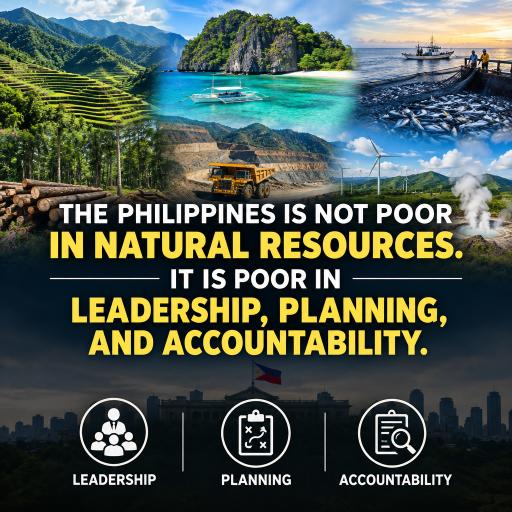
THE PHILIPPINES IS NOT POOR IN NATURAL RESOURCES. IT IS POOR IN LEADERSHIP, PLANNING, AND ACCOUNTABILITY.
The Philippines does not suffer from a shortage of природных wealth. It suffers from weak stewardship.
Across the archipelago lie forests that regulate water, mountains that stabilize entire watersheds, coastlines that feed communities, and agricultural lands that should secure future food supply. Yet these assets are repeatedly treated as disposable. Hills are cut for subdivisions, wetlands are filled, rivers absorb sewage and trash, and productive farmland disappears under roads, warehouses, and speculative real estate.
When floods rise or landslides hit, the public is told these are natural tragedies. But many are also planning failures. Disasters become worse when ecosystems are degraded, waterways are occupied, and land-use rules are ignored in favor of short-term gain.
This is why the country’s environmental crisis is inseparable from governance. The issue is not simply climate, population, or urban growth. It is the chronic inability—or unwillingness—of institutions to protect the public interest over political convenience.
Biodiversity is not scenery. It is a life-support system. Forests retain water, reduce erosion, cool landscapes, and shelter species found nowhere else. Healthy ecosystems support food production, fisheries, tourism, and disaster resilience. Once fragmented or polluted, the damage is costly and sometimes irreversible.
Despite this, environmental management too often remains reactive. Agencies announce tree-planting drives, cleanup events, and flood-control projects, but these activities are meaningless if forests continue shrinking, rivers remain contaminated, and hazardous construction keeps advancing into fragile areas. A government should be judged by ecological outcomes, not ceremonies.
Mountains are not vacant land banks. They are living infrastructure. Remove vegetation, disturb slopes, and pave recharge zones, and the effects travel downstream: faster runoff, heavier flooding, unstable ground, and damaged river systems. Yet approvals for hillside development often move forward without honest accounting of cumulative impacts across the entire watershed.
The same failure appears in the housing crisis. Informal settlements along esteros, riverbanks, coasts, and unstable slopes are not only a poverty issue; they are evidence of failed urban planning. Families settle in danger zones because safe, affordable, well-connected housing is unavailable. Demolition without humane relocation solves nothing. A serious state would protect waterways while also providing housing linked to transport, schools, livelihoods, and healthcare.
Agricultural land is another casualty of short-term thinking. Farmland is routinely converted into residential and commercial projects, even as food security becomes more fragile. Traditional farming landscapes and Indigenous land practices contain generations of ecological knowledge, yet these are often praised in speeches while ignored in policy. Concrete cannot replace soil, and no shopping complex can perform the function of a watershed.
Communities living closest to forests, reefs, and mountain habitats should be central to conservation, not treated as afterthoughts. Indigenous peoples and rural residents often understand local ecosystems better than distant planners. Their knowledge should help guide land management, tourism, and restoration. Conservation works best when people benefit from keeping ecosystems alive rather than being pushed toward destructive livelihoods.
This opens a major opportunity for tourism. The Philippines has world-class biodiversity, but tourism policy still too often chases visitor volume instead of ecological quality. A destination’s success should not be measured only by arrivals and hotel occupancy. It should also be measured by water quality, habitat condition, waste systems, community income, and whether ecosystems are healthier after tourism than before it.
Nature-based tourism can create livelihoods through birdwatching, reef interpretation, forest guiding, cultural immersion, and community-run homestays. But this only works if carrying capacity is respected. Not every beach needs a resort, not every mountain needs a road, and not every scenic site should be commercialized. Some places must remain protected precisely because they are valuable.
Rivers and wetlands deserve the same seriousness. Flooding is often treated as an engineering problem to be solved with concrete alone. But rivers cannot function if upstream forests are degraded, floodplains are occupied, drainage is blocked, and wastewater flows untreated into waterways. True flood management means restoring watersheds, protecting wetlands, enforcing easements, and aligning infrastructure with natural systems.
This is also where accountability becomes unavoidable. Public money for environmental protection and disaster mitigation is too often celebrated at the budget stage and forgotten at the results stage. If flood-control or rehabilitation projects are defective, overpriced, delayed, or politically manipulated, the consequences are paid for by families whose homes and livelihoods remain exposed. Corruption in resilience spending is not abstract financial misconduct; it can translate directly into human danger.
Technology can help, but it cannot substitute for integrity. Satellite imagery, GIS, sensors, AI-assisted mapping, and digital twins can detect forest loss, monitor river conditions, identify illegal excavation, and model flood risks before projects are approved. These tools could transform environmental oversight in the Philippines. But data matters only if agencies are willing to act on it and if findings cannot be buried for political reasons.
The deeper problem is the national habit of mistaking announcements for achievement. A signed permit is not sustainability. A ribbon-cutting is not resilience. A seedling in a photo opportunity is not a restored forest. Government must move from publicity-driven governance to measurable environmental performance: water quality, forest integrity, reduced disaster exposure, lawful land use, and real community benefit.
What would serious reform look like?
- Audit major watersheds, forestlands, protected areas, and high-risk developments, then publish the findings.
- Impose stricter limits on mountainside construction and cumulative-impact reviews for projects sharing the same ecosystem.
- Protect waterways while creating humane, affordable housing alternatives outside danger zones.
- Require transparent environmental monitoring and independent compliance checks for both national and local projects.
- Prioritize watershed restoration, wetland recovery, and river rehabilitation as core infrastructure.
- Use digital monitoring tools to make environmental data accessible to citizens, researchers, and watchdog groups.
- Ensure Indigenous and local communities share authority and benefits in conservation and tourism.
- Investigate misuse of environmental and disaster funds with the same urgency given to national security threats.
The Philippines does not need more slogans about sustainability. It needs leaders willing to reject destructive projects, planners able to think beyond election cycles, and institutions strong enough to withstand patronage and pressure.
The country’s greatest environmental threat is not a lack of riches beneath its soil or around its shores. It is the persistent failure to govern those riches wisely. If that does not change, future generations will inherit not a blessed archipelago, but a diminished one—its rivers dirtier, its mountains weaker, its farms fewer, and its disasters more severe.
The Philippines is not poor in natural resources. It is poor in leadership, planning, and accountability. Until those deficits are confronted, environmental decline will continue to be repackaged as progress.



Leave a Reply