

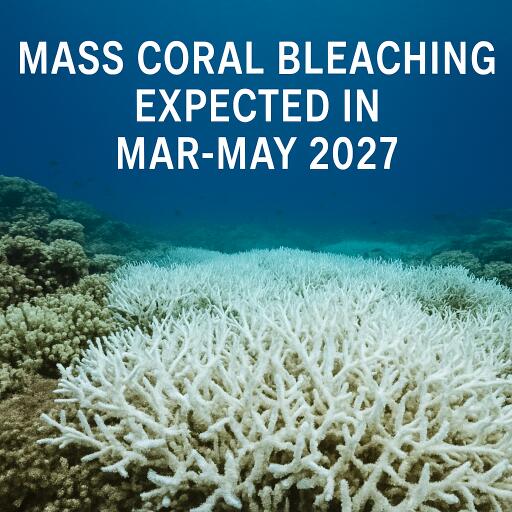
Mass coral bleaching expected in Mar-May 2027
Singapore’s coral reefs could face another major bleaching episode between March and May 2027 if forecast climate conditions intensify as expected. Scientists and conservation agencies are watching closely as a strengthening El Nino raises the risk of unusually warm seas, the main trigger behind coral bleaching.
Bleaching happens when corals become stressed by high water temperatures and expel the microscopic algae that live inside their tissues. Those algae give corals much of their colour and provide them with essential nutrients. Without them, corals turn pale or white, weaken, and become more vulnerable to disease and death.
Researchers say the danger is not only the immediate loss of coral, but also the shortening gap between bleaching events. Reefs need time to recover after heat stress, and repeated warming leaves less and less opportunity for that recovery. When corals struggle, the fish, invertebrates and other marine life that depend on reef habitats also decline.
In Singapore, recent bleaching episodes have not always caused extremely high short-term coral mortality. Studies suggest immediate losses have generally stayed below 10 per cent, with roughly 5 per cent mortality recorded during the 2024 event. But experts warn that survival figures alone do not tell the full story.
Even where many corals remain alive, reefs are being reshaped. Over time, repeated heat stress, murky waters, sedimentation and coastal pressures have pushed some reef areas away from branching, structurally complex corals and toward tougher, slower-growing massive forms. This process effectively “flattens” the reef, reducing the nooks and crevices that many marine species rely on for shelter and feeding.
Simpler reef structures may also undermine coral reproduction. Scientists caution that repeated bleaching and the loss of key coral forms could reduce spawning success and weaken the long-term resilience of reef systems, even if they appear to rebound on the surface.
The warning for 2027 comes amid a broader global decline in coral reef health. Marine assessments have found that reefs worldwide are being hit by a combination of ocean warming, pollution, coastal development, sediment runoff, disease and overuse of marine resources. Heatwaves, storms and disease outbreaks are also becoming more frequent and severe, making recovery increasingly difficult.
Another mounting pressure is ocean acidification, caused by the growing absorption of carbon dioxide by seawater. As waters become more acidic, corals find it harder to build and maintain their calcium carbonate skeletons. This can slow reef growth, weaken reef foundations and increase erosion risks. In Southeast Asia, these effects may be especially significant because reef systems are already coping with warming, nutrient pollution and land-based runoff at the same time.
Scientists warn that under high-emissions scenarios, many reefs in the region could become increasingly marginal for net growth in the coming decades. In practical terms, that means coral growth may barely keep up with the natural breakdown of reef structures, even if living coral is still present.
The growing threat has sharpened debate over what conservation can realistically achieve. Restoration projects can help support damaged reefs, but researchers stress that these tools cannot offset unchecked climate change on their own. Planting corals, managing local pollution and testing more heat-tolerant strains may buy time, yet lasting reef survival still depends on cutting greenhouse gas emissions and slowing global warming.
In Singapore, reef restoration is already being expanded. A national initiative launched in late 2024 aims to plant 100,000 corals over the coming decade and beyond, making it the country’s largest coral restoration effort so far. With only around 10 sq km of reefs remaining, local scientists say intervention may be unavoidable despite the cost and difficulty of large-scale restoration.
At the same time, researchers are experimenting with ways to help corals endure hotter conditions before they are transplanted back into the sea. One line of work focuses on beneficial bacteria that may improve heat tolerance. Scientists identified a microbe associated with a hardy coral species and found signs that it could help corals cope with thermal stress. The bacterium may support coral health by producing helpful compounds, limiting harmful infections and influencing chemical processes linked to stress resistance.
Another approach involves heat conditioning in aquarium settings, described by researchers as a kind of interval training for corals. Fragments are exposed to carefully controlled swings in temperature high enough to stress them, but not kill them, with the aim of improving their resistance to future marine heatwaves.
Some coral fragments have received microbial treatment, others heat conditioning, some both, and others none at all as controls. These corals have been placed onto reefs near Singapore for monitoring. Researchers are tracking their survival, growth, colour and overall health to see whether the treatments offer meaningful protection in real-world conditions.
Early results have been encouraging, with survival rates remaining high in the first weeks after transplantation. More species are also being tested in tanks ahead of possible reef deployment in 2027.
The deeper message from scientists is that future reefs may not look like those of the past. Conservation targets based on historical reef conditions may no longer be realistic in a rapidly changing ocean. Instead, managers may need to focus on helping reef ecosystems retain as much biodiversity and ecological function as possible under new climate realities.
If a strong El Nino does push sea temperatures higher into 2027, Singapore’s reefs could once again be forced into a severe stress test. Monitoring in the months ahead will be crucial, but experts are clear that the fate of coral reefs will depend not only on local restoration efforts, but also on how urgently the world tackles climate change.



Leave a Reply