

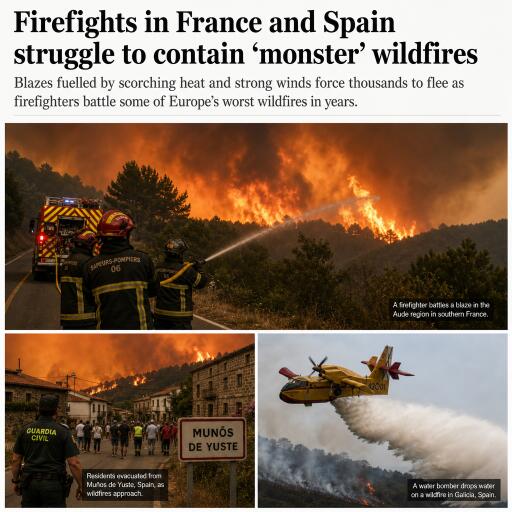
Firefights in France and Spain struggle to contain ‘monster’ wildfires
Fire crews in France and Spain faced another punishing night as sprawling wildfires, supercharged by heat and drought, tore through forests and rural communities. Authorities warned that a new pulse of extreme heat is set to grip the already scorched landscapes around Bordeaux and central Spain, raising fears that embers and shifting winds could breathe fresh life into multiple fronts.
France: wind-driven firestorms and mass evacuations
In the southwestern department of Gironde, home to the Bordeaux metropolitan area and its famed vineyards, firefighters wrestled with unpredictable flames driven by erratic gusts. The blaze has become powerful enough to generate a towering pyrocumulonimbus—an explosive fire cloud capable of producing its own lightning and turbulent winds that can ignite spot fires far ahead of the main front.
Emergency officials described a fluid, high-risk situation in which tactics must constantly adapt to wind shifts and a highly volatile fuel bed after months of scant rainfall. Overnight, local authorities reported that fire lines held “broadly stable,” yet the overall outlook remains fragile. National leaders scheduled a crisis meeting to coordinate resources and policy responses as the heat intensifies.
The human toll continues to mount. Across France and Spain combined, evacuations have surpassed 325,000 people. In Gironde alone, roughly 220,000 individuals have been moved from harm’s way since the latest fire siege began, with dozens of campgrounds shuttered and summer holidays cut short for around 40,000 visitors. Overnight youth trips and specialized camps for people with disabilities have been suspended as a precaution.
Despite warnings to leave, some residents in threatened villages used garden hoses to wet perimeters and slow advancing flames, hoping to protect homes until crews can reinforce defenses. Officials urged the public to avoid fire zones and tourism hotspots under threat, noting that the wind—and the fire—are dictating where teams can safely operate.
Infrastructure has suffered disruptions: the main southbound freeway and certain rail links near Bordeaux were suspended at times, and special measures were enacted to shield strategic industrial areas, including aerospace facilities on the city’s outskirts. The fire has burned an estimated 42,000 hectares in Gironde—roughly seven times the size of Manhattan—since midweek. At least 240 homes have been lost in the region, many in coastal and peri-urban communities. The city of Bordeaux, with about 850,000 residents in its greater area and serving as a refuge for many evacuees, had no immediate plans for a broader urban evacuation, though officials stressed they remain vigilant.
The strain on the frontline is intense. In Gironde, at least 84 firefighters have been injured during the current surge, with several requiring medical evacuation. Thousands of responders—approximately 2,500 firefighters, 1,500 military personnel, and around 1,200 police—have been deployed to the department, underscoring the scale and complexity of the emergency.
Spain: vast perimeters and “monster” fire behavior
Across the Pyrenees, flames continued to push through parched terrain in and around the Madrid region, as well as in Ávila, Toledo and the eastern province of Castellón in Valencia. Officials warned of exceptionally challenging fire behavior, describing an immense perimeter—approximately 280 kilometers—encompassing around 77,000 hectares in parts of central Spain.
Roughly 75,000 residents have been evacuated from high-risk zones, with additional precautionary departures ordered as winds redirected fire fronts. In the Valencia region, a new blaze was reported as “extremely intense,” triggering fresh alarms and displacements. One person was killed in a separate, smaller fire in the same area, the only civilian fatality reported to date in Spain in this episode. In France, two firefighters died earlier in the week during operations near Bordeaux.
Senior leaders visited shelters and fire command posts, praising the work of responders and warning communities to prepare for more difficult hours as temperatures rise again. Damage to Spain’s natural heritage—particularly forests and biodiversity-rich scrublands—was described as potentially incalculable.
Heat, drought and the climate signal
With another heatwave expected to settle from Tuesday, forecasters warn that temperatures could reach or exceed 40°C in parts of France and soar again across Spain. After successive heat surges and months with little rain, vegetation moisture levels are critically low—turning woodlands and heath into fast-burning fuel. Scientists have long cautioned that a warming climate is making heatwaves more frequent, droughts more severe and wildfire seasons longer and more destructive across southern Europe.
These fires have unfolded at the peak of the holiday season, a time when rural populations swell and evacuation logistics grow more complex. On some popular Atlantic and Mediterranean stretches, rapid, wind-driven flames have forced emergency clearances of beaches and campgrounds with little warning. Elsewhere in southern Europe, Italy has also faced major flareups; along the Puglia coast, hundreds of tourists were rescued by sea as blazes cut off escape routes on land.
On the ground: resources stretched, communities tested
Crews in France and Spain are relying on a mix of handlines, heavy machinery, and water-dropping aircraft where conditions allow. But high winds, thick smoke and towering convection plumes continue to complicate aerial operations. Firefighters emphasize the importance of creating defensible space—clearing vegetation around properties—and adhering strictly to evacuation orders when they are issued.
Local authorities in Gironde urged visitors to consider alternative destinations while emergency operations continue. The region’s tourism economy, vineyards, and coastal ecosystems are all under pressure from smoke, ash and closures. Beyond immediate losses, ecologists warn of medium-term impacts: soil erosion, wildlife displacement, and altered watersheds that can magnify flood risks when rains eventually return.
What comes next
Much hinges on the coming days. If temperatures spike and winds become erratic, embers could escape containment lines and trigger new outbreaks. If calmer, cooler conditions emerge, crews may gain ground by reinforcing perimeters, conducting strategic backburns, and reopening critical transport corridors. For now, the message from emergency services is consistent: remain alert to official advisories, limit nonessential travel into affected zones, and avoid any activities that could spark new ignitions.
As Europe contends with another brutal fire season, the scenes in France and Spain echo a broader reality: fire risk is rising, and communities at the forest edge are on the frontlines. The challenge ahead is not only to extinguish today’s flames, but to build resilience—through land management, early warning, and climate adaptation—before the next heatwave arrives.



Leave a Reply