

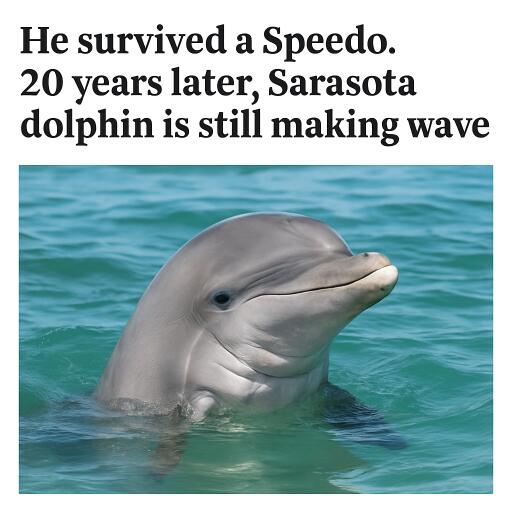
He survived a Speedo. 20 years later, Sarasota dolphin is still making waves
Nearly 20 years after a bizarre accident turned him into a local legend, a bottlenose dolphin known as Scrappy is still moving through Sarasota Bay — alive, thriving, and offering scientists a rare long-term view of how rescue work can shape the future of a wild animal.
His story began when researchers spotted something wrapped tightly around his body: an oversized men’s swimsuit lodged between his blowhole and flippers. What might sound absurd was in fact a serious entanglement. The fabric had started to slice into his skin, creating a potentially fatal injury.
For marine biologists who have spent decades following dolphins in Sarasota Bay, the episode became far more than an odd headline. It underscored how even everyday litter can become dangerous in coastal ecosystems, and how timely intervention can give a wild animal the chance to live out a normal life.
Scrappy, born in 1998, was still a young dolphin when the entanglement was discovered. Researchers monitored him closely after first noticing the swimsuit, hoping it might come free on its own. But dolphins are not built to reverse out of trouble. As the material remained stuck and the wound worsened, a rescue became unavoidable.
The operation took place on a punishingly hot summer day in 2006. Scrappy was fast, energetic, and difficult to approach in open water. After unsuccessful attempts and with a thunderstorm closing in, the team finally managed to secure him long enough for veterinarians to act. In the end, removing the swimsuit was surprisingly simple once they had him safely positioned. The real challenge had been reaching him before the injury became irreversible.
The outcome was remarkable. Scrappy recovered, returned to the bay, and continued living as a free-ranging dolphin. Today, he is one of the best-known individuals in the local population and has been recorded hundreds of times over the course of his life. Researchers have watched him mature, survive environmental pressures, and maintain long-term social bonds — including a close alliance with another male.
That long view is what makes his survival especially important. Dolphins are slow to reproduce and can live for decades, meaning each individual matters to the stability of the population. Saving one animal does not just prevent a single death; it can preserve social relationships, future breeding potential, and years of ecological knowledge.
In Sarasota Bay, that perspective is backed by one of the world’s longest-running dolphin studies. Since 1970, scientists have tracked generations of resident dolphins, building a detailed picture of family lines, health, habitat use, and social behavior. Around 170 dolphins are regularly monitored in the bay through boat surveys and photo identification, allowing researchers to recognize individuals by the unique markings on their dorsal fins.
The work has also become more technologically sophisticated. In addition to visual tracking, scientists now use an acoustic monitoring system with underwater listening stations placed around the bay. These hydrophones capture sounds made by dolphins and manatees, helping researchers detect animals even when they are out of sight. The system adds another layer of information, showing not only where animals are, but also how they use their environment and communicate within it.
This is more than a study of charismatic wildlife. Dolphins share the same coastal waters, fish stocks, and airborne pollutants as the people living nearby. Their health can reveal warning signs about the broader condition of the bay. Illness, poor nutrition, exposure to toxins, and injuries linked to human activity all provide evidence of changes in the ecosystem that can eventually affect other species, including humans.
That makes accidental injuries like Scrappy’s deeply relevant. The swimsuit that nearly killed him was unusual, but the larger issue is not. Marine animals are routinely harmed by discarded fishing line, hooks, plastic waste, and boat traffic. A soft piece of cloth was enough to cut into a dolphin’s skin; more durable materials can do far worse.
Researchers say one of the biggest threats in the area remains human interference, especially during busy boating and fishing periods. Holiday weekends and summer tourism put extra pressure on Sarasota Bay, increasing the risk of collisions, entanglements, and disturbance in shallow waters where dolphins, manatees, and sea turtles may be feeding or resting.
Simple choices by the public can reduce that harm. Slowing boats in shallow zones, staying alert for surfacing animals, disposing of trash properly, and keeping fishing gear under control all make a difference. In many cases, conservation is less about dramatic rescues and more about preventing emergencies from happening in the first place.
There are signs that public awareness may be helping. In some recent years, the number of direct dolphin interventions in the bay has been relatively low compared with the usual annual average. That does not eliminate the need for vigilance, but it suggests that education and community engagement may be reducing avoidable injuries.
Scrappy’s endurance gives those efforts a face — or rather, a fin. He is no longer just the dolphin that survived an improbable entanglement. He has become evidence that rescue work can have lasting value, and that an animal once briefly imperiled by human carelessness can still go on to lead a full life in the wild.
His story also carries a broader message for coastal communities. The wildlife of Sarasota Bay is not separate from daily human life; it is part of the same shared environment. Dolphins are longtime residents of these waters, raising young, forming alliances, and navigating the same changing conditions year after year.
Scrappy’s survival is a rare good-news story in a marine world increasingly shaped by pollution, warming waters, habitat stress, and heavy recreational use. Two decades after a stray swimsuit nearly ended his life, he remains in the bay as both survivor and signal: what people discard into the water matters, and so does the effort to undo the damage.



Leave a Reply