

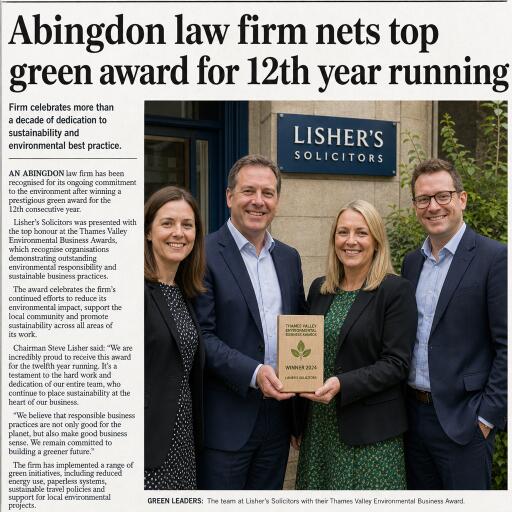
Abingdon law firm nets top green award for 12th year running
Roythornes Solicitors, which has a base in Abingdon, has secured the highest accolade from the Investors in the Environment accreditation scheme for the twelfth consecutive year—an unusually consistent run that underlines long-term commitment rather than one-off initiatives.
The recognition arrives after more than a decade of steady investment in lower-impact operations. Practical steps taken by the firm include installing solar panels on office buildings, introducing staff schemes to support the switch to electric vehicles, and placing comprehensive recycling points across its workplaces. These measures sit within a broader push to cut resource use, stabilise energy costs, and embed environmental thinking into everyday decisions.
According to operations director Ann Barrasso, the latest result reflects a cross-firm effort. Working closely with farms and rural businesses has sharpened the firm’s focus on how climate change and environmental pressures affect both livelihoods and landscapes—issues that require not only legal expertise but also a clear-eyed approach to sustainability inside the organisation itself.
With more than 300 employees spread across six offices, staff engagement has been central to progress. Roythornes credits the consistency of its results to everyday actions—how people commute, consume energy, and handle waste—multiplied across a large team. That approach has helped normalise behaviour changes that can be hard to sustain without collective buy-in.
Investors in the Environment independently assesses organisations against set criteria, looking for evidence of resource tracking, reduction targets, leadership, and continuous improvement. Its Green level is the top tier, signalling that an organisation not only has systems in place but is also demonstrating year-on-year progress. Maintaining that benchmark over twelve years suggests that environmental management is woven into the firm’s governance rather than treated as an occasional project.
Beyond the legal sector, the story hints at a broader shift: professional services, once dismissed as “low-impact,” are examining their footprints more closely. Office energy use, travel, IT infrastructure, and procurement choices add up. As more firms work with clients on climate risk, nature stewardship, and decarbonisation pathways, their own operations face growing scrutiny. Consistency—precisely what Roythornes has shown—matters as much as ambition.
The experience also highlights strategies that tend to deliver durable results. On-site renewables can insulate organisations from volatile energy prices while cutting emissions. EV support schemes help employees transition away from fossil fuels, particularly when paired with charging infrastructure and flexible commuting policies. Visible, well-managed recycling points make disposal choices easier, but the deeper gains typically come from preventing waste in the first place and tracking material flows to identify hotspots.
As the climate warms and weather extremes intensify, legal advice to landowners and farmers increasingly intersects with environmental regulation, biodiversity considerations, and resilience planning. Firms serving these sectors can play a pivotal role by aligning their own operations with the transition they encourage in the wider economy—an alignment that builds credibility with clients navigating change on the ground.
While the next steps were not detailed, the trajectory is clear: keep measuring, keep reducing, and keep bringing staff along for the journey. In the crowded field of corporate sustainability claims, twelve straight years at the top end of an independent standard is a strong signal that steady, structured work can deliver both environmental and organisational dividends.



Leave a Reply