

Invisible Ocean Microorganisms Are Vanishing: What Scientists Want You to Know – World Today Journal
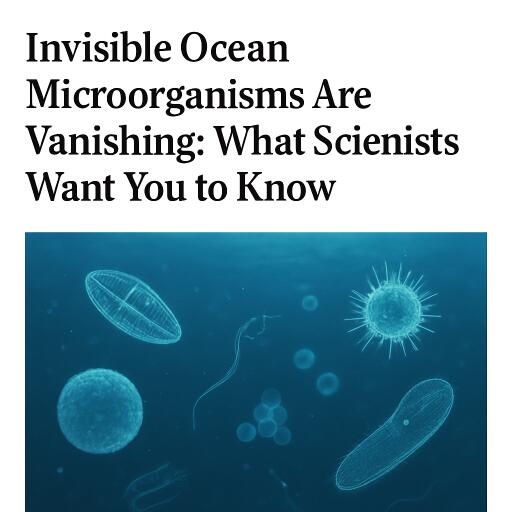
Tiny organisms floating near the ocean’s sunlit surface are easy to overlook, yet they quietly support much of life on Earth. These microscopic communities, including phytoplankton and zooplankton, feed marine food chains, help regulate the climate, and contribute enormously to the planet’s oxygen supply. Scientists now warn that many of these organisms are declining in number across large parts of the global ocean.
The trend has raised concern because these life forms are not a minor feature of the seas. They are the base of marine ecosystems. When their populations weaken, the effects can spread upward to fish, seabirds, whales, and the people whose livelihoods depend on healthy oceans.
Why these organisms matter so much
Phytoplankton are microscopic plant-like organisms that use sunlight and nutrients to grow. In doing so, they absorb carbon dioxide and release oxygen. Zooplankton, many of them tiny drifting animals, feed on phytoplankton and become food for larger species. Together, they form the first link in an immense oceanic food web.
If these microorganisms become less abundant, less energy moves through the system. That can disrupt fisheries, weaken ecosystem stability, and reduce the ocean’s ability to store carbon. What seems invisible at the surface can have very visible consequences on coasts and in global climate patterns.
What is driving the decline
Researchers point to a mix of pressures, with climate change at the center. As the ocean warms, the upper layer of seawater becomes lighter and more stable. This makes it harder for deeper, colder, nutrient-rich water to rise toward the surface.
That mixing is essential. Surface-dwelling phytoplankton need sunlight, but they also need nutrients such as nitrates and phosphates. When those nutrients remain trapped below, growth slows. In effect, warm surface waters can leave microscopic life in bright but nutrient-poor conditions.
Pollution adds to the problem. Runoff from agriculture, industrial contaminants, and other human-made stressors can alter coastal chemistry and damage already fragile ecosystems. At the same time, the ocean continues to absorb large amounts of carbon dioxide from the atmosphere, which changes seawater chemistry and lowers pH.
For species that build shells or protective structures from calcium carbonate, that shift is especially serious. More acidic conditions make construction and survival more difficult, adding another layer of stress to organisms already coping with warmer water and reduced nutrients.
How warming changes the ocean from top to bottom
More than 90 percent of the excess heat trapped by greenhouse gases ends up in the ocean. That heat does not spread evenly. It often strengthens the separation between warm surface water and colder deep water, a process known as stratification.
Stratification may sound technical, but its consequences are straightforward. When the ocean becomes more layered, nutrients circulate less efficiently. Phytoplankton in the upper ocean lose access to the ingredients they need for photosynthesis. In many regions, this reduces primary productivity, the basic biological output that supports marine life.
Scientists have observed these shifts across major ocean basins. Some colder-water plankton species are retreating toward the poles, while warmer-water species move into new regions. That change does not always balance out. In many places, the structure of the ecosystem itself is being rearranged.
What scientists use to monitor invisible life
Tracking microscopic organisms across vast oceans is a major technological challenge. Researchers rely on satellites that detect changes in ocean color, which can reveal the amount and type of plankton present near the surface. Newer instruments can distinguish communities in greater detail than earlier systems, helping scientists identify changes over time.
These observations are paired with autonomous floats and ship-based sampling. Robotic instruments drift through the sea measuring temperature, salinity, pH, and chlorophyll, a pigment associated with phytoplankton. Together, these tools allow scientists to compare remote sensing data with direct measurements from the water itself.
Long-running plankton surveys are especially valuable because they provide historical perspective. With records stretching back decades, researchers can see not just seasonal fluctuations but long-term biological shifts. Those records increasingly point to declines in biomass and major changes in species composition.
Why the loss reaches beyond the sea
The disappearance of marine microorganisms is not only an ecological story. It is also an economic and human one. Fisheries depend on productive food webs. Coastal communities depend on reliable catches. Nations depend on the ocean’s role in absorbing heat and carbon.
If the smallest ocean life continues to diminish, the impacts may include lower fish productivity, greater instability in marine ecosystems, and reduced climate buffering. In other words, the weakening of the ocean’s invisible workforce could intensify problems already linked to warming seas.
What can be done
Scientists say the most important response is to slow global warming by cutting greenhouse gas emissions. Stabilizing temperatures would help reduce further warming, weaken the trend toward stronger stratification, and limit acidification.
Local and regional actions matter too. Protecting marine habitats, reducing overfishing, and cutting nutrient and chemical pollution can improve resilience, especially in coastal waters. Marine protected areas can help ecosystems recover from some direct human pressures, even if they cannot solve climate change on their own.
Better monitoring is also crucial. The more accurately researchers can track plankton communities, the faster they can identify danger zones, changing patterns, and opportunities for intervention.
The bigger message
The warning from scientists is clear: the health of the planet depends in part on organisms too small to see with the naked eye. Their decline is a sign that the ocean is undergoing deep physical and chemical change. Protecting them means protecting the food web, the climate system, and the future productivity of the seas.
These microorganisms may be invisible, but their loss would be anything but.



Leave a Reply