

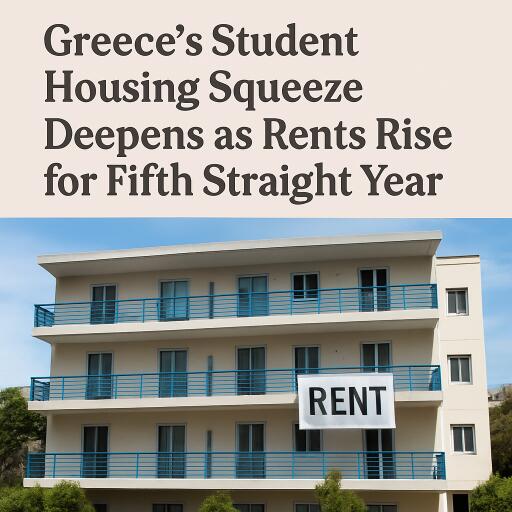
Greece’s Student Housing Squeeze Deepens as Rents Rise for Fifth Straight Year
As a new academic year approaches, thousands of first-year students are scouring Greece’s main university cities for a place to live—only to confront a market that has tightened yet again. For the fifth consecutive year, asking rents for small apartments are climbing, driven by a chronic shortage of compact homes and steady demand near campuses and transit hubs. For many families, the cost of housing has become the most burdensome line item of higher education.
A Small-Home Shortage Meets Steady Demand
Greece’s building stock offers limited options in the 20–45 square meter range that students typically seek. Years of subdued construction after the financial crisis left the pipeline thin, while a share of centrally located properties migrated to seasonal or short-term use. At the same time, more single-person households are competing for the same studios and one-bedrooms. The result: fewer choices and persistently high asking prices, even as household budgets are squeezed by broader living costs.
What Listings Show in Key Cities
In Athens, compact studios of roughly 25–40 square meters that have been renovated and furnished are commonly listed at about €16–€19 per square meter per month. Unfurnished options tend to be advertised around €14–€17, while older, unrenovated apartments often appear near €13–€14 per square meter.
Beyond the capital, pricing remains elevated in major university centers:
- Thessaloniki: renovated, furnished student-friendly apartments frequently advertised at €14–€16/sq m.
- Patras: comparable listings typically at €12–€15/sq m.
- Heraklion (Crete): many offers fall in the €13–€15/sq m range.
- Kalamata: asking prices often hover around €13–€16/sq m.
- Xanthi: in more budget-friendly cases, unrenovated units can start near €8/sq m.
Neighborhoods with direct access to campuses or rapid transit command premium pricing. In Athens districts such as Zografou and Neos Kosmos, renovated, furnished small apartments are frequently listed near €17–€19/sq m, while in Kypseli they often range from €16–€17/sq m. In several parts of the capital, even modest one-bedrooms of 45–55 square meters are being marketed at €680–€720 per month—significant sums in a country where many students still rely on family support.
The Real Cost Goes Beyond the Rent
Students and their families increasingly need to budget for the full cost of occupancy, not just the monthly rent advertised on a listing. Key considerations include:
- Building charges and maintenance fees: Monthly common charges can add up over a year, particularly in elevator buildings or those with shared heating.
- Energy efficiency: Older apartments with inadequate insulation or outdated heating systems can lead to substantially higher winter bills. A slightly higher rent for a more efficient property may prove cheaper overall.
- Location versus transportation: A bargain on the urban fringe may lose its edge once daily commuting costs and time are factored in—especially in cities where campus travel requires multiple modes of transport.
- Furnishings and appliances: Unfurnished units can seem attractive on paper, but the outlay for a bed, refrigerator, washing machine, and essentials—plus the hassle of moving them—can outweigh initial savings for a short tenancy.
Timing and Negotiation Power
Early birds still have an advantage. Students who begin their search well ahead of orientation week typically encounter a broader set of options and better leverage to negotiate. As the season progresses and stock tightens, advertised prices grow stickier and the scope for concessions narrows. It’s also worth noting that listed rents don’t always match final agreements; conditions, competition, and a landlord’s priorities can sway the outcome.
Alternative Arrangements Emerge
To navigate the shortage, some families are exploring nontraditional arrangements. In destinations with robust summer tourism, nine-month leases are increasingly common. The model aligns neatly with the academic timetable but can leave students scrambling for a solution if they plan to stay on for exams, work, or internships during the summer months.
Private student residences are another visible alternative. Rooms typically sized 15–25 square meters are often marketed at €450–€650 per month, with utilities, furniture, and certain services included. While the price-per-square-meter appears steep, the bundled costs and convenience can narrow the gap with conventional apartments—especially for short stays where furniture purchases don’t make sense.
Energy, Affordability, and the Path Forward
This year’s hunt is not only about scarce square meters; it’s also about kilowatt-hours and emissions. Many student rentals are in older buildings where poor insulation and legacy heating systems drive up bills and carbon footprints alike. Targeted energy retrofits—window upgrades, wall insulation, efficient heat pumps—could reduce running costs for tenants while lifting property values and cutting emissions.
In the medium term, additional purpose-built student housing and incentives for long-term leases could relieve pressure on the micro-apartment segment. Policies that encourage energy upgrades, streamline permits for dormitory-style developments, and support the conversion of underused buildings into year-round student accommodation would address both affordability and sustainability. Until then, students are likely to keep paying more for less space—and budgeting carefully for the hidden costs of staying warm, connected, and close to class.



Leave a Reply