

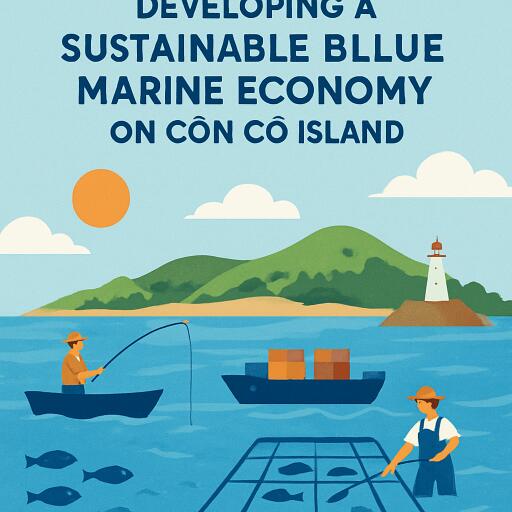
Developing a sustainable blue marine economy on Con Co Island
Off the coast of Quang Tri Province, Con Co Island is emerging as a compelling example of how marine conservation can support economic development rather than obstruct it. The island’s protected waters are home to rich coral reefs, productive fishing grounds, and striking seascapes, giving local authorities and communities a rare opportunity: to build a blue marine economy rooted in ecological protection, smart technology, and sustainable livelihoods.
Con Co’s marine protected area, established in 2009, spans more than 4,300 hectares and is divided into zones for strict protection, ecological recovery, and service management. This zoning framework is intended to balance preservation with carefully controlled human activity. Its importance lies not only in safeguarding biodiversity, but also in creating the environmental foundation for tourism, fisheries recovery, and marine services that can endure over time.
Scientific surveys over many years have revealed the remarkable ecological value of the island’s waters. Researchers have recorded hundreds of marine species in the area, including a highly diverse coral reef system regarded as one of the notable reef habitats in the Gulf of Tonkin. Coral communities around the island support fish, plankton, seaweed, and bottom-dwelling organisms, forming a complex food web and providing breeding, nursery, and feeding grounds for aquatic life.
These ecosystems are more than natural treasures. They represent practical assets for the local economy. Healthy reefs and clean coastal waters can underpin eco-tourism, environmental education, scientific research, recreational diving, and better-managed fisheries. In that sense, conservation is not a barrier to development on Con Co Island; it is the resource base on which future development depends.
Yet that potential is under pressure. Like many coastal and island environments, Con Co faces a mix of threats from climate change, fishing activity, and marine waste. Plastic debris, abandoned fishing gear, and discarded nets can entangle marine life and damage coral structures. On a small island, even the logistics of waste collection and transport to the mainland are difficult, making pollution control both expensive and operationally complex.
Local management teams and community partners have responded with practical cleanup campaigns, reef protection efforts, and plastic reduction initiatives. Removing ghost nets and other debris from coral areas has become an important task, alongside public awareness efforts aimed at fishers, residents, and visitors. The broader objective is to create a waste management approach designed specifically for island conditions, where infrastructure is limited and environmental sensitivity is high.
But the long-term strategy goes beyond cleanups. Con Co is gradually shifting away from a conservation model based solely on restriction and enforcement. In its place, authorities are promoting a more modern approach that combines scientific data, community participation, and planned use of marine space. The idea is simple: if local people are excluded from economic opportunity, conservation will struggle to gain lasting support. If they benefit from healthy ecosystems, protection becomes a shared interest.
This is why livelihood transformation is central to the island’s future. Activities that put heavy stress on marine resources need to be reduced over time, while greener alternatives are expanded. Promising sectors include fisheries logistics, environmentally responsible aquaculture, passenger and tourist transport, guided marine experiences, diving services, and eco-tourism products built around the island’s natural landscape and underwater biodiversity.
Such a transition requires careful planning. Tourism must be managed so that visitor growth does not destroy the very habitats that attract visitors. Aquaculture must avoid pollution and habitat degradation. Marine services must operate within clear environmental limits. A sustainable blue economy is not simply about expanding ocean-based business; it is about designing economic activity to work within ecological thresholds.
Technology is becoming a key tool in that effort. Managers are increasing the use of digital systems such as geographic information platforms, spatial databases, remote sensing, and image analysis tools to improve reef monitoring and ecosystem surveillance. These technologies can help track environmental change, identify emerging risks, and support faster, evidence-based decision-making.
Digital monitoring does not replace field patrols, diver observations, or hands-on ecological surveys. However, it can make management far more efficient by improving data storage, comparison, and trend detection. With standardized and regularly updated information, authorities can move from reactive interventions to more preventive, risk-based governance. In practice, that means spotting signs of reef decline, illegal activity, or pollution earlier and responding before damage becomes harder to reverse.
Policy support is also strengthening. A new management plan for the 2026-2030 period is expected to guide coordinated measures to protect major ecosystems, restore fishery resources, improve management capacity, and attract wider support for conservation and sustainable development. The plan reflects a growing recognition that marine protected areas should not be isolated pockets of preservation, but active engines of a greener coastal economy.
At the provincial level, there is also consideration of expanding the protected area to roughly 10,000 hectares. If implemented, a larger marine conservation zone could improve ecological connectivity and offer stronger protection for spawning grounds, nursery habitats, feeding areas, and migration routes. Expansion would also provide more space to align economic activity with conservation goals across a broader seascape.
For this vision to succeed, coordination will be essential. Island authorities, environmental managers, maritime enforcement forces, scientists, businesses, and fishing communities all have roles to play. Sustainable marine governance depends on trust, shared data, clear rules, and practical incentives that reward protection rather than overexploitation.
Con Co Island’s path forward illustrates an increasingly important lesson for coastal regions: the blue economy only becomes sustainable when ecology is treated as core infrastructure. If coral reefs recover, fish stocks are protected, waste is controlled, and livelihoods are redesigned around environmental limits, the island can grow without exhausting its natural capital. In that model, conservation does not sit at the edge of development. It becomes the foundation of it.



Leave a Reply