

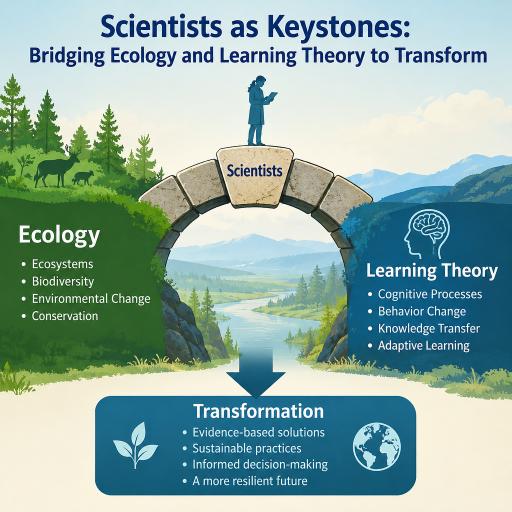
Scientists as keystones: bridging ecology and learning theory to transform
What if one of the most powerful tools for confronting biodiversity collapse and climate disruption is not a new device, law, or funding mechanism, but a different understanding of how people learn? A fresh line of thinking in environmental research suggests that learning should not be treated as a side effect of conservation work. Instead, it should be recognized as part of the living system itself.
This idea reframes environmental learning as a core feature of social-ecological systems—the intertwined networks of people, places, species, institutions, and material conditions that shape life on Earth. In that view, scientists are not only observers or data producers. They can also function as “keystone” actors: people whose presence and interactions help hold together broader ecosystems of knowledge, care, and public engagement.
Learning as infrastructure, not an afterthought
Environmental crises are rarely caused by a single factor. Habitat destruction, climate inequality, pollution, and species loss all emerge from tangled relationships between human societies and the natural world. Because these problems are dynamic and unpredictable, technical fixes alone often fall short.
The newer perspective argues that learning is one of the deeper leverage points in these systems. Unlike visible interventions such as regulations or restoration projects, learning operates more subtly. Yet it can alter values, identities, habits, and the way communities relate to landscapes, waters, and other species. In that sense, it has the potential to trigger change from the inside out.
This approach challenges an old assumption embedded in much conventional education: that humans stand apart from nature. By contrast, social-ecological thinking sees humans as embedded within ecosystems, not external to them. Learning, then, becomes part of the same fabric as forests, rivers, cities, and food webs.
What is a learning ecosystem?
A learning ecosystem includes all the places, relationships, and experiences through which learning happens across a lifetime. It reaches far beyond the classroom. Parks, museums, youth clubs, neighborhoods, public transit, gardens, digital spaces, and everyday conversations all contribute. So do cultural traditions, memories, and local histories.
Within this broader ecosystem, each person moves through a unique “learningscape”—the combination of social and physical environments that shape how they come to know the world. A child might learn about pollinators at school, deepen that interest in a community garden, and later connect it to climate science through a volunteer program. Those links matter. They can turn scattered experiences into lasting engagement.
The concept becomes especially powerful when it is treated not as a simple network of institutions, but as a real system: adaptive, uneven, place-based, and constantly changing.
Shared traits with ecological systems
Learning ecosystems resemble ecological systems in several important ways.
First, both operate across multiple scales. Individual experiences sit within family routines, local communities, regional cultures, and national institutions. Like watersheds or food webs, these layers influence one another continuously.
Second, both are material. Learning is shaped by real places and real time. A wetland trail, an urban science center, a schoolyard tree canopy, or a shoreline restoration site all influence what people notice, feel, and remember. History also matters: the meanings attached to a place can change across generations.
Third, both are complex. Many actors interact at once, including schools, researchers, nonprofits, local governments, families, and nonhuman life. That complexity creates opportunities for change, but it also makes outcomes difficult to predict.
Learning with the more-than-human world
In this framework, learning is not just a mental process happening inside individuals. It also unfolds through relationships—with communities, institutions, and the more-than-human world. People learn through contact with birds, soils, tides, heat, drought, and seasonal change. These are not passive backdrops. They shape perception, attention, and care.
This broadens the familiar model of learning about the environment. It points toward learning from the environment as well: listening to what places, species, and ecological change reveal through direct experience. That orientation aligns with many longstanding knowledge traditions that emphasize reciprocity, responsibility, and respectful coexistence.
The practical implication is significant. If environmental education focuses only on information transfer, it may produce awareness without attachment. But when people develop emotional, sensory, and ethical relationships with place, they are more likely to sustain long-term action.
Why scientists matter beyond the lab
This is where scientists enter the picture in a new way. The argument is that environmental researchers can serve a role similar to keystone species in ecology: their influence may be disproportionate to their number. Not because they control the system, but because they can connect people to it.
Even brief encounters with scientists can shape environmental identity. A field biologist visiting a youth program, a marine ecologist leading a public survey, or a researcher chatting with families during a community event can make science feel accessible and alive. Those moments may help transform abstract issues into personal ones.
Importantly, the strongest effect often does not come from delivering more facts. Publics are already flooded with information about crisis. Facts alone can overwhelm, numb, or intensify eco-anxiety. What often makes a difference is when scientists share curiosity, wonder, uncertainty, and personal motivation. Stories of failure, persistence, and discovery can humanize science and invite participation from people who might otherwise feel excluded from it.
From awareness to transformation
The larger goal is not simply environmental literacy, but transformative learning. That kind of change usually unfolds slowly. It may begin with disruption—a wildfire, a flood, a first encounter with species decline, or a conversation that unsettles old assumptions. Over time, reflection and experience can reshape how a person sees their role in the world.
This process is rarely neat. It can be cyclical, emotional, and uneven. People may move forward, stall, and begin again. But when new habits and relationships take root, environmental action can become part of identity rather than a temporary response.
That is why engagement matters as much as explanation. Conservation communication that builds meaning, belonging, and agency may be more durable than communication focused only on expert instruction.
A systems view of public engagement
Bringing learning theory together with ecology offers a practical challenge to scientific institutions. If learning is part of the ecosystem, then outreach is not peripheral work. It is structural. Public walks, citizen science, school partnerships, exhibitions, neighborhood restoration, and informal dialogue all become meaningful sites of ecological change.
This perspective also raises the bar for institutions. It suggests they should design pathways that connect experiences across a person’s life, rather than treating each event as isolated. The aim is to cultivate communities that are not only informed about environmental problems, but also emotionally invested, socially connected, and prepared to act.
At a time when environmental breakdown can feel relentless, this argument offers a different kind of leverage. Not a silver bullet, but a deeper intervention: changing how society learns to live within nature rather than apart from it. In that system, scientists are more than experts. They are catalysts, connectors, and, potentially, keystones of cultural transformation.



Leave a Reply